Skip to content
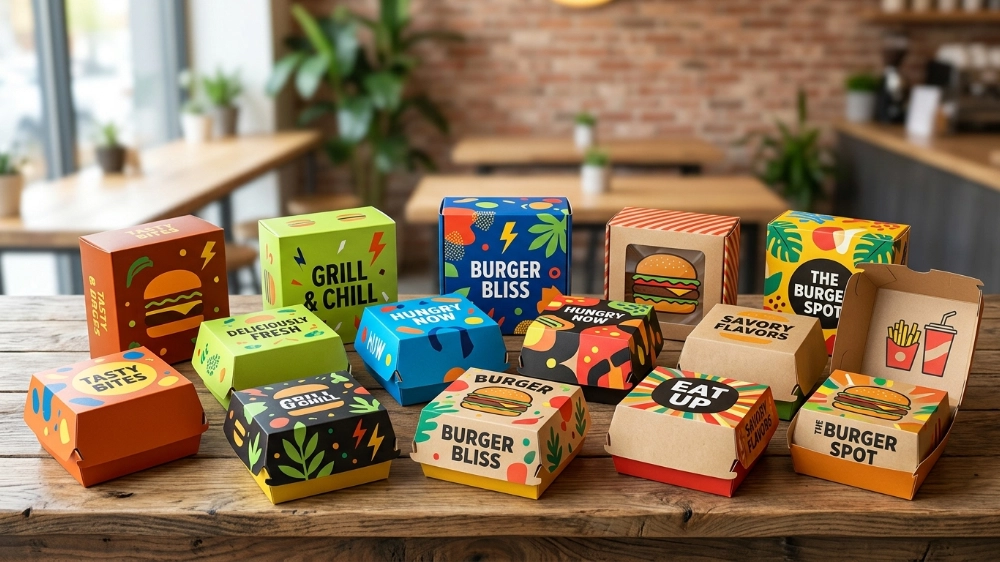
Choosing a reliable burger box manufacturer is not only about finding the lowest unit price. A good manufacturer should help you control food safety, grease resistance, structural strength, print quality, lead time, and repeat-order consistency before your burger boxes reach customers.
For restaurants, burger chains, food trucks, cloud kitchens, and packaging distributors, burger boxes are not just containers. They affect how the burger travels, how the brand looks, how much waste the operation creates, and whether the packaging can meet food-contact expectations in your target market.
This guide explains how to evaluate a burger box manufacturer before placing a custom or wholesale order.
How do you choose a reliable burger box manufacturer?
Choose a burger box manufacturer by checking food-contact compliance, material performance, sample quality, production control, MOQ transparency, and export reliability. Price matters, but it should never be judged separately from documentation, delivery performance, and repeat-order consistency.
A reliable manufacturer should be able to answer practical questions, not only show attractive product photos. They should explain what paperboard is used, whether the box is suitable for greasy and hot food, what coating or barrier is applied, how the artwork will be printed, and what quality checks happen before shipment.
For food packaging, “food-grade” is too general by itself. The U.S. FDA explains that a food contact substance includes food packaging and its components, such as adhesives, colorants, coatings, and other substances applied to packaging surfaces. That means buyers should evaluate the whole burger box system, not only the paperboard.
In the EU, food-contact materials must follow the general safety and inertness principles under Regulation (EC) No 1935/2004, which requires materials not to release constituents into food at levels harmful to health or change food composition, taste, or odor in an unacceptable way.
What makes a burger box manufacturer reliable?
A reliable burger box manufacturer can produce the same approved box repeatedly, with controlled materials, stable printing, clean forming, clear QC records, and realistic lead times. Reliability is measured by repeatability, not by one good sample.
Many suppliers can make a sample that looks acceptable in a photo. The real question is whether they can deliver 50,000, 500,000, or 5 million burger boxes with the same structure, color, material, and packing quality across multiple production batches.
For a burger box manufacturer, reliability usually depends on six areas:
- Control over raw paperboard, coating, printing, die-cutting, forming, and packing
- Food-contact documentation and material traceability
- Ability to match box structure with real burger use cases
- Sample approval before bulk production
- Stable color and logo reproduction for custom printing
- Clear process for inspection, defect handling, and reorder planning
Third-party packaging safety standards can help buyers understand what a mature packaging factory system looks like. For example, BRCGS Packaging Materials Issue 7 highlights areas such as product safety culture, hazard analysis, risk assessment systems, continual improvement, and the inclusion of single-use disposable products.
How can you tell if a burger box supplier is a real manufacturer or only a trader?

Ask where the paperboard is sourced, where printing and forming happen, and who controls final inspection. A trader can still be useful, but direct manufacturing control usually gives better traceability, faster troubleshooting, and more stable repeat orders.
A real manufacturer should be able to explain the production flow in detail. For burger boxes, that flow often includes material selection, printing, lamination or coating if required, die-cutting, creasing, forming, inspection, counting, carton packing, and palletizing.
If the supplier cannot explain who controls each step, you may face problems later. Common risks include color inconsistency, weak folding lines, poor lid closure, incorrect carton counts, delayed production updates, and unclear responsibility when defects appear.
Ask these questions before ordering:
- Do you produce the burger boxes in your own factory?
- Which steps are done in-house and which are outsourced?
- Can you provide photos or videos of printing, die-cutting, forming, and QC?
- Who checks artwork before production?
- Who signs off the pre-production sample?
- What happens if bulk production does not match the approved sample?
What food safety documents should a burger box manufacturer provide?
A reliable burger box manufacturer should provide food-contact support documents, material declarations, coating information, ink information, and test reports where relevant. For international buyers, vague claims like “food-safe” or “eco-friendly” are not enough.
Burger boxes touch hot, greasy, and moist food. This makes documentation especially important because the box may include paperboard, coating, ink, adhesive, and sometimes a grease-resistant barrier.
For U.S. buyers, the FDA notes that food packaging components can include substances used to prevent grease from leaking through paper or cardboard food packaging. The same FDA page also explains that food-contact safety review may consider migration data and toxicological data for intended use.
For EU buyers, the European Commission states that food-contact materials must support compliance documentation and traceability. It also links food-contact manufacturing to good manufacturing practice, documented quality assurance, documented quality control, and suitable starting materials.
A practical document request may include:
- Food-contact declaration or declaration of compliance where applicable
- Material composition statement
- Migration test support when required by market or customer
- PFAS-free statement or test support for grease-resistant paper packaging where relevant
- Ink and coating information
- FSC certificate or chain-of-custody information if FSC paper is requested
- Production batch traceability information
Why should buyers ask about PFAS-free grease-resistant burger boxes?
Burger boxes often need grease resistance, but buyers should know what barrier chemistry creates that resistance. PFAS-free verification is now an important question for paper-based burger boxes, especially for U.S. and international foodservice buyers.
Grease resistance is one of the most important performance features in burger packaging. A burger box may need to resist beef fat, fried chicken oil, cheese, sauce, pickles, steam, and long holding time in a delivery bag.
Historically, some paper and paperboard food packaging used PFAS-containing grease-proofing agents. In February 2024, the FDA announced that grease-proofing substances containing PFAS are no longer being sold for food-contact use in the U.S. market. The FDA also stated that these substances had been applied to fast-food wrappers, take-out paperboard containers, and similar packaging to prevent grease and oil leakage.
For buyers, the lesson is simple: do not only ask whether the box is grease-resistant. Ask how the grease resistance is achieved, whether the coating is suitable for your target market, and whether the manufacturer can provide PFAS-free support when required.
Why do printing inks matter for custom burger boxes?
Printing inks matter because custom burger boxes may be exposed to heat, grease, moisture, stacking pressure, and indirect food-contact conditions. Buyers should ask what ink system is used and whether the manufacturer understands food-contact packaging requirements.
A burger box is often printed with brand colors, logos, slogans, QR codes, social media handles, and promotional artwork. Poor ink control can cause color variation, odor problems, rubbing, set-off, or compliance concerns.
The European Printing Ink Association provides a Guideline on Printing Inks Applied to Food Contact Materials, and EuPIA identifies food-contact materials as a key topic covering consumer safety, transparency, raw material selection, risk assessment, migration, and good manufacturing practice.
Before approving custom printed burger boxes, buyers should confirm:
- Whether the printing surface is inside, outside, or close to food-contact areas
- Whether the ink system is suitable for food packaging
- Whether the printed box has unusual odor
- Whether ink rub-off occurs after stacking or transport
- Whether artwork proofs and pre-production samples are approved before mass production
How do you test burger box quality before bulk production?
Test burger box quality with the real burger, real sauce, real holding time, and real delivery conditions. A flat sample or product photo cannot prove grease resistance, lid closure, venting, stacking strength, or heat-and-steam performance.
A reliable burger box manufacturer should welcome sample testing. If a supplier pushes you to approve bulk production based only on a photo, that is a warning sign.
The correct test is not complicated. Put your actual burger inside the sample box, close the lid, wait 20 to 40 minutes, move it in a delivery bag, stack two or three boxes, and then inspect the box and the food.
Check for these results:
- Does the burger fit without being compressed?
- Does the lid stay closed during handling?
- Does grease stain or leak through the bottom?
- Does steam make the bun too wet?
- Does the box collapse when stacked?
- Does the printed surface stay clean and odor-free?
- Does the customer receive the burger in a presentable condition?
What should you check in a burger box sample?
Check size fit, lid lock, crease quality, bottom strength, grease resistance, ventilation, stacking performance, print accuracy, odor, and carton packing. A good sample should match both the food and the service model.
Start with size. The burger should sit securely without sliding too much, but the box should not crush the bun or toppings. If the box is too large, the burger may shift during delivery. If it is too small, the lid may press into the bun or sauce may transfer to the top panel.
Then test structure. The lid should close easily, the lock should not tear, and the folding lines should be clean. Weak creasing or poor die-cutting can slow down restaurant staff during busy service.
Finally, test the box under actual food conditions. Hot burgers release steam. Sauces and cheese create moisture. Beef patties and fried chicken release grease. A good burger box should balance heat retention, moisture control, and oil resistance.
Should burger boxes have ventilation holes?

Ventilation can help release steam and reduce sogginess, but too much ventilation can reduce heat retention. The best vent design depends on burger type, holding time, sauce level, fries pairing, and delivery distance.
Ventilation is not automatically good or bad. A crispy chicken burger, smash burger, saucy beef burger, and burger-with-fries combo may each need a different balance between heat, moisture, and airflow.
Foodservice operators often discuss venting because trapped steam can make fried or toasted food lose texture. In one operator discussion, food truck users asked about vented to-go containers for fries and sandwiches that get soggy, with replies mentioning practical fixes such as lid cuts, side holes, and open paper bags before pickup.
For burger brands, the practical answer is to test both options. Ask the manufacturer for a standard box, a vented structure, or a modified structure, then compare food texture after the same holding time.
What materials are best for burger boxes?
The best burger box material depends on grease level, burger size, delivery time, branding needs, cost target, and local compliance expectations. Kraft paperboard, white paperboard, coated board, bagasse, and corrugated-style structures each solve different problems.
There is no universal “best” material for all burger boxes. A single-store food truck, a premium burger brand, a national QSR chain, and a wholesale distributor may need different box structures.
Common options include:
- Kraft paperboard: natural appearance, casual takeaway style, often used for eco-positioned or rustic branding
- White paperboard: cleaner background for colorful printing and premium visual presentation
- Coated paperboard: improved grease and moisture resistance when the coating is suitable for food-contact use
- Corrugated-style burger boxes: stronger structure for heavier meals or delivery stacking
- Bagasse or molded fiber boxes: often selected for compostable or fiber-based positioning, but still needs performance and compliance checks
If responsible paper sourcing is part of your brand or tender requirement, FSC can be relevant. The Forest Stewardship Council explains that chain-of-custody certification verifies processes to produce and trade FSC-certified products, which is useful when buyers need stronger sourcing transparency for paper-based packaging.
Are kraft burger boxes better than white burger boxes?
Kraft burger boxes are not automatically better than white burger boxes. Kraft often gives a natural look, while white board can provide cleaner print results; performance depends more on board grade, coating, and structure than color.
Choose kraft when you want a natural, simple, or casual foodservice look. Kraft is common for burger shops, food trucks, outdoor events, and brands that want a less polished visual style.
Choose white board when your brand needs brighter color printing, clearer logo contrast, or a more premium takeaway presentation. White board can work well for QSR chains, mall restaurants, premium burger concepts, and brands that rely heavily on visual consistency.
However, the paper color does not decide performance. A weak kraft box can leak, and a strong white board box can perform well. Ask about board thickness, coating, grease resistance, forming quality, and sample testing before choosing.
Are eco-friendly burger boxes always the best choice?

Eco-friendly burger boxes are useful only when they match food performance, market compliance, disposal infrastructure, and customer expectations. A box that looks sustainable but leaks, collapses, or lacks documentation can create more operational risk than value.
Many burger brands want recyclable, compostable, plastic-free, or FSC-certified packaging. These goals are reasonable, but buyers should avoid relying only on marketing terms.
A better question is: sustainable under what system? A burger box may be paper-based, but it may still have coating, ink, adhesive, or grease-barrier requirements. A compostable box may not deliver value if the local market has no composting infrastructure. A recyclable box may fail in practice if it is heavily contaminated with grease.
The right manufacturer should help you compare material performance, compliance documents, disposal claims, and cost. Sustainability should be part of the specification, not a slogan added after the box is designed.
How do MOQ, lead time, and landed cost affect supplier choice?
MOQ, lead time, and landed cost decide whether a supplier is practical for your business. The cheapest burger box can become expensive if it creates storage pressure, freight surprises, delivery delays, or unusable inventory.
For custom burger boxes, MOQ depends on box size, paper material, printing method, coating, structure, and whether special tooling is needed. A reliable manufacturer should explain the MOQ instead of giving a number without context.
Lead time should also be separated into steps:
- Artwork confirmation
- Digital or physical proofing
- Pre-production sample
- Bulk production
- Inspection and packing
- Export documents
- Shipping and customs clearance
Landed cost is more important than unit price. A lower box price may not be better if freight is high, carton volume is inefficient, delivery is late, or the MOQ forces you to hold too much inventory.
Is it better to buy burger boxes locally or from overseas?
Local sourcing is often better for urgent small orders, while overseas manufacturing can be better for larger custom runs, brand consistency, and cost control. Compare total landed cost, not only the factory unit price.
Local buying may be faster when you need standard stock boxes quickly. It can also reduce communication complexity, import paperwork, and minimum-order pressure.
Overseas manufacturing may be better when you need custom printing, chain-wide consistency, larger volume, multiple packaging items, or a lower cost per unit at scale. It can also help restaurants and distributors source burger boxes, fries boxes, paper bags, cups, sleeves, and other fast-food packaging from one production network.
The best choice depends on order volume, storage space, artwork needs, reorder frequency, and whether you can plan ahead.
What MOQ is reasonable for custom printed burger boxes?
A reasonable MOQ depends on material, printing, size, coating, and structure. Be cautious when a supplier offers full customization at an unrealistically low MOQ or demands a high MOQ without explaining the production reason.
MOQ should reflect real manufacturing economics. Printing setup, die-cutting, machine adjustment, material purchasing, and color matching all create fixed costs before production starts.
If your order is small, ask whether the manufacturer can offer a standard structure with custom printing, a shared material option, or a phased order plan. If your order is large, ask whether the factory can support repeat orders with the same color, same carton packing, and same delivery schedule.
Do not judge MOQ alone. A higher MOQ may be acceptable if the manufacturer provides better price stability, stronger material control, better export packing, and consistent repeat production.
What questions should you ask before choosing a burger box manufacturer?
Ask questions that reveal compliance, material control, sample testing, production capability, QC process, MOQ, shipping, and defect handling. A reliable manufacturer should answer clearly and provide evidence where needed.
The table below can be used as a practical evaluation checklist before you approve a burger box supplier.
| Evaluation Area | What to Ask the Manufacturer | Why It Matters | Red Flag |
|---|---|---|---|
| Food-contact compliance | Can you provide food-contact declarations, test reports, or compliance support for my target market? | Burger boxes may include board, coating, ink, adhesive, and grease-resistant treatment. | The supplier only says “food-grade” without documents. |
| Grease resistance | What coating or barrier is used, and can you support PFAS-free requirements where needed? | Grease, oil, sauce, and steam can cause leakage or staining. | The supplier cannot explain how grease resistance is achieved. |
| Material choice | Which board grade fits my burger size, grease level, delivery time, and branding? | Different burgers need different strength, barrier, and ventilation performance. | The supplier recommends one material for every use case. |
| Sample testing | Can I test a physical sample with real food before bulk production? | Photos cannot prove grease resistance, steam control, or lid closure. | The supplier pushes mass production without sample approval. |
| Printing quality | What printing method and ink system will be used? | Custom boxes need consistent color, sharp logo reproduction, and suitable ink use. | No artwork proofing or color approval process. |
| Production capability | Do you control printing, die-cutting, forming, QC, and packing? | Direct control improves consistency and problem-solving speed. | The supplier cannot explain the production workflow. |
| MOQ and lead time | What is the real MOQ, sample time, production time, and reorder time? | This affects cash flow, storage, launch schedule, and reorder planning. | The supplier quotes a low price but gives an unclear schedule. |
| Export and logistics | Can you support export packing, shipping documents, and carton/pallet planning? | International buyers need stable packing, clear documents, and predictable shipping. | No clear support for export documentation or shipping coordination. |
A useful rule is to ask for evidence, not promises. If the manufacturer claims food safety, ask for documents. If they claim grease resistance, ask for coating details and samples. If they claim fast delivery, ask for the production schedule by stage.
What are red flags when choosing a burger box manufacturer?
Red flags include vague food-safety claims, no coating information, no physical sample, unclear MOQ, unstable printing, weak communication, and no defect-handling process. A low price is risky when the supplier cannot explain how quality is controlled.
Watch for these warning signs:
- The supplier cannot provide food-contact documentation.
- The supplier cannot explain the grease-resistant barrier.
- The supplier refuses sample testing before bulk production.
- The box sample has odor, weak folding lines, or poor lid closure.
- The supplier cannot explain printing method, ink suitability, or artwork proofing.
- The quotation does not separate product price, tooling, sample cost, freight, and lead time.
- The supplier gives a very low price but cannot confirm board grade or coating.
- The supplier has no clear process for inspection or claims handling.
A mature food packaging manufacturer should work under controlled production and quality systems. The European Commission links food-contact GMP to documented quality assurance and quality control systems, while BRCGS highlights product safety culture, hazard analysis, and continual improvement in its Packaging Materials Issue 7 update.
What is the best way to choose a burger box manufacturer for your restaurant or QSR brand?
The best way is to define your burger use case, request compliance documents, test real samples, compare landed cost, and verify production control before scaling. A reliable burger box manufacturer should reduce operational risk, not only supply boxes.
Start with the food. A dry classic burger, saucy smash burger, fried chicken burger, and loaded burger combo do not need the same box. Define the burger size, grease level, sauce level, holding time, delivery distance, and whether the meal will be stacked with fries or drinks.
Then define the brand requirement. Decide whether you need kraft, white board, full-color printing, minimal printing, FSC-certified paper, PFAS-free grease resistance, or a premium structure.
Next, ask for documents and samples. A qualified manufacturer should help you check food-contact expectations, material options, ink and coating information, production feasibility, MOQ, and delivery schedule.
Finally, test before scaling. Approve the structure, artwork, material, and packing method before bulk production. For chain brands or distributors, keep the approved sample and production specifications as the standard for future reorders. Contact MB Packaging to explore your one-stop solution burger box supplier.
FAQ: How to Choose a Reliable Burger Box Manufacturer
What is the best material for burger boxes?
The best material depends on burger size, grease level, delivery time, branding needs, and market compliance requirements. Kraft paperboard, white paperboard, coated board, corrugated-style board, and molded fiber can all work when matched to the right use case.
How do I know if burger boxes are food-safe?
What is the best material for burger boxes?
The best material depends on burger size, grease level, delivery time, branding needs, and market compliance requirements. Kraft paperboard, white paperboard, coated board, corrugated-style board, and molded fiber can all work when matched to the right use case.
Are custom burger boxes worth it for small restaurants?
Are custom burger boxes worth it for small restaurants?
What should I test before ordering burger boxes in bulk?
What should I test before ordering burger boxes in bulk?