Skip to content
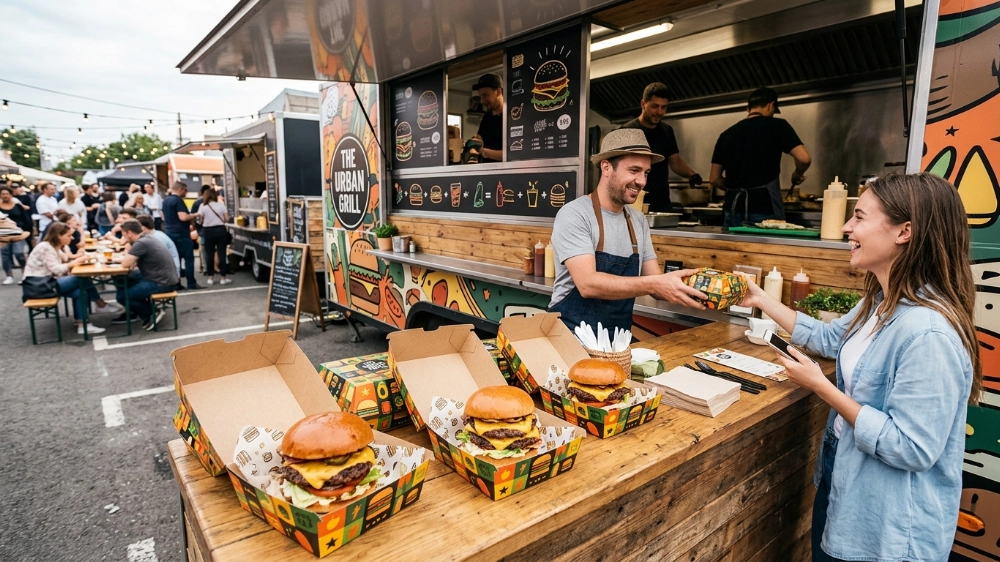
Food truck burger packaging must protect the meal while working within limited storage, rapid service, hand-held eating, outdoor events, and short takeaway journeys. The best solution is therefore not simply the strongest box or the most sustainable-looking material, but the format that performs reliably throughout the operator’s actual workflow.
A burger can leave the grill in excellent condition and still reach the customer with a wet bun, collapsed toppings, greasy packaging, or softened fries. These failures often result from trapped steam, poor portion fit, premature packing, weak closures, or combining foods with different ventilation needs.
Mobile caterers face an additional constraint: every box, wrapper, lid, sauce cup, and carrier must be stored and handled inside a compact workspace. Packaging selection must therefore balance food quality, storage footprint, assembly time, food safety, customer convenience, and total packed-order cost.
If you want to give away all your consideration, you could choose a one-stop solution like MB Packaging.
What makes burger packaging different for food trucks and mobile catering?
Mobile operators need packaging that is quick to assemble, compact to store, easy to carry, and capable of managing heat, grease, and steam. A package that works in a full-sized restaurant may be too bulky, slow, or complicated for a food truck.
In a conventional kitchen, packaging may be stored in a dedicated stockroom and assembled away from the cooking line. In a food truck, the same cartons often compete with ingredients, appliances, cleaning supplies, utensils, and staff movement.
The packaging also has to function in several service situations. One customer may eat beside the truck immediately, another may walk ten minutes to an office, and a catering order may remain packed longer before distribution.
Why does limited storage space affect packaging selection?
Large nested containers and excessive packaging sizes can consume valuable cabinet and shelf space. Flat-packed boxes, compact wrappers, and standardized dimensions generally make inventory easier to manage.
Operators should compare storage efficiency by counting how many usable packages fit within a defined shelf, drawer, or carton space. The smallest package is not automatically the most efficient if it requires several additional liners, sleeves, or support components.
Storage conditions must also protect food-contact packaging. The FDA Food Code states that single-service articles should be stored in a clean, dry location, protected from splash, dust, and other contamination, and generally kept in their original protective packaging or otherwise protected until use.
Why does packaging speed matter during peak service?
Every fold, liner, closure, label, and bagging step adds time during a rush. Packaging should be evaluated as part of the production line rather than as a purchase made separately from kitchen operations.
A box that takes only a few seconds longer to form may create a significant bottleneck when dozens of meals are prepared in a short period. Complicated locking tabs, weak creases, and lids that require repeated adjustment are especially disruptive in narrow workspaces.
Before approving a format, staff should perform a timed service trial. They should assemble the packaging, insert the burger, add sides and sauces, close it, label it, place it in a bag, and hand it over using the same movements required during real service.
Should a food truck use burger wrappers, boxes, or both?

Wrappers are compact and efficient for burgers intended for immediate consumption, while boxes provide better protection for tall or heavily loaded products. Some operators use both when grease containment and structural protection are equally important.
The decision should be based on burger height, topping stability, sauce level, customer eating behavior, and expected holding time. Choosing a format only because it looks premium can lead to unnecessary material use or poorer food quality. Click custom street food packaging solutions to help with your consideration.
Tips: Click to learn Butcher Paper vs Parchment Paper: What’s the Difference and Which Should You Use?
When is a burger wrapper the better choice?
A grease-resistant wrapper is often suitable for compact burgers that will be eaten soon after purchase. It occupies little storage space, can support fast service, and allows customers to hold the burger without touching oily surfaces.
Wrapping can keep the burger together and reduce topping movement while the customer walks. It is particularly useful for smash burgers, cheeseburgers, sliders, and other products that do not require a rigid structure.
The wrapper must still be tested with the actual recipe. Highly oily patties, melted cheese, hot sauces, and long holding periods may cause staining or soak-through if the paper does not have an appropriate grease barrier.
When is a burger box the better choice?
A box is generally better for tall, premium, heavily topped, or delivery-oriented burgers. Its rigid structure reduces crushing and gives the burger more protection from movement inside a takeaway bag.
Boxes can also improve presentation when customers open the meal at an event, workplace, or catering location. However, excessive internal space may allow the burger to slide, while an undersized box can compress the bun and force toppings outward.
Grease performance should be assessed rather than assumed. The Foodservice Packaging Institute’s harmonized hot-oil test provides an industry testing approach for evaluating grease resistance and soak-through in finished foodservice packaging.
When should a burger be wrapped before being placed inside a box?
A wrapper-and-box combination can improve grease containment and prevent a loaded burger from falling apart. It may also trap more steam, so the combination should be tested over the intended takeaway time.
This format is useful when the wrapper supports hand-held eating while the outer box protects the burger during transport. It can also reduce direct grease contact with the box and keep printed exterior surfaces cleaner.
More packaging is not automatically better. If the burger is tightly wrapped and immediately sealed inside an unvented box, moisture has few routes to escape, increasing the risk of a softened bun and wilted vegetables.
Burger Packaging Formats Compared for Food Trucks

The following table compares common burger packaging formats by workflow and performance rather than appearance alone. Operators should treat it as a shortlist and verify each option with their own menu. Given that you may also consider a burger packaging supplier, we provide you How to Choose a Reliable Burger Box Manufacturer to help you in detail.
| Packaging format | Best use | Storage efficiency | Assembly speed | Grease control | Steam release | Structural protection | Typical limitation |
|---|---|---|---|---|---|---|---|
| Grease-resistant wrapper | Immediate consumption and compact burgers | High | Fast | Good when correctly specified | Moderate | Low | Limited crush protection |
| Paperboard burger box | Standard takeaway orders | Medium to high when flat-packed | Moderate | Depends on board and barrier | Good when vented | Good | May require assembly |
| Corrugated burger box | Large, premium, or heavily loaded burgers | Medium | Moderate | Good with a suitable liner or barrier | Moderate | High | Uses more storage and material |
| Molded-fiber clamshell | Events and operations with compatible waste systems | Low to medium | Fast | Variable by formulation and coating | Moderate | Good | Nested units can be bulky |
| Wrapper plus box | Loaded burgers and longer takeaway journeys | Medium | Slower | High | Must be tested | High | More material and labor |
The material description alone does not establish the disposal route. The EPA recommends matching foodservice ware to an effective reuse, commercial composting, or local recycling system, while the Sustainable Packaging Coalition emphasizes certification and clear labeling for compostable packaging.
How do you keep burgers from getting soggy in takeaway packaging?
Burgers usually become soggy because moisture is trapped or transferred between ingredients. Ventilation, ingredient placement, packing time, burger temperature, and holding duration all matter as much as the packaging material.
A hot patty releases moisture, while sauces, pickles, tomatoes, and freshly washed vegetables add additional water. Once the burger is closed inside a package, this moisture may condense on the lid and return to the bun.
The solution is not always to add more ventilation. Too much airflow may cool the product quickly, so the aim is to find a workable balance between moisture release and temperature retention.
How much ventilation does a burger box need?
A box needs enough ventilation to release excess steam without exposing the burger to unnecessary heat loss. The correct vent area depends on the burger, box volume, outside temperature, and expected holding time.
Small vents near the upper part of the box can allow rising steam to escape without creating a direct opening beneath the food. The shape, number, and location of vents should be tested rather than copied from an unrelated container.
Compare a vented and non-vented sample after five, ten, twenty, and thirty minutes. Record internal condensation, bun texture, ingredient condition, exterior temperature, and customer eating quality.
Should hot patties and cold toppings be packed separately?
Separating cold toppings can preserve lettuce, tomato, pickles, and delicate sauces during longer journeys. It also increases component count, labor, and the amount of assembly required from the customer.
For immediate consumption, correct ingredient layering may be sufficient. Cheese, a dry lettuce layer, or a controlled sauce portion can sometimes help reduce direct moisture transfer to the bottom bun.
For catering orders with a longer holding period, a separate topping cup or compartment may provide better results. Cold ingredients must still be maintained under appropriate food-safety controls rather than left at ambient temperature simply because they are separately packed.
Should burgers rest before they are wrapped or boxed?
A brief controlled rest can reduce intense surface steam before the burger is enclosed. The burger should not be left exposed for an extended period or held outside safe operational controls.
Immediately sealing a very hot, moist burger may create rapid condensation. A short pause on a clean, designated surface can sometimes improve performance, but the appropriate time should be determined through testing.
Temperature safety remains more important than texture optimization. The FDA advises keeping hot foods at or above 140°F and limiting the time perishable food remains between 40°F and 140°F.
How long should a packaged burger maintain acceptable quality?
The quality target should match the operator’s real service window rather than an arbitrary industry claim. A burger intended for immediate eating has different packaging needs from one expected to travel for thirty minutes.
Operators should define several checkpoints: immediately after packing, ten minutes, twenty minutes, and thirty minutes. At each point, assess temperature, bun texture, sauce movement, vegetable condition, grease leakage, box strength, and eating convenience.
Food quality and food safety are related but not identical. A burger may remain within a controlled service process yet lose acceptable texture, so both factors should appear on the test scorecard.
Should burgers and fries be packed in the same container?

Combined packaging can simplify handover, but the burger’s steam and grease may soften fries. A shared box works best when it provides separation, suitable ventilation, and enough space to prevent crushing.
Burgers and fries have different packaging needs. A burger often benefits from moderate heat retention and structural support, while fries generally need rapid steam release to protect their surface texture.
When does a combined burger-and-fries box work well?
A combination box can work well for meals eaten soon after purchase. It reduces loose components and makes the complete order easier for customers to carry.
The box should prevent fries from sitting beneath the burger or absorbing grease from it. A divider, separate tray area, or raised structure can reduce direct contact and maintain a more organized presentation.
The lid should close without pressing on the burger or sealing the fries in a saturated environment. Test the full meal rather than testing the burger and fries separately.
When should fries be packed separately?
Separate fry packaging is usually preferable for longer holding periods or heavily sauced burgers. It allows the fries to release steam independently and reduces moisture transfer from the burger.
Open-top fry cartons are practical for immediate eating but provide limited protection inside delivery bags. For mobile catering, a lightly vented fry carton or sleeve may offer a better balance between containment and airflow.
Separate packaging also makes portion control easier when several fry sizes are offered. The trade-off is an additional SKU, more storage demand, and another item for staff to handle.
How should sauces be packed with a burger meal?
Sauce containers should close securely, remain easy to identify, and stay upright during transport. A small leaking cup can damage the bag, weaken paperboard, and affect the entire meal.
Operators should test sauce cups by filling them with the thinnest and oiliest sauces on the menu. The lids should be checked for fit after refrigeration, ambient storage, and contact with warm food packaging.
Sauces should not be placed beneath hot containers or loose inside an oversized bag. A designated compartment, carton corner, or stable carrier position reduces movement.
How can drinks be carried without weakening the takeaway bag?
Cold-drink condensation should be separated from unprotected paper food packaging. Stable cup carriers, correctly fitted lids, and suitable bag dimensions reduce wetting and tipping.
Putting a cold cup directly beside a warm paperboard burger box can create moisture on both packages. The risk increases during humid weather, at outdoor events, and when drinks remain in the bag for longer periods.
A carrier should support the cup near its lower body rather than relying only on lid pressure. For multi-item orders, test how the bag behaves while walking, turning, climbing steps, and being placed on a vehicle seat.
Which burger packaging materials work best for mobile catering?
No material is automatically best for every food truck. Selection should consider grease resistance, ventilation, strength, storage efficiency, food-contact suitability, service time, and the local end-of-life system.
Material names can hide important differences. Two paperboard boxes may use different fiber structures, barriers, folds, glues, vent designs, or manufacturing tolerances and therefore perform very differently.
Is paperboard suitable for hot and greasy burgers?
Paperboard can work well when its board structure, barrier, seams, and folds match the recipe. Sample testing is essential because visual inspection cannot confirm grease resistance.
A box may appear strong when empty but soften after contact with oil, sauce, and condensation. Corners, locking tabs, cut edges, and fold lines should receive particular attention because failure often begins at these points.
The FPI hot-oil method uses heated dyed corn oil to identify soak-through and grease-resistance failures. Food truck operators do not need to reproduce a laboratory test exactly, but suppliers should be able to explain how grease performance has been verified.
Are molded-fiber burger boxes better for the environment?
Molded fiber may be appropriate in some systems, but its environmental outcome depends on more than the base fiber. Coatings, food contamination, collection, certification, and local processing all affect disposal.
A fiber appearance does not guarantee that a package is plastic-free, recyclable, or compostable. Operators should request the complete material composition and identify whether a barrier coating, additive, or laminated layer changes the accepted waste stream.
Local conditions must guide the claim. A package designed for commercial composting provides limited practical value when the event, city, or waste contractor sends all used foodservice packaging to landfill.
Are compostable burger boxes suitable for food trucks and festivals?
Compostable boxes are most credible when certified products are paired with dedicated collection and an accepting commercial composting facility. Without that system, the intended disposal route may not occur.
The EPA notes that commercial composting facilities are not universally available and that some facilities do not accept compostable foodservice products. It recommends purchasing certified compostable ware only where a suitable local program accepts it and collection services are arranged.
Festivals can create a stronger use case because organizers may control all packaging formats, bin labels, collection points, and waste contractors. Operators should confirm these arrangements before printing compostability claims on event packaging.
Are plastic clamshells ever suitable for burgers?
Plastic clamshells can provide visibility, moisture resistance, and rapid closure, but they may retain condensation. Their suitability depends on temperature performance, local rules, recycling access, and the intended customer experience.
A clear lid may support merchandising at a prepared-food counter, yet visibility is less useful when condensation obscures the burger. The package must also be specified for its intended food-contact temperature.
Operators should avoid making broad recyclability claims based only on the resin type. Shape, size, food residue, color, local collection rules, and sorting capability can all affect whether the used item is accepted.
How can food trucks reduce packaging storage without slowing service?
Food trucks can reduce storage pressure by standardizing dimensions, choosing compact formats, and removing unnecessary components. The objective is a smaller packaging system, not simply a smaller individual box.
A well-designed system may use one base footprint across burger boxes, side boxes, bags, and carriers. This can improve carton stacking, shelf organization, purchasing, and staff familiarity.
Are flat-packed burger boxes better than pre-assembled clamshells?
Flat-packed boxes normally use storage space more efficiently, while nested clamshells are usually faster to open and fill. The better option depends on the operator’s storage capacity and labor flow.
A flat-packed box may be assembled before service in controlled batches, reducing delays during peak periods. However, pre-assembling too many boxes can recreate the same storage problem the flat format was intended to solve.
Nested clamshells eliminate folding but can occupy a large vertical volume. They should be tested for reliable separation, because containers that stick together may slow staff and increase accidental double use.
How many burger packaging sizes does a food truck need?
Most mobile operators benefit from the smallest practical range of sizes. Too many sizes increase purchasing complexity, storage demand, picking errors, and leftover stock.
One box may cover several burgers when their footprints are similar, but height must also be considered. A premium double burger may require more headroom even when its diameter matches the standard menu item.
Use physical prototypes of the smallest and largest burger rather than relying only on listed dimensions. Include the real bun, toppings, skewer, wrapper, and garnish in the fit test.
Can one packaging system cover burgers, sandwiches, and side dishes?
A modular system can reduce SKU count when several menu items share similar dimensions and performance needs. Each food should still be tested for grease, moisture, heat, and portion fit.
A standard paperboard footprint may support burger boxes, sandwich cartons, and divided meal boxes while allowing the same bag size to be used. This can simplify inventory and create a more consistent brand presentation.
Do not force unsuitable foods into the system solely to reduce SKUs. A wet side dish, crispy fried product, and tall burger may each require different ventilation or barrier performance.
How should burger packaging be tested before a bulk order?

Packaging should be tested with real food, real staff, and realistic holding times before bulk purchasing. Appearance, supplier samples, and material descriptions alone cannot predict operational performance.
The test should reproduce the busiest and most demanding order, not the easiest menu item. Include the greasiest burger, the wettest sauce, the tallest build, the hottest serving temperature, and the longest expected journey.
How do you test a burger box for grease resistance?
Fill the sample with the actual hot burger and inspect the base, corners, seams, and exterior at fixed intervals. Record staining, softening, leakage, delamination, and transfer to the customer’s hands or bag.
Place each sample on clean absorbent paper so that small leaks are visible. Test several units from the sample batch because one successful box does not establish consistent production quality.
For supplier qualification, ask whether finished-product grease testing follows a recognized method. The Foodservice Packaging Institute procedure evaluates specimens with oil maintained at approximately 150–155°F and checks performance after a defined exposure period.
How do you test whether a burger box traps too much steam?
Compare identical burgers in vented and non-vented samples over the same holding period. Measure condensation, bun texture, topping condition, temperature, and visible moisture inside the lid.
Use the same preparation time, ingredient quantities, packing method, and test environment. Changing the sauce portion or vegetable temperature between samples will make the comparison unreliable.
Ask several people to score the burger without telling them which package was used. Blind evaluation can reduce the tendency to prefer the package with the more attractive design.
How do you test burger packaging during a service rush?
Run the packaging through a simulated high-volume service period. Staff should form, fill, close, label, stack, bag, and hand over multiple orders without slowing their normal movements.
Record assembly time and note where employees pause, change grip, reach across another station, or reopen a closure. These small disruptions may be more important than a minor difference in unit price.
The trial should also identify whether packaging blocks ventilation equipment, occupies preparation space, or creates excessive waste near the service line. Packaging is part of the workstation layout.
What should be included in a burger packaging test scorecard?
The scorecard should cover food quality, operational efficiency, carrying performance, compliance information, and cost. A single “pass” or “fail” rating does not show why one package performs better.
- Internal burger dimensions and usable height
- Empty packaging storage volume
- Assembly time per unit
- Closure strength and reopening risk
- Grease staining and soak-through
- Condensation and steam release
- Bun, topping, and fry quality after each holding interval
- Exterior temperature and hand comfort
- Bag stability and stacking performance
- Food-contact and material documentation
- Local disposal compatibility
- Total cost per completed order
Use a consistent scoring scale and define what each score means. Photographs taken at the same angle and time interval can provide useful evidence when comparing samples from several suppliers.
How much should a food truck spend on burger packaging?
Packaging cost should be calculated per complete customer order rather than per box. Wrappers, liners, sauce cups, labels, bags, carriers, freight, storage, and labor all contribute to the real cost.
A low unit price can be misleading when the package requires additional components or generates more damaged meals. Operators should compare total packed-order cost alongside service performance.
What costs should be included in the packaging calculation?
The calculation should include every item and process required to hand the complete meal to the customer. It should also account for freight, wastage, storage, and assembly labor.
- Burger wrapper or primary container
- Greaseproof liner
- Fry carton or meal divider
- Sauce cups and lids
- Napkins, cutlery, and condiments
- Takeaway bag and cup carrier
- Labels, seals, and printed sleeves
- Inbound freight and customs costs
- Damaged or unusable packaging
- Labor needed to assemble and pack the order
- Inventory held because of minimum order quantities
Calculate several common orders rather than using one average. A single burger, burger-and-fries meal, family order, and event catering set may have very different packaging costs.
Is the cheapest burger box usually the lowest-cost option?
The lowest-priced box may not produce the lowest total cost. Leakage, slow assembly, extra liners, poor closures, customer complaints, and food damage can outweigh a small unit-price saving.
A stronger or easier-to-use package may reduce double packing and staff handling time. Conversely, a premium package may add no value when the burger is eaten immediately beside the truck.
Compare packages by cost per successful order. A container that fails during real service is expensive even when its purchase price is low.
When is custom-printed burger packaging worth the cost?
Custom printing is easier to justify when demand is stable and the packaging is used consistently across several sales channels. Operators should first confirm the structure before investing in printing plates, tooling, or large inventory.
Printing can strengthen recognition at festivals, offices, delivery locations, and on social media. Clear product labels, disposal instructions, allergen communication, or reheating guidance may also provide functional value.
Before ordering, evaluate minimum order quantity, lead time, storage space, artwork flexibility, and the risk of menu or brand changes. A printed sticker or sleeve may be a more flexible starting point for a new food truck.
What sustainability claims can a mobile food business make about its packaging?
Environmental claims should describe the complete package and the disposal system available where it is used. Terms such as recyclable, compostable, biodegradable, and plastic-free should not be treated as interchangeable.
A package’s end-of-life outcome depends on collection, customer sorting, food contamination, local acceptance, and processing infrastructure. Material selection and disposal communication should therefore be planned together. Click Sustainable Burger Packaging Trends Every Restaurant Should Know to learn about sustainable burger packaging.
Does compostable burger packaging actually get composted?
Compostable packaging is unlikely to be composted without a dedicated collection stream and an accepting facility. Certification alone does not guarantee that the package reaches the intended processing system.
The EPA recommends certified commercially compostable foodservice ware only where a local program accepts the products and collection or hauling is available. Clearly labeled bins are also necessary to reduce contamination.
At an event, the operator should ask who collects the waste, which facility receives it, and whether that facility accepts food-soiled compostable cartons, coatings, lids, cutlery, and sauce cups.
Is biodegradable the same as compostable?
Biodegradable and compostable are not equivalent terms. Compostability refers to defined conditions and verified performance, while biodegradable is a broader description that may not provide useful disposal instructions.
The Sustainable Packaging Coalition explains that compostable packaging should be verified through third-party certification and clearly distinguished from packaging described only as biodegradable.
Customers should be told where the item belongs after use. A vague claim without a practical disposal instruction can increase sorting errors rather than improve recovery.
Should food trucks prioritize recyclable or compostable packaging?
The preferred option depends on the waste system operating at the service location. A theoretically recyclable or compostable package provides little benefit when the local system does not accept it.
The EPA places reusable foodservice ware first when an effective collection, washing, and return system can operate. For single-use service, the agency recommends checking local commercial composting and recycling acceptance before purchasing.
Food trucks working across several cities may need different packaging or disposal communication for different events. A single national claim may not accurately describe every local outcome.
How should disposal instructions appear on burger packaging?
Disposal instructions should be specific, visible, and consistent with the bins provided where the package is used. Broad environmental slogans should not replace practical sorting directions.
Instructions may identify the correct bin, required food removal, acceptable local program, or certification mark. The wording should be checked whenever an operator changes venue or waste contractor.
At controlled festivals, matching colors and language across packaging, signs, and bins can make sorting easier. Avoid placing a recycling symbol on a package intended only for commercial composting.
How should unused food packaging be stored inside a food truck?
Unused boxes, wrappers, cups, lids, and utensils should remain clean, dry, covered, and protected from contamination. Compact space does not remove the need for controlled food-contact packaging storage.
The 2022 FDA Food Code is a model code that recommends protected storage for single-service and single-use articles. Operators must also check the specific rules adopted by their local licensing and health authorities.
Can burger boxes be stored in open shelves above the preparation area?
Open shelving is only suitable when the packaging is protected from dust, grease, splash, and other contamination. An exposed stack directly above an active preparation area may be difficult to protect.
Closed cabinets, covered dispensers, or packaging retained inside a protective sleeve can reduce exposure. Staff should touch only the exterior surfaces that will not contact food.
Storage should also avoid excessive heat or humidity that can distort board, weaken glue, or make flat-packed boxes difficult to form.
Should packaging remain in its original protective wrapping?
Keeping packaging covered until needed is a practical way to reduce contamination. Smaller working quantities can be transferred to protected dispensers or closed containers during service.
The FDA Food Code states that single-service and single-use articles should remain in their original protective package or be stored by another method that protects them until use.
Operators should avoid opening every carton at the start of the day. Refill the working station in controlled quantities and close bulk cartons after removing stock.
How should packaging be protected during transport to an event?

Packaging should travel in clean, closed cartons or protective containers. It should be separated from chemicals, raw food, wet equipment, waste containers, and exposed vehicle surfaces.
Inspect transport cartons for water damage, crushing, pest activity, and dust before loading them into the food truck. Damaged outer packaging may indicate that the food-contact items inside require closer inspection.
Event backup stock should remain closed until needed. This reduces exposure and prevents the entire inventory from becoming unusable after a spill or weather incident.
How do you choose the right burger packaging solution for your operation?
The right solution is the package that passes the operator’s food, workflow, storage, cost, and disposal tests. Selection should follow a repeatable process rather than relying on material trends or visual preference.
- Measure the burger. Record its diameter, finished height, sauce level, topping stability, and weight.
- Define the eating situation. Estimate the share of immediate consumption, walking takeaway, delivery, and event catering.
- Set the holding-time target. Test the burger immediately and after realistic ten-, twenty-, and thirty-minute periods.
- Measure storage space. Compare the number of usable units that fit into the truck’s actual cabinets and shelves.
- Shortlist the format. Compare wrappers, paperboard boxes, clamshells, and wrapper-plus-box systems.
- Test grease and steam. Evaluate leakage, staining, condensation, bun texture, and heat retention.
- Run a live workflow trial. Measure assembly, packing, stacking, and handover during simulated peak service.
- Calculate total packed-order cost. Include every component, freight, labor, waste, and inventory requirement.
- Verify documentation. Review food-contact information, material composition, certifications, and local regulatory requirements.
- Confirm the disposal route. Check the waste system available at the actual service location.
- Approve production samples. Repeat critical tests on the final printed and manufactured packaging before bulk release.
This process helps separate a package that merely looks suitable from one that performs consistently. It also creates a documented basis for comparing suppliers and approving future production batches.
Conclusion
Burger packaging for food trucks must be designed around the complete service system. Food quality, storage, speed, safety, carrying stability, cost, and disposal all affect whether the solution succeeds.
A compact wrapper may be the best choice for an immediately served smash burger, while a vented paperboard box may better protect a loaded takeaway burger. Combined meal boxes, molded-fiber clamshells, and custom-printed formats each have useful applications, but none should be selected without real-menu testing.
The most reliable purchasing approach is to test production samples under actual operating conditions. A food truck should know how the package performs after the burger leaves the grill, during the busiest service period, inside the customer’s bag, and at the point where the used package enters the local waste system.
Frequently Asked Questions
What is the best burger packaging for a food truck?
The best packaging depends on the burger’s size, toppings, holding time, and the truck’s available storage and assembly capacity. Wrappers are efficient for immediate consumption, while boxes provide more protection for loaded burgers and takeaway orders.
Are paper burger boxes suitable for greasy burgers?
Paper boxes can be suitable when the board, barrier, seams, and folds have been tested with the actual hot food. Operators should inspect samples for staining, softening, and soak-through at realistic holding intervals.
How do food trucks keep takeaway burgers from becoming soggy?
They control steam through suitable ventilation, ingredient placement, sauce portions, packing time, and realistic holding-time tests. The package must release moisture without allowing the burger to cool too quickly.
Is compostable burger packaging always more sustainable?
No, because practical performance depends on certification, separate collection, and access to a facility that accepts the package. Without a compatible composting system, the package may be disposed of with general waste.