Skip to content
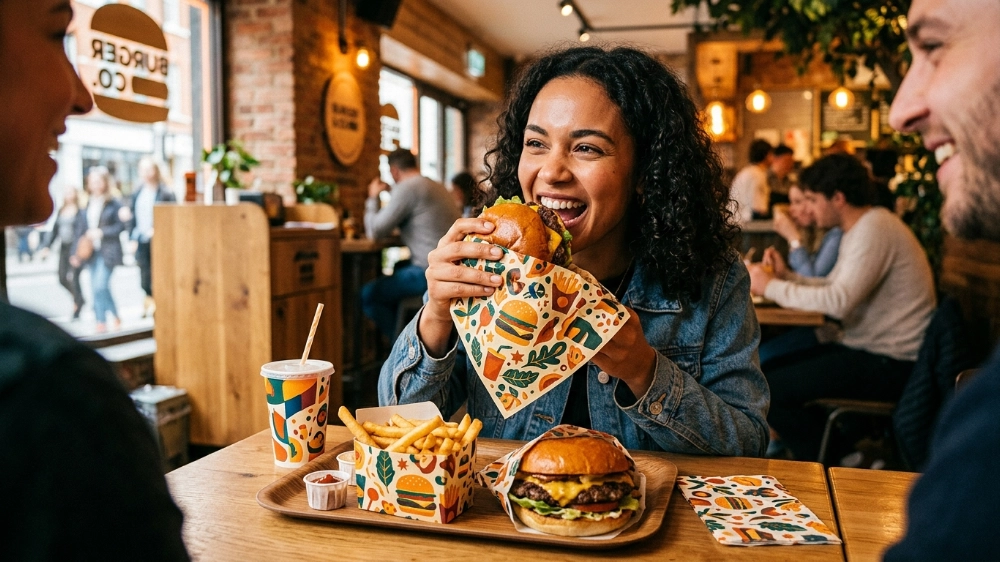
Better burger packaging can increase the likelihood of repeat orders by protecting food quality, reducing delivery disappointment, and making the restaurant feel more dependable. It works as a retention tool when structural performance, convenience, and brand presentation support the same customer promise.
A customer does not experience a takeaway burger as separate components called “food,” “packaging,” and “delivery.” They experience one complete order. If the burger arrives hot, upright, clean, and easy to eat, the restaurant receives credit for the result. If it arrives crushed, wet, leaking, or cold, the restaurant receives the blame.
This is why packaging should not be treated only as a disposable supply expense. A peer-reviewed study of 317 online fresh-food customers found that packaging was one of the post-purchase experience factors that supported repurchase intention through customer satisfaction. The study was not limited to burgers, but its mechanism is directly relevant to takeaway food: what customers receive after payment affects whether they feel confident buying again.
Better packaging does not rescue an unsatisfactory burger or guarantee loyalty. It removes preventable reasons for customers to switch restaurants, complain, request refunds, or decide that a menu item is unsuitable for delivery. For your better packaging, you should learn to choose a reliable burger box manufacturer.
Does Burger Packaging Really Affect Repeat Orders?
Packaging does not create loyalty on its own, but it influences the condition in which customers receive the meal. When it helps the burger arrive closer to its intended temperature, texture, and appearance, it supports satisfaction and makes a future order more likely.
The connection is practical rather than mysterious. A customer orders a burger based on a menu photo, description, previous visit, recommendation, or earlier purchase. The package determines how much of that expected experience survives the journey from the kitchen to the customer.
The National Restaurant Association’s 2025 off-premises research found that 90% of surveyed off-premises customers would be likely to order a wider variety of takeaway or delivery foods if upgraded packaging helped preserve restaurant-level temperature, taste, and quality. This indicates that packaging can influence not only how customers judge an existing order, but also which menu items they feel safe ordering next time.
How Does Packaging Influence Customer Satisfaction?
Customers judge the complete delivered meal rather than evaluating the recipe and package independently. A good burger can therefore produce a disappointing experience when its box traps steam, leaks grease, crushes the bun, or allows the ingredients to slide apart.
Customer satisfaction is largely based on whether the received experience matches the expected experience. A burger advertised with a high, soft bun and distinct layers creates expectations that are immediately contradicted when the customer opens a flattened, grease-soaked package.
Packaging also affects convenience after opening. A hamburger box that stays stable on a desk, keeps sauces contained, and gives the customer room to pick up the burger produces less friction than a package that must be held together or cleaned up before eating.
What Is the Connection Between Satisfaction and Repurchase Intention?
Packaging can support repurchase intention indirectly by improving the post-purchase experience and customer satisfaction. It should therefore be evaluated as part of customer retention rather than only as a cost per unit.
The International Journal of Retail & Distribution Management research found that packaging, the product received, customer support, and perceived benefits significantly influenced repurchase intention through satisfaction. The appropriate conclusion is not that a particular box guarantees another sale, but that packaging is one controllable part of the experience that shapes future behavior.
This distinction matters for restaurant operators. Reducing the box price by a few cents may look efficient in a purchasing report, but the saving becomes less meaningful if the cheaper structure increases damage, complaints, refunds, or customer loss.
What Packaging Problems Make Customers Avoid Ordering Burgers Again?

Customers may avoid reordering when packaging causes soggy buns, trapped condensation, grease leakage, crushed ingredients, heat loss, or messy handling. These failures create a visible gap between the burger promised online and the burger delivered to the customer.
Not every customer submits a complaint. Some simply stop ordering that item, choose another restaurant, or limit future purchases to foods they believe travel more reliably. This makes packaging failure difficult to measure when a restaurant looks only at formal refund data.
The most damaging problems are usually repeatable rather than random. An unsuitable box may create the same condensation during every 25-minute journey, while an oversized package may allow the burger to slide every time a courier brakes or turns.
Why Do Burger Buns Become Soggy During Delivery?
Hot meat, sauces, vegetables, and the bun itself release or transfer moisture after the package is closed. When steam cannot escape or liquids remain in direct contact with bread, the bun absorbs moisture and loses its intended texture.
A hot burger continues changing after leaving the kitchen. Steam rises from the patty, while juices, sauces, tomatoes, pickles, and other wet ingredients add moisture inside a small enclosed space. As the internal air cools, some moisture can condense on the lid or inner surfaces and return to the food.
The solution is not always to add as many vents as possible. Restaurants need to identify the moisture source, delivery time, burger construction, and desired serving temperature before deciding whether to change the box, wrap, ingredient order, draining process, or assembly method.
Why Do Some Burger Boxes Keep Food Hot but Ruin Its Texture?
A tightly enclosed package may reduce heat loss while trapping the steam released by the hot burger. Effective packaging must balance temperature retention with moisture release instead of treating maximum insulation as the only objective.
Heat and crispness do not always require the same packaging conditions. A sealed environment may help the burger remain warm, but that same environment can soften toasted buns, fried coatings, bacon, onion rings, or other ingredients that depend on a drier surface.
Restaurants should therefore define what “good condition” means for each burger. For one product, warmth may be the priority. For another, protecting the bun and fried ingredients from condensation may matter more than retaining every degree of heat.
How Do Grease Leaks and Crushed Burgers Damage Customer Trust?
Leakage and structural failure make the order feel uncontrolled and can create concerns about cleanliness or handling. Customers may interpret a collapsed box or open lid as evidence that the restaurant is inconsistent, even when the food itself is safe.
Grease stains are not automatically a defect, particularly with natural paper packaging, but excessive penetration can weaken the board, mark the delivery bag, soil other items, and make the burger inconvenient to handle. A box that loses stiffness during transport also provides less protection against stacking pressure.
The FDA’s guidance for food delivered directly to consumers identifies proper packaging, temperature control, contamination prevention, and allergen control as interconnected last-mile considerations. This supports a broader principle: packaging should help maintain control over the order until it reaches the customer.
What Features Make Burger Packaging Better for Delivery?

Effective burger packaging combines suitable dimensions, grease resistance, structural strength, controlled ventilation, secure closure, and easy handling. The correct format depends on the burger’s height, moisture, ingredients, holding time, delivery distance, and packing process.
There is no universal “best burger box” because burgers create different packaging demands. A compact cheeseburger, a double smash burger, a heavily sauced chicken burger, and a tall gourmet burger should not automatically use the same dimensions or barrier structure.
Selection should begin with the actual product and route. Restaurants need to test the burger at the point when customers normally eat it, not only inspect the package immediately after it is filled in the kitchen.
Should a Burger Box Have Ventilation Holes?
Ventilation can release excess steam and help protect the texture of buns and fried ingredients. However, the number, size, and position of the openings should be tested because excessive airflow may accelerate heat loss. MB Packaging can provide you with a one-stop and professional burger packaging solution.
Vents are most useful when they allow moisture to escape without exposing the burger too directly to outside air. Their effectiveness also depends on whether a wrap blocks the openings, whether boxes are stacked, and whether the outer delivery bag is tightly closed.
A practical test should compare the same burger in vented and non-vented structures after realistic holding periods. The restaurant should assess temperature, condensation on the lid, bun texture, ingredient movement, and the customer’s first impression when opening the package.
How Should a Burger Box Fit the Burger?
A box needs enough internal space to avoid crushing the bun while limiting unnecessary movement. An oversized box can allow sliding and faster heat loss, while an undersized box can compress the burger, force the lid open, or displace ingredients.
Internal dimensions matter more than the dimensions shown on an external carton specification. Tapered side walls, folded corners, locking tabs, internal flaps, and the shape of the lid can reduce the usable area or height.
Restaurants should measure the burger at its widest and tallest point after full assembly. The package should then be tested with realistic stacking pressure, because the top of a tall bun may remain untouched in a single box but become compressed when several orders are carried together.
Which Materials Work Best for Greasy Burgers?
The material must resist grease and moisture for the intended delivery period without losing its shape or contaminating other items. Selection should also consider food-contact suitability, coating type, local disposal systems, print requirements, and the burger’s actual recipe.
Paperboard packaging can provide rigidity and a large printable surface, while grease-resistant paper can help wrap and stabilize the burger. The required barrier level depends on the fat content, sauces, temperature, holding time, and whether the product touches the package directly.
A stronger barrier is not automatically the most sustainable or operationally suitable option. Restaurants should ask suppliers what materials and coatings are used, which food-contact documents are available, and how the finished package should be disposed of in the target market.
Should Burgers Be Wrapped Before They Are Placed in a Box?
A suitable inner wrap can help hold ingredients together, reduce grease transfer, retain warmth, and make the burger easier to eat. Used incorrectly, however, it can trap moisture and soften the bun before the customer opens the box.
Wrapping can be effective for compact burgers that need ingredient stability, especially when the customer may eat while traveling. A box can then provide crush protection and a cleaner branded presentation around the wrapped product.
Restaurants should compare fully wrapped, partially wrapped, and unwrapped formats. The best combination is the one that protects the burger throughout the real service window without adding unnecessary packing time or excessive material.
Does Attractive Burger Packaging Increase Brand Loyalty?

Attractive packaging can improve enjoyment, recognition, and perceived value, but visual design helps only when the food arrives as expected. A premium-looking box cannot compensate for a cold, leaking, or damaged burger.
Packaging is often the only physical branded environment surrounding a delivery order. The customer may never see the restaurant’s interior, menu boards, staff uniforms, or tableware, so the box and delivery bag carry more responsibility for expressing the brand.
Research published in the Journal of Retailing and Consumer Services found that appealing shipping-box aesthetics could increase enjoyment of the delivery experience and support loyalty intentions under certain conditions. The effect was conditional, reinforcing the need for packaging appearance to match product expectations rather than replace performance.
Why Does Branded Packaging Make a Restaurant More Memorable?
Consistent colors, typography, logos, messages, and package shapes create repeated visual cues across ordering occasions. These cues can help customers connect a satisfying meal with the restaurant that supplied it and recognize the brand more quickly later.
Recognition is particularly valuable on third-party delivery platforms, where many restaurants appear in similar lists and compete through small images, ratings, discounts, and menu descriptions. A distinctive physical experience can help the brand remain identifiable after the app has been closed.
Consistency matters more than filling every surface with graphics. A focused design repeated across burger boxes, bags, cups, and side packaging generally communicates a clearer identity than unrelated designs or excessive promotional text.
Can Premium Packaging Make a Burger Feel More Valuable?
Well-designed packaging can signal care, attention, and consistency before the customer tastes the food. That signal strengthens perceived value only when the burger inside performs at a level that justifies the promise made by the package.
A rigid box that opens cleanly, presents the burger upright, and keeps grease contained can make the order feel deliberate rather than improvised. This is especially relevant for premium burgers sold at prices above standard quick-service alternatives.
The opposite is also true. Highly finished packaging can raise expectations, making weak food quality or structural failure more noticeable. The package and product therefore need to be developed as one experience.
What Should Restaurants Print on a Burger Box?
Useful printed content can include the restaurant identity, product labels, allergen or handling information where appropriate, disposal guidance, reheating advice, and a simple route for feedback or reordering. Printing should improve the experience rather than overcrowd the package.
The outside of the box should help the customer recognize the brand quickly. The inside can be used for a concise message, a product story, a campaign, or instructions that become visible during opening.
QR codes can direct customers to direct-ordering pages, loyalty programs, menus, or feedback forms, but the destination must be mobile-friendly and useful. A code that leads only to a generic homepage adds little value and may reduce the chance that customers scan future packaging. Click to get the best practical guide for your restaurants.
Does Sustainable Burger Packaging Encourage Customers to Return?
Sustainable packaging can strengthen trust and align the restaurant with customer values when environmental claims are credible and understandable. It will not support loyalty if the structure leaks, collapses, confuses customers, or fails to protect the burger.
Customers cannot verify every packaging claim while eating. They rely on material appearance, printed instructions, certifications, brand reputation, and the restaurant’s explanation of how the package should be handled after use.
A 2024 study in Foods examined eco-friendly packaging, trust, and intention to reuse food-delivery apps. The research found that eco-friendly packaging significantly moderated the relationship between perceived food healthiness and trust, while trust positively influenced reuse intention.
Do Customers Trust Restaurants More When They Use Eco-Friendly Packaging?
Eco-friendly packaging can provide a positive cue about responsibility, safety, or product quality for some customers. Its influence depends on the credibility of the claim, the food being served, and whether the package performs reliably during delivery. So you should learn more about sustainable burger packaging trends.
The study of 343 food-delivery app users found the highest trust level among respondents who perceived both food healthiness and eco-friendly packaging positively. This does not prove that changing a burger box alone will create loyalty, but it shows that environmental packaging perceptions can contribute to trust.
Restaurants should avoid vague claims such as “100% green” or “completely eco-friendly.” More useful communication identifies the material, relevant certification, intended disposal route, or specific improvement, such as reduced plastic content.
Is Recyclable Packaging Always the Best Choice for Burgers?
No packaging is recyclable everywhere simply because it is made mainly from paper or plastic. Actual recyclability depends on the complete structure, coatings, adhesives, food contamination, local collection rules, and the capabilities of available recycling facilities. Click Bagasse Hamburger Box to learn about eco-friendly material.
A paper burger box that is heavily contaminated with food may not be accepted in some recycling systems. A technically recyclable plastic package may also be discarded if the local market does not collect or process that resin and format.
Restaurants should use disposal instructions that reflect the markets where the packaging is sold. Clear, specific guidance is more trustworthy than universal claims that may not be accurate in every city or country.
Should Restaurants Choose Sustainability or Performance First?
Food protection and environmental impact should be evaluated together rather than treated as opposing goals. The preferred package is one that uses resources responsibly while still preventing damage, leakage, food waste, remakes, and dissatisfied customers.
A package that contains less material but regularly collapses may increase product loss and require double packing. A package with an environmental label may also create a poor customer experience if it absorbs grease too quickly or cannot handle the intended delivery time.
The correct process is to define minimum performance requirements first and then compare compliant options for material efficiency, recoverability, renewable content, coating type, and verified environmental attributes.
How Does Burger Packaging Build Trust in Delivery Orders?
Customers trust delivery brands that provide clean, secure, correctly identified, and consistently packed orders. Packaging demonstrates whether the restaurant maintained control over the meal from final assembly to the customer’s door.
Trust becomes especially important when a third-party courier stands between the restaurant and the customer. The customer may not know who handled the bag, where it was placed, or whether it was opened during transit.
The FDA’s third-party delivery recommendations emphasize risk assessment, proper packaging, temperature control, contamination prevention, and allergen control. Packaging is therefore one visible part of a larger delivery-control system.
Does Tamper-Evident Packaging Matter for Burger Delivery?
Tamper-evident closures can reassure customers that an order has not been opened after leaving the restaurant. They are most valuable when the seal is easy to inspect, difficult to replace unnoticed, and applied consistently by staff.
A tamper-evident feature may be a label across the opening, a sealed bag, a tear strip, or an integrated locking structure. It should not make the package unnecessarily difficult to open or damage the food when the customer breaks the seal.
Tamper evidence does not replace safe food handling, temperature management, or courier procedures. It simply gives the customer a visible indication of whether the final packed order remained closed.
How Can Packaging Reduce Missing or Incorrect Items?
Labels, seals, dividers, and standardized packing procedures make orders easier to verify before dispatch. Better organization can reduce the chance that customized burgers, sauces, sides, or drinks are omitted or delivered to the wrong customer.
Printed or applied labels can identify burger type, modifications, order number, preparation time, and required accompaniments. The goal is to make checking fast enough that staff can complete it during busy service periods.
Packaging should also help separate similar products. Distinct size codes, check boxes, stickers, or marked wrapping can prevent staff from opening completed burgers to identify them again.
Why Is Packaging Consistency Important Across Multiple Locations?
Customers expect the same burger condition and presentation each time they order from a chain or franchise. Standardized specifications reduce variation between stores and make the brand experience more predictable.
Consistency requires more than sending every location the same box. Stores must use the same packing sequence, holding limits, closure method, labels, and rules for separating hot, cold, wet, and crisp components.
The repurchase study found that companies with a stronger corporate image may face more serious consequences when the post-purchase experience fails to match that image. For established restaurant brands, high-quality post-purchase performance must support the expectations created by the brand.
Are Customers Willing to Pay More for Better Burger Packaging?
Many customers indicate that they will pay more when packaging protects the temperature, taste, and overall quality of takeaway food. They are paying for a more reliable meal experience, not merely for a box that looks more expensive.
According to the National Restaurant Association, more than half of surveyed customers were willing to pay extra when takeaway or delivery packaging helped maintain food quality. The proportion reached 60% among Gen Z and millennial adults.
This does not mean restaurants should automatically add a visible packaging fee. It means that the market may accept a higher menu price or delivery proposition when customers can perceive a meaningful improvement in the condition of the food.
When Does Premium Packaging Justify Its Extra Cost?
A higher-cost package can be justified when it reduces damage, complaints, refunds, remakes, packing errors, or customer loss. The decision should be based on the total economics of a successful delivered order rather than unit price alone.
Suppose one structure costs slightly more but reduces grease leakage and protects tall burgers from being crushed. The value may appear through fewer refunds, stronger reviews, more premium-burger orders, or lower use of additional wraps and backup bags.
Restaurants should also include operational costs. A complex box that takes longer to assemble may reduce service capacity, while a slightly more expensive pre-formed structure may save labor during peak periods.
Can Better Packaging Increase the Range of Burgers Customers Order for Delivery?
Customers may order more menu items when they trust the packaging to protect them during transport. Better packaging can therefore make tall, loaded, premium, crispy, or heavily sauced burgers more credible as delivery products.
The finding that 90% of off-premises customers would consider a wider variety of foods when packaging preserved quality is important for menu strategy. Restaurants may be unnecessarily limiting off-premises sales because customers expect certain items to travel badly.
Packaging development should still be paired with recipe and assembly testing. Some burgers may need less sauce, better-drained vegetables, redesigned ingredient order, or separate components in addition to a new box.
How Can a Restaurant Measure the ROI of Better Burger Packaging?
Packaging ROI should be measured through customer outcomes and operational performance, not only the difference in unit cost. Restaurants can compare formats using complaints, refunds, damage rates, ratings, packing speed, and repeat-order behavior.
A proper test needs a baseline. Before changing the package, the restaurant should record current packaging cost, delivery complaints, refund reasons, review language, average packing time, and repeat-order rate for the relevant menu items.
After the change, the same metrics should be monitored under comparable conditions. The restaurant can then determine whether a higher package cost is offset by better food condition, fewer service failures, or stronger customer behavior.
Which Packaging Metrics Should Restaurants Track?
Useful metrics include leakage complaints, damaged orders, crushed burgers, refund and remake rates, packing time, review language, and repeat-order frequency. These results should be compared with packaging cost, labor, average order value, and delivery distance.
Restaurants can categorize customer comments using terms such as “soggy,” “cold,” “crushed,” “messy,” “leaking,” “open,” or “missing.” Tracking the frequency of these terms can reveal patterns that are hidden inside an overall star rating.
Data should also be divided by channel. Pickup, in-house delivery, and third-party delivery may produce different outcomes because their holding times, stacking methods, and levels of handling are not the same.
How Should Restaurants Test Two Burger Box Designs?
Use the same burger, preparation method, holding period, route, and outer delivery bag for both packages. Compare internal temperature, condensation, bun texture, leakage, structural stability, ingredient movement, opening experience, and staff packing time.
The test should simulate normal service rather than ideal laboratory handling. Boxes should be carried, stacked, tilted, placed in insulated delivery bags, and kept for the typical delivery window before evaluation.
Blind customer or staff comparisons can reduce design bias. Participants should evaluate the food before being told which package costs more or which option management prefers.
How Long Should a Burger Packaging Trial Run?
The trial should cover enough orders to include different shifts, staff members, burger types, delivery distances, and demand levels. Repeat-order effects should then be reviewed over a defined period such as 30, 60, or 90 days.
A one-day test may identify obvious leakage or assembly problems but miss variation between quiet and peak periods. A limited launch across selected stores, delivery zones, or menu items provides a more representative assessment.
Restaurants should define the success threshold before starting. For example, the new box might need to reduce packaging-related complaints by a specified percentage without increasing packing time beyond an acceptable limit.
Which Burger Packaging Features Have the Greatest Effect on Repeat Orders?

Packaging features affect repeat business by solving specific customer problems rather than by existing in isolation. Each feature should therefore be linked to an observable food-condition, convenience, trust, or brand-recognition outcome.
The table below provides a practical framework for connecting packaging decisions with measurable results. These are evaluation indicators, not guaranteed outcomes, because the burger, delivery process, staff execution, and customer expectations also influence the result.
| Packaging feature | Customer problem addressed | Likely experience effect | Suggested measurement |
|---|---|---|---|
| Controlled ventilation | Condensation and soggy buns | Better texture after delivery | Bun condition after 20–30 minutes |
| Grease-resistant barrier | Leakage and weakened paperboard | Cleaner handling and greater confidence | Leakage complaints per 1,000 orders |
| Correct internal dimensions | Crushing or excessive movement | More consistent presentation | Arrival damage rate |
| Secure closure | Boxes opening during transport | Better protection and trust | Closure or seal failures |
| Structural strength | Collapsed or compressed boxes | Improved stacking protection | Damage during courier handling |
| Clear product labels | Incorrect or missing items | Easier order verification | Order-accuracy complaints |
| Consistent branded design | Low brand recognition | Stronger memory and perceived value | Repeat and direct-order rate |
| Clear disposal instructions | Confusing environmental claims | Greater convenience and credibility | Customer feedback and disposal questions |
The priorities will vary by restaurant. A delivery-first burger kitchen may place ventilation, stability, and order labels above elaborate printing, while a premium dine-in brand expanding into takeaway may need both food protection and presentation consistency.
How Can Restaurants Improve Burger Packaging Without Disrupting Operations?
Packaging changes should follow a structured process involving product assessment, samples, delivery simulation, staff feedback, and limited-volume trials. The objective is to improve the customer experience without slowing assembly, complicating storage, or increasing packing errors.
The kitchen team should be involved before a purchasing decision is finalized. A package may perform well during a supplier presentation but prove difficult to erect, close, label, or stack during a busy service period.
Improvements should be introduced one defined problem at a time. If the current issue is crushed burgers, changing the dimensions, coating, artwork, closure, and packing method simultaneously will make it difficult to identify which change produced the result.
What Should Restaurants Check Before Ordering Burger Boxes in Bulk?
Buyers should verify internal dimensions, material composition, food-contact documentation, grease resistance, ventilation, closure strength, stackability, printing, carton quantity, lead time, storage needs, and quality tolerances. Samples must be tested with the actual burger before bulk approval.
Flat dimensions alone are not enough. Buyers should request assembled samples and test them with the tallest and heaviest relevant products, including special editions that may exceed the size of the standard menu.
For custom manufacturing, the restaurant should also approve artwork, printing tolerances, color expectations, substrate, coating, carton marks, packing method, and the process for handling nonconforming goods.
How Can Staff Feedback Improve Packaging Selection?
Kitchen and packing staff can identify assembly, closure, labeling, storage, and speed problems that may not appear in management reviews. Their feedback helps determine whether a technically effective package can also work reliably during daily operations.
Staff should test packages during actual peak periods rather than only during training. Useful observations include how often tabs fail to lock, whether gloves catch on folds, how much counter space is required, and whether completed boxes stack securely.
Feedback should be documented rather than collected informally. A simple scorecard can compare assembly time, closure security, food fit, storage efficiency, and overall preference across shifts.
What Is the Best Burger Packaging Improvement Checklist?
Identify the largest current failure, define a measurable target, test suitable samples under real delivery conditions, and introduce the strongest option in a controlled trial. Standardize the successful format and review it whenever the burger, route, or service process changes.
- Review complaints, refunds, reviews, and staff observations.
- Select one priority problem, such as sogginess, crushing, or leakage.
- Measure the burger and document its ingredients, temperature, and normal holding time.
- Request several packaging structures rather than choosing by appearance alone.
- Test the packages with the actual food and outer delivery system.
- Compare food condition, assembly time, storage, material use, and cost.
- Run a limited-volume field trial.
- Measure results against the original baseline.
- Document the approved specification and packing procedure.
- Review performance when menu or delivery conditions change.
This process prevents subjective decisions such as selecting the thickest board, the lowest quotation, or the design that looks best while empty. It makes packaging selection part of product and service development.
What Is the Main Reason Better Burger Packaging Creates Repeat Customers?
Better packaging makes the delivered experience more predictable. When customers repeatedly receive a burger that is intact, enjoyable, easy to handle, and consistent with the brand promise, they have fewer reasons to choose another restaurant.
Repeat purchasing is built through accumulated evidence. Each successful order tells the customer that the restaurant can be trusted to reproduce the experience, even when the meal travels through a delivery system the restaurant does not fully control.
Packaging contributes by protecting what the kitchen created. It cannot replace food quality, accurate orders, timely delivery, or responsive service, but it can prevent those efforts from being undermined during the final stage of the customer journey.
The most useful question is therefore not, “How can we make our burger box look more premium?” It is, “What must this package do so that customers receive the burger we intended them to experience?” Don't worry, we offer you a one-stop burger packaging solution to attract your clients.
Frequently Asked Questions
Does Better Burger Packaging Actually Increase Repeat Orders?
Better packaging can support repeat orders by improving food condition, satisfaction, trust, and consistency. It does not guarantee customer loyalty because recipe quality, price, order accuracy, service, and delivery time also affect the decision to reorder.
What Is the Best Packaging for Keeping Burgers from Getting Soggy?
The best format balances controlled ventilation, suitable grease resistance, correct sizing, and the burger’s actual moisture level. Restaurants should test the complete burger after its normal delivery time because a box that works for one recipe may perform poorly with another.
Is Custom-Printed Burger Packaging Worth the Cost?
Custom printing can improve recognition and make the delivery experience feel more deliberate when the structure already protects the food. Printing is less likely to generate value when the box leaks, crushes the burger, slows packing, or does not fit the product.
Does Eco-Friendly Burger Packaging Improve Customer Loyalty?
Eco-friendly packaging can contribute to trust and align the restaurant with customer values when its environmental claims are credible. It must still protect the burger effectively, because customers are unlikely to reward sustainability messaging attached to a disappointing meal.