Skip to content
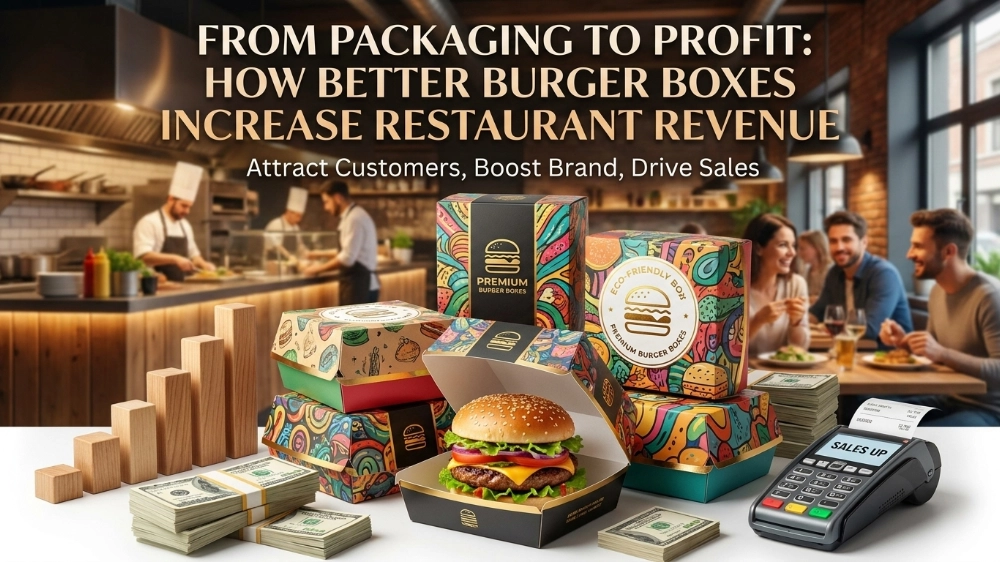
Better burger boxes can increase restaurant revenue when they protect the food, reduce preventable losses, strengthen repeat-order confidence, and make takeaway operations easier to run. The business case is not that a more attractive box automatically produces sales. It is that a better-performing box improves several measurable parts of the order economics at the same time.
For burger restaurants, the package is part of the product customers actually receive. The kitchen may prepare a hot, structured, visually appealing burger, but the customer judges the version that arrives after holding, stacking, transport, and exposure to steam, grease, sauces, and movement.
This matters because off-premises dining is no longer a secondary channel. According to the National Restaurant Association’s 2025 off-premises research, nearly 75% of restaurant traffic now occurs outside the dining room. For a burger business that depends on takeaway, drive-thru, or delivery, the burger box is therefore one of the final operational controls between the kitchen and the customer.
Can better burger boxes actually increase restaurant revenue?
Better burger boxes can support revenue by helping more orders arrive in the condition customers expected and by reducing problems that make those customers less likely to return. Their value usually appears through a combination of repeat orders, fewer refunds, stronger perceived value, broader delivery menus, and lower handling costs.
The most useful way to understand this is as a chain rather than a single marketing claim:
Better box performance → better delivered food → fewer complaints and refunds → more reliable customer experiences → stronger repeat-order potential → higher revenue per acquired customer. If you want to learn it in detail, you could read Why Better Burger Packaging Leads to More Repeat Customers.
Each link in that chain can be measured. A restaurant can track packaging-related complaints, refunded orders, remakes, food-condition ratings, packing time, average order value, and 30- or 60-day reorder rates before and after a packaging change.
Packaging is especially relevant to retention. Based on more than 100 million guest records, Olo reports that repeat guests drive 60% of restaurant revenue. A burger box should not be credited for every repeat order, but a crushed, soggy, leaking, or cold delivery can become a preventable reason not to place the next one.
How does a burger box affect the quality of a delivered burger?
A burger continues releasing heat and moisture after it leaves the kitchen, so its packaging must manage temperature, steam, grease, movement, and compression together. A box that performs poorly in one of these areas can damage the bun, filling structure, appearance, or eating experience before the order reaches the customer.
A burger package is not only a shell. Its dimensions, board strength, coating, vent placement, closure, internal clearance, and interaction with wrappers and delivery bags all influence how the product travels.
The correct design depends on the menu. A thin cheeseburger, a tall double-patty burger, a heavily sauced chicken burger, and a premium burger with delicate toppings do not create the same packaging conditions. Standardizing every item into one generic box may simplify purchasing, but it can also create avoidable food-quality problems. If you are searching for a reliable burger packaging supplier, you must read How to Choose a Reliable Burger Box Manufacturer.
Why do burgers become soggy inside takeaway boxes?

Hot patties, sauces, vegetables, and buns release moisture that can condense on cooler package surfaces when steam cannot escape. The trapped moisture then returns to the food, softening the bun and weakening crisp components.
Sogginess is rarely caused by one factor alone. A burger may enter the box too quickly after cooking, contain a high-moisture sauce, sit under a tightly sealed lid, share a bag with steaming sides, or travel longer than the packaging system was designed to handle.
The practical goal is not to remove all humidity. Excessive airflow can cool the food too quickly, while insufficient airflow can create a humid “sauna” around it. Restaurants need a controlled balance between heat retention and moisture release.
The National Restaurant Association recommends evaluating takeaway packaging for temperature, texture, appearance, structural integrity, and branding impact. Those criteria are more useful than judging an empty sample only by how thick or attractive it feels.
Are vented burger boxes better for delivery?
Vented burger boxes can reduce condensation, but more ventilation is not automatically better because excessive airflow may accelerate heat loss. The right vent size and location depend on the burger, journey time, climate, secondary wrapping, and delivery-bag setup.
Small vents positioned near the upper part of the box can allow rising steam to escape while limiting direct exposure around the burger. However, a very open structure may work for immediate takeaway and perform poorly during a 30-minute delivery.
Restaurants should test at least three realistic journey conditions: a short pickup hold, an average delivery, and the longest delivery normally accepted. The winning box is the one that produces the best overall result, not necessarily the hottest temperature or the driest bun in isolation.
How does the size of a burger box affect food quality?
A box that is too small can compress the bun and force ingredients outward, while an oversized box allows the burger to slide and lose its intended presentation. Correct sizing supports the product without crushing it and leaves enough clearance for heat and moisture management.
Measure the finished burger, not only the patty. The useful specifications include maximum diameter, total assembled height, unstable toppings, sauce volume, and whether the burger is wrapped before boxing.
For tall or premium products, internal supports, corner locks, or a fitted base can reduce movement without pressing the lid against the food. For simpler products, a wrapper-plus-box system may provide enough support while improving speed and grease control.
How can better burger boxes increase repeat orders?
Customers decide whether to reorder based on the meal they received, not the version that looked perfect at the kitchen pass. Packaging that consistently delivers an intact, warm, clean, and recognizable burger removes several preventable reasons for customers to switch restaurants.
Repeat-order growth rarely comes from packaging alone. Food quality, price, accuracy, speed, delivery coverage, and service recovery also matter. The box contributes by reducing the gap between the restaurant’s dine-in standard and its off-premises result.
This distinction is important: better packaging is not a substitute for a good burger. It is a system for protecting the value already created by the recipe, staff, ingredients, cooking process, and brand.
Why is packaging consistency important for customer retention?
Consistency builds confidence that the next order will arrive as expected. When box size, closure, grease resistance, labeling, and packing method vary by shift or location, customers experience the same menu item as an inconsistent product.
Restaurant teams can reduce that variation by defining a packaging standard for each major product family. The standard should state which box, wrapper, insert, label, and delivery-bag configuration to use, as well as the maximum recommended hold or journey time.
This also makes training easier. Instead of telling staff to “pack it carefully,” the restaurant gives them a repeatable packing method that can be audited during busy periods.
Can burger packaging improve delivery ratings and reviews?
Packaging can influence ratings when customers encounter crushed burgers, soggy buns, leaking sauces, grease-stained bags, open closures, or food that has shifted during transport. A better box cannot guarantee a positive review, but it can remove common reasons for a negative one.
Review text is useful operational data. Restaurants should search comments for recurring terms such as “soggy,” “cold,” “leaked,” “messy,” “squashed,” “fell apart,” or “box opened.” These words can reveal whether a problem is associated with one menu item, one branch, one delivery radius, or one packaging format.
Do not classify every bad review as a packaging failure. A delayed courier, undercooked patty, incorrect order, or long kitchen hold requires a different fix. Accurate classification prevents the restaurant from buying a more expensive box for a problem it cannot solve.
Can premium burger packaging help restaurants charge higher prices?
Packaging can support premium pricing by reinforcing the customer’s perception of care, quality, professionalism, and brand consistency. It cannot justify a higher price by itself; the burger, portion, service, and overall experience must deliver the same value message.
Customers form expectations before opening the box. A clean structure, deliberate print design, strong closure, and tidy presentation suggest that the restaurant has controlled the details. A weak, stained, badly fitted box can communicate the opposite, even when the ingredients are expensive.
The commercial opportunity is not simply “make the box look luxurious.” It is to ensure that the packaging supports the position already claimed by the menu. A value burger needs efficient, reliable packaging. A premium burger needs functional protection plus a level of presentation that makes the price feel coherent.
Tips: Burger packaging affects not only affect restaurants, but also food trucks & mobile catering.
How does packaging design influence perceived value?
Color, graphics, logo treatment, typography, and layout shape the first visual impression of the order. Consistent design can strengthen brand experience and make an unfamiliar delivery brand feel more deliberate and trustworthy.
A 2025 study using 490 consumers found that color, graphics, logos, and layout influenced purchase intention through brand experience. The study focused on tea packaging rather than restaurant delivery, so it should not be treated as direct proof that printed burger boxes raise sales; it does support the broader role of visual packaging elements in customer judgment.
For burger packaging, clarity often works better than decoration overload. The brand mark should be easy to recognize, colors should reproduce consistently, essential messages should remain legible, and the design should still look intentional after grease, handling, and stacking.
Does the material of a burger box change how customers judge the product?
Material can affect expectations about sustainability, cleanliness, quality, and price before the customer tastes the food. Functional suitability still comes first because a material that creates the desired image but fails under grease, heat, or moisture can damage trust.
A 2024 study found that food shown in cardboard packaging was perceived as more sustainable and more expensive than the same food shown in plastic packaging. The same research also found that expected tastiness remained a primary predictor of willingness to consume, which is a useful reminder that packaging perception cannot replace product quality.
Kraft paperboard may signal naturalness or simplicity, while white paperboard may support brighter printing and a cleaner premium appearance. Coatings and barriers should be selected according to the actual grease, sauce, heat, and hold-time demands rather than visual preference alone.
How can burger boxes reduce refunds, remakes, and lost revenue?

A packaging failure costs more than the box itself because it can trigger replacement food, refunds, delivery credits, staff time, waste, and customer loss. Measuring these hidden costs often changes which box is genuinely the cheapest option.
Suppose an upgraded box costs $0.06 more per order. If the existing box contributes to enough leakage, collapse, or texture complaints to create more than $0.06 in average losses per order, the higher-priced box may reduce total cost.
The calculation should include direct and indirect effects. Direct losses include refunded food and remakes. Indirect losses include customer-service labor, platform disputes, poor ratings, lost repeat orders, and time spent repacking damaged products.
Which packaging failures cost restaurants the most money?
The most expensive failures are those that compromise the entire order, including leakage, structural collapse, severe condensation, grease transfer, open closures, and product movement. These problems can destroy both the current transaction and the customer’s confidence in ordering again.
High-cost failures often occur at the interfaces between components. The burger box may be adequate on its own but fail when stacked under heavy items, placed in an oversized bag, combined with a hot side dish, or sealed before excess steam has escaped.
Restaurants should therefore test the whole packing system: food, wrapper, box, label or seal, side packaging, carrier bag, stacking pattern, and delivery method. Optimizing one component while ignoring the rest can simply move the failure elsewhere.
How should restaurants identify packaging-related complaints?
Restaurants should tag complaints by failure type instead of recording every issue as “food quality.” Separating packaging failures from kitchen errors and courier delays reveals which losses an upgraded box can realistically prevent.
A simple complaint code system may include: condensation or sogginess, heat loss, leakage, grease transfer, closure failure, crushed box, burger movement, missing label, incorrect package size, and difficult opening.
Attach the order time, branch, menu item, delivery duration, box SKU, and customer photo when available. After several weeks, patterns will emerge that are much more actionable than isolated anecdotes.
Can better burger boxes improve kitchen and packing efficiency?
Packaging affects how quickly staff can form, fill, close, label, stack, and hand off an order. A box with a higher unit price may lower total order cost when it saves labor, prevents packing mistakes, and stays reliable during peak periods.
Restaurant packaging is handled at the worst possible moment for complexity: when orders are accumulating and staff are working quickly. A closure that looks elegant in a supplier presentation may become a bottleneck if it requires multiple folds, precise alignment, or frequent re-closing.
Efficiency should be tested with the employees who actually pack orders. Procurement staff, designers, and owners may handle a sample carefully; a peak-hour line needs a structure that works rapidly and consistently.
How does box assembly time affect restaurant profit?
A few extra seconds per box can become a material labor cost across hundreds of daily orders. Restaurants should measure the complete handling cycle, including forming, filling, closing, labeling, stacking, and correcting failed closures.
For example, saving six seconds on 600 daily orders saves one labor hour per day. The financial value depends on local wages and whether the saved time actually improves throughput, but the calculation shows why assembly speed belongs in packaging ROI.
Also measure the error rate. A fast box that occasionally opens in the bag may be worse than a slightly slower structure with a reliable lock. The goal is the lowest labor time per successfully packed order.
Should a restaurant use one burger box size or several sizes?
One universal size simplifies purchasing and inventory, but it may perform poorly when the menu includes burgers with very different diameters and heights. A small, controlled size range can improve fit without creating unnecessary stock complexity.
Restaurants can group menu items by real packed dimensions rather than by marketing labels such as regular, large, or premium. Two well-chosen sizes may cover most menus, with a third specialist format for unusually tall or loaded products.
SKU reduction still matters. Every additional size creates forecasting, storage, labeling, and minimum-order implications. The correct number is the smallest range that protects the menu reliably.
How can burger packaging generate additional sales?
The burger box can become a measurable communication channel after the customer has already placed an order. A focused reorder prompt, loyalty invitation, QR code, or menu suggestion can turn the package from a passive container into a customer-retention tool.
Unlike a social ad, packaging reaches a verified buyer while the product experience is fresh. That makes it suitable for actions closely connected to the order, such as earning points, ordering directly next time, reviewing the meal, or discovering a complementary menu item.
The message should remain secondary to the eating experience. A box crowded with offers, social handles, sustainability claims, instructions, and promotional copy can become difficult to read and visually cheapen the product.
What should restaurants print on a burger box to encourage another order?

The most effective box message gives the customer one clear next action. Restaurants should choose the action that best supports their business model rather than printing every available channel.
Useful options include a direct-order QR code, loyalty enrollment, a unique reorder code, a request for structured feedback, or a prompt to try a high-margin side or limited-time burger. Unique codes or tagged URLs make the result measurable.
For example, a restaurant could print “Order direct next time and earn double points” beside a QR code. It could then compare scans, completed orders, average spend, and repeat behavior against boxes without the prompt.
Can better packaging help restaurants sell more delivery menu items?
Restaurants sometimes exclude profitable items from delivery because the existing package cannot preserve their structure or texture. Better-performing packaging can make a wider menu commercially viable, provided each item survives realistic journey testing.
The National Restaurant Association reports that 90% of off-premises customers would likely order a greater variety of items if upgraded packaging kept food closer to its restaurant temperature, taste, and quality. The same source states that more than half of customers—and 60% of Gen Z and millennial adults—would pay extra when packaging helps maintain food quality.
For burger businesses, this may support the delivery of taller premium burgers, loaded products, bundles, or sides that were previously too fragile. The opportunity should still be tested through actual sales and quality data rather than assumed from consumer intent alone.
How do you calculate the ROI of upgrading burger boxes?
Packaging ROI compares the additional box cost with measurable gains in revenue, avoided losses, and labor savings. Restaurants should use a defined baseline and test period instead of attributing every change in sales to the new box.
A practical formula is:
Incremental Packaging Profit = Additional Revenue + Avoided Refunds and Remakes + Estimated Retained-Customer Value + Labor Savings − Additional Packaging Cost
Packaging ROI = Incremental Packaging Profit ÷ Additional Packaging Cost × 100
“Estimated retained-customer value” should be used conservatively because it is not directly observable for every order. A restaurant can estimate it from identified customers, loyalty accounts, direct-order data, or cohort reorder behavior instead of assigning an arbitrary lifetime value to every complaint avoided.
What is a simple burger-box ROI example?
A hypothetical example shows how several small improvements can outweigh a modest increase in unit cost. The numbers below are illustrative and should be replaced with the restaurant’s own order and complaint data.
Assume a restaurant sells 20,000 takeaway burgers during an eight-week test. The upgraded box costs $0.05 more, creating an additional packaging expense of $1,000.
- Avoided refunds and remakes: $450
- Measured labor savings from faster assembly: $300
- Additional gross profit from higher reorder activity: $900
- Additional gross profit from premium or add-on sales: $250
The incremental packaging profit would be $900 after subtracting the $1,000 added box cost from $1,900 in measured benefits. The resulting ROI would be 90% for the test period, but the restaurant should also test whether the improvement continues after promotions, seasonality, and operational changes are considered.
What should restaurants measure before and after upgrading burger boxes?
No single metric proves that a box increased revenue. The strongest case appears when several related indicators improve together, such as fewer complaints, lower refunds, faster packing, stronger reorder rates, and stable or higher order values.
| Metric | Current Box Baseline | Upgraded Box Result | Why It Affects Profit |
|---|---|---|---|
| Packaging cost per order | Record current cost | Record new cost | Measures the direct additional investment |
| Packing time per order | Average seconds | Average seconds | Reveals labor savings or added complexity |
| Packaging-related complaint rate | Complaints per 1,000 orders | Complaints per 1,000 orders | Tracks preventable dissatisfaction |
| Refund and remake rate | Percentage and value | Percentage and value | Measures avoided failure costs |
| Average delivery rating | Baseline rating | Test-period rating | Tracks received-order quality |
| Average order value | Baseline value | Test-period value | Shows whether premium or add-on sales change |
| 30-day reorder rate | Baseline cohort | Test cohort | Measures short-term retention |
| 60-day reorder rate | Baseline cohort | Test cohort | Shows whether retention persists |
| QR or direct-order conversion | Current conversion | New conversion | Measures actions generated by the package |
| Food-condition score | Temperature, texture, leakage, appearance | Same scoring method | Connects physical performance to customer outcomes |
Use rates rather than raw totals when order volume changes. For example, compare packaging complaints per 1,000 orders and refunded value as a percentage of off-premises sales.
Also separate gross revenue from gross profit. A packaging-generated promotion may increase orders but produce little value if it relies on deep discounts or low-margin items.
How should restaurants test new burger boxes before ordering in bulk?
Restaurants should test boxes with actual menu products under realistic holding and delivery conditions rather than evaluating empty samples. The current and proposed boxes should face the same burger, journey, bag setup, and scoring method.
- Select representative products. Include a high-volume standard burger, a tall or premium burger, and the item that currently generates the most packaging complaints.
- Define journey conditions. Test immediate pickup, average delivery time, and the longest normal journey.
- Control the preparation. Use the same recipe, cooking process, rest time, wrapping method, and packing sequence.
- Measure physical performance. Record temperature, bun texture, leakage, burger movement, appearance, box strength, and ease of opening.
- Measure operational performance. Time box forming, filling, closure, labeling, and handoff.
- Run an operational trial. A four-to-eight-week comparison can capture complaints, refunds, ratings, repeat behavior, and staff feedback.
- Review total economics. Include box price, freight, storage, labor, defects, and prevented losses.
Before a large custom print run, test unprinted structural samples first. Once the dimensions, board, barrier, venting, and closure perform correctly, test printing and finishing without changing the structure unnoticed.
What should restaurants look for when choosing a more profitable burger box?
The most profitable box is not automatically the cheapest, thickest, most sustainable-looking, or most heavily printed option. It is the box that meets the restaurant’s food, operational, branding, compliance, supply, and cost requirements with the fewest avoidable failures.
Restaurants should write a performance specification before requesting quotations. Without one, suppliers may quote products that look similar but differ in internal dimensions, paper grade, coating, forming method, strength, print process, packing quantity, and usable yield.
You May Also Need:
How to Find the Right Custom Fast Food Packaging Partner for Your Business
Top Takeaway Packaging Companies for Restaurants
Which burger-box features have the greatest effect on restaurant performance?
The most commercially important features are correct dimensions, moisture control, grease resistance, closure reliability, stackability, food-contact suitability, fast assembly, and stable supply. Decorative printing should be developed after these functional requirements are solved.
- Internal size: supports the burger without crushing or excessive movement.
- Ventilation: balances steam release and heat retention.
- Grease barrier: limits staining, softening, and transfer into the bag.
- Board strength: resists stacking, compression, and humid conditions.
- Closure: stays shut in transport but opens easily for the customer.
- Assembly design: works rapidly and consistently during peak periods.
- Print quality: keeps logos, colors, instructions, and QR codes legible.
- Supply consistency: ensures repeat orders match the approved sample.
Food-contact documents and relevant compliance evidence should match the finished material and intended market, not only a generic raw-material statement. Restaurants buying internationally should also confirm production lead time, quality-control method, packing configuration, and how defects or repeat-order variations will be handled.
How should restaurants balance packaging cost and performance?
Restaurants should compare total cost per successful order rather than unit box price alone. A low-priced box becomes expensive when it adds labor, defects, product damage, complaints, refunds, or supply disruption.
Total landed cost includes the box, printing plates or tooling, freight, duties where applicable, warehousing, inner and outer packing, assembly labor, damage allowance, and cash tied up in minimum order quantities.
Performance has a value too. A reliable box may allow the restaurant to extend delivery coverage, keep a premium item on the menu, reduce double wrapping, use a smaller carrier bag, or avoid frequent service recovery. These gains should be included when comparing suppliers.
When is upgrading burger boxes unlikely to increase revenue?
A box upgrade is unlikely to create meaningful returns when the main failures come from the recipe, kitchen delays, order errors, uncontrolled delivery times, or weak demand. Packaging should be treated as part of the operating system, not as a substitute for fixing the food or service.
For example, no paper box can keep a burger at restaurant temperature indefinitely. If a platform regularly assigns journeys beyond the product’s realistic quality window, the restaurant may need to reduce the delivery radius, adjust menu availability, use different thermal systems, or change the product.
Packaging also produces limited value when staff do not use it correctly. Overfilling, incomplete locks, premature sealing, poor stacking, or placing cold and hot items together can defeat a technically suitable design.
Finally, cosmetic upgrades without a business objective may only increase cost. Foil, special finishes, complex structures, or oversized boxes should be connected to a measurable purpose such as premium positioning, stronger recognition, customer engagement, or improved product protection.
What is the business case for investing in better burger boxes?
Better burger boxes create value when they help more orders arrive as intended and when that improvement appears in customer, operational, and financial data. Restaurants should invest when the expected gains from retention, pricing, menu reach, labor efficiency, and avoided failures exceed the added packaging cost. But no worries, we have prepared a practical burger packaging selection guide to you.
The strongest business case usually combines several modest improvements rather than one dramatic sales claim. A small reduction in refunded orders, a few seconds saved during packing, a better reorder rate, and a measurable response to a direct-order prompt can collectively produce a meaningful return.
Start with performance, then add communication. Solve fit, steam, grease, closure, stacking, and assembly before investing in elaborate printing. Once the box protects the burger reliably, branding and customer prompts can help the package contribute more directly to recognition and repeat purchasing.
The final question is therefore not “How cheap is this burger box?” It is “What does this box cost per successful order, and what revenue or loss does it influence across the complete customer journey?” If you're looking for a one-stop burger packaging solution, you could contact MB Packging.
Frequently Asked Questions
Are custom burger boxes worth the extra cost?
Custom burger boxes may be worth the extra cost when customization improves fit, function, brand recognition, or measurable customer action. Printing a logo on a poorly performing structure is unlikely to create a meaningful return.
What is the best packaging for keeping burgers from getting soggy?
The best packaging balances controlled ventilation, grease resistance, correct sizing, and suitable heat retention for the restaurant’s normal journey time. No single box is best for every burger, so test it with the actual recipe, wrapper, bag, and delivery conditions.
How much should a restaurant spend on burger packaging?
The spending limit should be based on total order economics rather than a universal unit-price target. Compare the additional box cost with prevented refunds, labor savings, order value, menu opportunities, and customer retention.
How long should restaurants test a new burger box?
Immediate delivery simulations can reveal physical problems, but revenue and retention effects need a longer operational comparison. A four-to-eight-week trial is often more useful for tracking complaints, refunds, packing time, ratings, and reorder behavior.