Skip to content
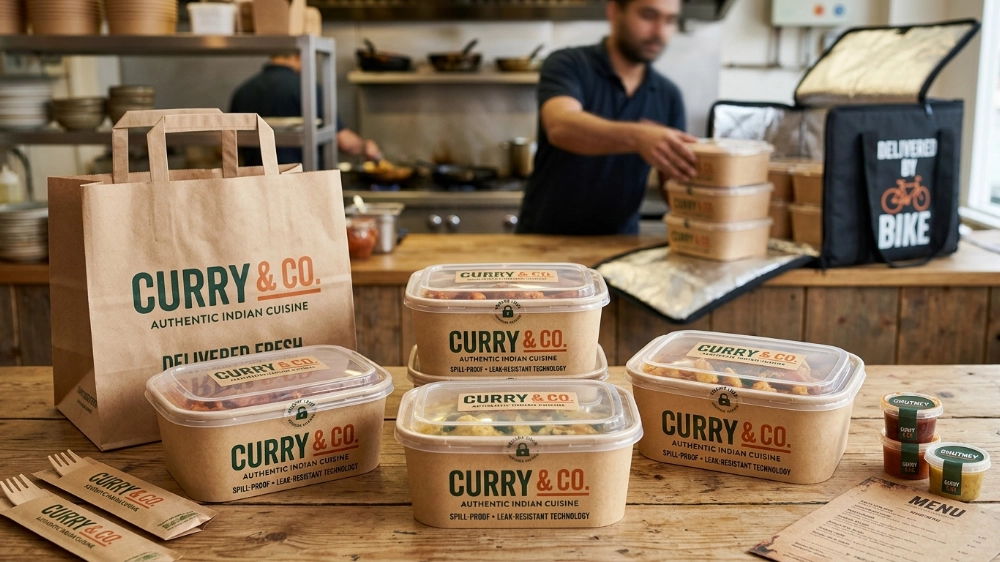
Takeaway containers rarely leak because of one obvious defect. Restaurants usually need to evaluate the food, fill level, container structure, lid, holding time, and delivery conditions together when choosing a professional takeaway packaging manufacturer for soups, curries, dressings, and other sauce-heavy meals.
Packaging performance matters because customers judge the meal they receive, not the empty container used in the kitchen. According to the National Restaurant Association, 64% of surveyed diners considered leak-proof and spill-proof performance especially important, while 60% valued protection against grease stains.
The right restaurant food containers must therefore do more than hold food on a counter. They must remain stable during filling, sealing, stacking, carrying, vehicle movement, temperature changes, and the full delivery window.
Why do takeaway containers leak during food delivery?
Takeaway containers usually leak because the food, container, lid, fill level, and delivery movement are not matched as one system. A strong base can still fail when sauce enters the rim, heat softens the structure, or stacked packages push the lid open.
The lid-to-rim connection is one of the most common failure points. If the lid and base come from different product series, the rim is damaged, or employees close only part of the perimeter, the package may appear sealed while remaining vulnerable to sideways movement.
Overfilling creates another problem. When soup or sauce reaches the closure channel, there is no clean surface for the lid to engage, and liquid can be forced outward when the container walls flex. Limited headspace also gives hot food less room to move when the driver brakes, turns, or carries the bag at an angle.
Container integrity matters beyond the visible lid. ASTM package-integrity testing recognizes that leaks may occur through package components, defects, or sealing areas, which explains why a container can fail even when the closure appears secure during a quick kitchen inspection.
Common causes of delivery leakage include:
- An incorrect or poorly fitted lid
- Sauce trapped along the container rim
- Excessive fill volume
- Weak corners, folds, or bottom seams
- Heat-related softening or distortion
- Pressure from stacked containers
- Long delivery and holding times
- Repeated tilting, braking, and vibration
- A wet primary container placed directly into a paper bag
Restaurants should investigate where the liquid first escaped. A wet lid edge usually indicates a closure problem, while staining underneath the pack may point to a bottom seam, absorbed moisture, or a puncture.
Which foods are most likely to leak during takeaway delivery?
Soups, curries, oily noodles, dressed salads, and meals with free-flowing sauce carry the highest delivery risk. Heat, low viscosity, oil, acidity, and long holding times challenge different parts of the container. Similar considerations apply when selecting takeaway packaging for gyros, kebabs, and Mediterranean food, where sauces, oils, fillings, and heat retention can affect how well packaging performs during delivery.
Thin liquids move quickly and can enter small gaps around a lid. Broth, consommé, ramen soup, and watery sauces therefore need a closure that remains secure even when the package is tilted.
Thicker curries and gravies move more slowly, but their weight can still push against the side walls during transport. Oil may spread across paper fibers and expose weak areas that water alone does not reveal, while hot food can reduce the stiffness of some container structures.
Salads are usually considered lower risk, but problems occur when dressing is poured over the food before delivery. Separating dressing into a secure portion cup can reduce prolonged liquid contact, preserve texture, and prevent dressing from reaching the lid.
Food-contact suitability must reflect the actual temperature and food type. The FDA distinguishes food-contact uses by food category and conditions such as hot filling, refrigeration, freezing, and reheating, so a pack suitable for a cold salad should not automatically be assumed suitable for hot curry.
| Food category | Main leak challenge | Packaging priority |
|---|---|---|
| Soup and broth | Fast-moving liquid | Secure full-perimeter lid |
| Curry and gravy | Heat, weight, and oil | Rigid base and grease barrier |
| Saucy noodles | Liquid movement and uneven load | Deep container with headspace |
| Oily stir-fries | Hot oil and sharp ingredients | Oil-resistant, puncture-resistant base |
| Dressed salads | Cold liquid and prolonged contact | Coated bowl or separate dressing cup |
| Rice with sauce | Sauce migration into corners | Strong folds or seamless bowl |
| Mixed meals | Different moisture levels | Compartments or separate containers |
Do lids or containers cause more leaks?
Both lids and container bases can cause leaks. Failures often start at the lid-to-rim interface, but weak corners, bottom seams, and flexible side walls can also release liquid when the package is lifted, tilted, or compressed.
A lid must match the exact rim dimensions and closure design of the base. Similar-looking lids are not necessarily interchangeable, and even a small difference in diameter, flange depth, or locking profile can leave one section incompletely closed.
Employees should be able to feel or hear the closure engage around the entire perimeter. A lid that requires excessive force slows packing and increases inconsistency, while a lid that closes too easily may not provide enough retention during transport.
The base must also remain dimensionally stable. When staff grip a flexible container from the sides, the walls can bow inward and lift the lid away from the rim. A rigid rim and reinforced upper edge help the container maintain its shape while being carried.
Paperboard cartons may fail at folds and glued seams when used with more liquid than the structure was designed to hold. For high-moisture dishes, a seamless or round format such as a hot soup bowl may provide a more predictable liquid-contact area than a shallow folded carton.
Steam creates another design tradeoff. Venting can help fried foods release moisture, but a vent opening can become a leak path when a container holding free-flowing liquid is tilted. Restaurants should not add holes to soup lids unless the complete system was engineered for both pressure management and liquid retention.

Which takeaway container materials work best for hot, saucy foods?
The best material depends on food temperature, oil content, sauce viscosity, holding time, and reheating needs. PP, lined paperboard, foil-lined paper bowls, and selected fiber formats can work, but only within their intended conditions. Restaurants handling fried menu items should also consider choosing the right takeaway packaging for fried foods because oil, steam, and moisture can quickly affect food quality and packaging performance.
Polypropylene containers are widely used for hot soup and saucy meals because well-designed versions can combine a rigid rim with a secure snap-on lid. The National Restaurant Association identifies round polypropylene containers with snap-on lids and lined paperboard bowls as practical soup-packaging options.
Lined paperboard can provide a lightweight, printable format for hot or cold foods. However, paper boxes and bowls generally need an appropriate moisture and grease barrier for soups, curries, and sauce-heavy meals, and that additional layer can affect how the packaging should be recovered after use.
A foil paper bowl may be considered where heat retention and grease resistance are priorities, provided the format is approved for the intended food-contact conditions and reheating method.
A paper salad bowl is generally better suited to chilled meals, grain bowls, salads, and foods containing controlled amounts of dressing. Dressings should still be packed separately when delivery times are long or the recipe contains a large volume of liquid.
Fiber-based formats can work well for many meals, but a plant-based material claim does not by itself describe resistance to hot oil, prolonged sauce contact, or lid security. Restaurants should check the barrier, temperature range, contact time, and compatible lid separately.
Best takeaway container options for saucy foods
| Food type | Leak risk | Suitable container style | Closure priority | Material note | Practical recommendation |
|---|---|---|---|---|---|
| Clear soup or broth | Very high | Deep round bowl | Full-perimeter snap fit | PP or lined paperboard | Leave headspace and keep upright |
| Thick curry | High | Rigid bowl or deep meal box | Strong rim engagement | PP, coated paperboard, or suitable foil-lined format | Test with the hottest and oiliest recipe |
| Saucy rice meal | Medium to high | Deep rectangular or compartment box | Secure corners and lid | Rigid plastic or coated paperboard | Keep sauce away from the closure channel |
| Noodles in broth | Very high | Separate noodle and broth containers | Liquid-tight broth lid | PP or tested lined bowl | Combining at the destination reduces risk |
| Dressed salad | Medium | Coated salad bowl | Stable cold-food lid | Coated paperboard or a suitable clear-lid system | Pack dressing separately for longer trips |
| Oily stir-fry | High | Rigid, grease-resistant meal box | Strong side-wall support | PP or oil-resistant coated board | Check corners for oil staining |
| Sauced sandwich | Medium | Structured sandwich box with an inner wrap | Moisture control rather than a liquid seal | Coated paperboard | Avoid placing excess sauce near folds |
| Mixed takeaway meal | Variable | Compartment box or separate packs | Each food needs the correct closure | Material may vary by compartment | Do not rely on one universal container |
Are paper, bagasse, and compostable containers really leak-proof?
No, a paper, bagasse, or compostable label does not automatically mean leak-proof. Wet-food performance depends on the barrier layer, forming quality, lid fit, fill level, and how long the food remains in contact with the pack.
An unlined paper carton may be suitable for fries, bread, or a relatively dry sandwich but unsuitable for soup. Adding a coating or liner can improve moisture and grease resistance, yet the barrier must still be compatible with the food temperature and expected holding time.
Bagasse and other molded-fiber products vary by thickness, forming pressure, surface treatment, closure design, and intended application. A shallow hinged container that works for rice and grilled food should not automatically be used for a free-flowing curry.
Compostability describes an end-of-life pathway under specified conditions; it does not guarantee delivery performance. The EPA advises that certified commercially compostable food-service ware should be selected only when an appropriate local facility accepts it and a collection system is available.
Before switching materials, restaurants should request:
- Food-contact documentation for the intended market
- Material and coating specifications
- Recommended temperature range
- Maximum practical contact time
- Compatible lid information
- Migration or compliance reports where applicable
- Samples for testing with actual menu items
- Clear disposal or recovery instructions
The National Restaurant Association recommends putting more sustainable packaging through rigorous testing before committing to a full transition, because environmental attributes do not replace strength, temperature control, or leak resistance.
How can restaurants choose leak proof takeaway containers for saucy foods?
Choose leak proof takeaway containers by testing them with the actual menu item and delivery route. The container must fit the portion, resist heat and grease, close consistently, remain stable when stacked, and protect the food throughout the delivery window.
Start with the food rather than the packaging catalog. Record the serving temperature, portion weight, free-liquid volume, oil level, acidity, sharp ingredients, average delivery time, maximum delivery time, and whether customers will reheat the meal.
Next, define the specific failure that must be prevented. Soup primarily needs liquid containment, while fried chicken needs grease resistance and ventilation. A salad needs cold-food stability and presentation, while a sauced rice meal needs both a strong base and reliable corner protection.
For Asian meals, curries, noodles, rice dishes, and combination orders, a custom Chinese take-out box may work well for semi-dry foods, but high-liquid dishes may require a dedicated bowl. Packaging should be selected according to menu behavior rather than appearance alone.
Use an appropriate fill line. A correctly sized container should hold the normal portion without forcing food into the lid channel, yet it should not be so oversized that the meal moves excessively during transport. Proper choosing the right takeaway container size is therefore an important step in reducing leakage risks, improving food stability, and avoiding unnecessary packaging waste.
The National Restaurant Association notes that containers that are too small may leak, while oversized formats can waste material and allow food to move around. This means capacity selection is part of leak prevention, not merely a cost or presentation decision.
When developing custom takeaway containers, provide the manufacturer with:
- Exact portion volume and weight
- Food temperature at filling
- Expected delivery duration
- Sauce, oil, and acidity characteristics
- Stacking and carrying requirements
- Microwave, freezer, or refrigerator requirements
- Lid-opening and resealing needs
- Printing and branding requirements
- Destination-market compliance requirements
- Target disposal or recovery pathway
Customization should solve a measurable operational problem. Changing the rim, depth, board grade, coating, compartment layout, or lid retention can improve performance; changing only the artwork will not correct a structural leak.

How should restaurants test takeaway containers before placing a bulk order?
Test samples with real food at the hottest serving temperature and longest expected delivery time. Fill, close, tilt, stack, carry, and inspect each pack before approving it for a bulk order.
The National Restaurant Association recommends testing packaging under the maximum expected conditions, including preparing the actual menu item, checking temperature and texture retention, and tipping the container to identify leakage. Empty samples alone cannot show how packaging will perform during a real order.
A practical restaurant test can follow these steps:
- Prepare the highest-risk food. Use the hottest soup, oiliest curry, thinnest dressing, or heaviest sauced meal.
- Measure the normal portion. Do not intentionally underfill the test pack.
- Check the headspace. Food should not enter the rim or closure channel.
- Close the lid during normal service conditions. Ask several employees to repeat the process.
- Start with a clean exterior. This makes small leaks easier to identify.
- Hold the pack for the maximum delivery time. Include time spent waiting for pickup.
- Tilt the container in several directions. Use controlled angles that reflect realistic delivery movement.
- Test the expected stacking load. Place the normal number of meals above or below the sample.
- Carry it in the normal delivery bag. Include walking, vehicle turns, braking, and vibration.
- Inspect the lid, rim, seams, base, and outer bag. Record softening, staining, lid lift, or visible liquid.
- Repeat the test. One successful container does not prove consistent production performance.
| Test item | Pass standard |
|---|---|
| Lid closure | Fully engaged by different staff members |
| Exterior after filling | Clean and dry |
| Tilt test | No droplets or wet rim |
| Holding-time test | No softening, staining, or distortion |
| Stack test | Lid remains fully engaged |
| Carry test | No liquid in the delivery bag |
| Opening experience | Customer can open the pack without spilling |
| Disposal instructions | Clear and accurate for the target market |
Secondary packaging should not be expected to correct a leaking primary container. A stable custom paper bag with handles can improve carrying and help keep containers upright, but liquid escaping from the food pack can weaken paper and eventually damage the bag.
How can restaurants reduce leaks and still use sustainable takeaway packaging?
Sustainable takeaway packaging must prevent food loss before its end-of-life claim matters. Restaurants should reduce unnecessary material, match each container to the menu, and select reusable, compostable, or recyclable formats only where collection and processing systems support them.
Reviewing sustainable takeaway packaging options can help restaurants understand how environmental goals, leak prevention, food protection, and regulatory requirements can work together.
Begin by reducing avoidable packaging rather than replacing every item with a different disposable material. Remove unnecessary components, standardize lid families where performance allows, offer cutlery on request, and use separate sauce cups only when they preserve food quality or prevent leakage.
The EPA identifies reusable food-service ware as a preferred option when an effective collection, washing, and return system is available. It also notes that commercial composting facilities are not universally available and may not accept every product labeled as compostable.
Reusable packaging must also be evaluated as a complete system. A 2023 life-cycle assessment of reusable and single-use restaurant food containers found a base-case global-warming break-even point of approximately four to six uses, while showing that return rates, washing, and additional transport can materially change the result.
For single-use packaging, restaurants should ask three questions:
- Does the container protect the food without requiring double-packing?
- Is the claimed recovery route available where the customer will dispose of it?
- Can the customer clearly understand what to do with the packaging after use?
A recyclable package may still be rejected when heavily contaminated with food, while a compostable package may go to landfill when no collection program exists. Material claims should therefore be aligned with local infrastructure and realistic consumer behavior.

The most practical hierarchy is:
Prevent food and sauce leakage → use the minimum effective packaging → improve material efficiency → choose a locally supported recovery route → communicate disposal instructions clearly.
Restaurants reviewing solutions from a professional takeaway packaging manufacturer should treat leak resistance, food compatibility, delivery performance, and end-of-life handling as connected purchasing decisions rather than separate goals.
MaiBao works with restaurant groups, distributors, and food brands as a long-term foodservice packaging partner, supporting material selection, structural development, printing, testing, and production planning. Rather than treating every menu as the same packaging problem, MaiBao helps businesses match packaging performance to the food, delivery route, branding requirements, and practical sustainability objectives.
Frequently Asked Questions
What are the best leak proof takeaway containers for soup?
Round PP soup containers or lined paper bowls with secure, correctly matched lids are usually among the most reliable options for hot soup, but no format should be approved from an empty-container inspection alone. Restaurants should test the container with their hottest soup, leave adequate headspace, close the entire lid perimeter, tilt it in several directions, and hold it inside a delivery bag for the normal journey time; reject any option that softens, warps, releases liquid around the rim, or wets the outer bag.
Can paper takeaway containers hold curry and sauce?
Yes, paper takeaway containers can hold curry and sauce when they use an appropriate moisture-and-grease barrier, strong formed seams, and a lid designed for the exact rim. Restaurants should test each paper format with the actual hot, oily, or acidic recipe for the full delivery period, avoid filling sauce into the closure channel, and move to a dedicated lined bowl or rigid food container when the paper becomes soft, stained, distorted, or difficult for staff and delivery drivers to carry securely.
Should restaurants vent hot takeaway containers?
Yes, some hot foods benefit from controlled venting, but vent holes can become leak paths when the container is tilted, so the correct choice depends on whether the priority is releasing steam or retaining liquid. Use vented restaurant food containers for fried or crisp foods that lose quality from trapped moisture, keep soups and free-flowing sauces in secure non-vented closures unless the lid is specifically engineered otherwise, and test the packaging through holding, stacking, vehicle turns, braking, and time inside an insulated delivery bag.
Is sustainable takeaway packaging always better than plastic containers?
No, sustainable takeaway packaging is not automatically better simply because it is made from paper, bagasse, PLA, or another plant-based material. A restaurant should first confirm food safety and leak resistance, then evaluate material use, local recycling or commercial composting access, contamination rules, and whether a reusable system can achieve enough return cycles, because packaging that leaks, requires double-bagging, or causes a meal to be remade may undermine the intended environmental benefit and create additional food, material, and delivery waste.c