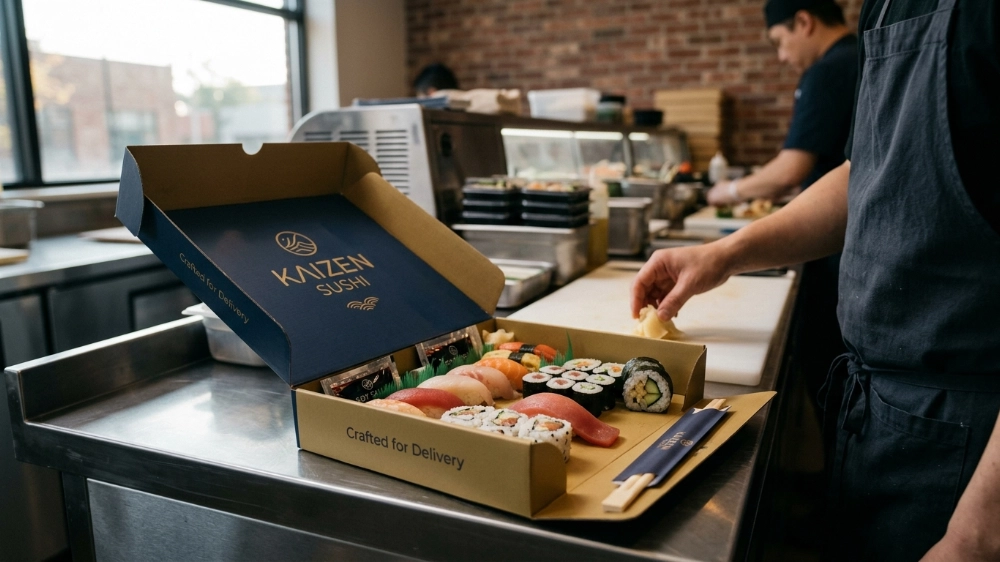
Good sushi packaging must protect more than freshness. It must keep delicate rolls, nigiri, sashimi, garnishes, and condiments stable while the order is carried, stacked, turned, stopped, and sometimes tilted during delivery.
When sushi arrives collapsed, the container is not always the only problem. Failures usually begin with a combination of food preparation, box dimensions, internal moisture, condiment placement, stacking pressure, and delivery movement.
Restaurants can reduce complaints by treating the sushi and its packaging as one delivery system rather than evaluating each part separately.
Why does sushi fall apart during delivery?
Sushi usually falls apart because several small weaknesses occur at the same time. Loose rice, excess moisture, poor box fit, unsecured condiments, and delivery vibration can turn an attractive order into a disorganized one.
A roll may look stable on the preparation counter but behave differently after 30 minutes on a motorcycle or in a delivery vehicle. Acceleration, braking, cornering, vibration, and repeated handling create forces that are not present during dine-in service.
This is why packaging performance should not be judged by appearance alone. The International Safe Transit Association explains that a package and its product should be evaluated together, because protective performance depends on how the contents interact with the container under shock, vibration, and other transport stresses.
Restaurants should separate delivery failures into three categories:
- Structural failure: Rolls separate, nigiri tips over, toppings slide, or food strikes the lid.
- Quality failure: Nori becomes soft, rice becomes wet or dry, and the clear lid becomes foggy.
- Food safety failure: Temperature, handling time, contamination, or raw-ingredient control does not meet the restaurant’s approved procedures.
The third category must not be treated as only a packaging issue. The FDA Food Code provides a model framework for protecting food served in retail and foodservice operations, while research on takeaway sushi meals in Portugal found that hygiene practices and raw-material quality materially affected microbiological results.
Is the problem the sushi or the packaging?
Restaurants should test the food and the container separately before assuming the box is responsible. A controlled comparison can reveal whether the failure begins during preparation, packing, or transport.
Pack the same sushi recipe in two different containers, and pack two different sushi batches in the same container. If both batches fail in one box, the packaging is the likely cause. If one batch fails in every box, examine rice texture, forming consistency, cutting, topping attachment, and the time between preparation and packing.
A useful diagnostic order is:
- Check whether the sushi is stable before packing.
- Check the clearance around and above the food.
- Check whether sauces or garnishes can move.
- Check the box after a realistic delivery route.
- Check temperature, moisture, appearance, and product position at opening.
This process prevents a restaurant from paying for custom packaging when the main problem is an inconsistent preparation process.
What packaging mistakes make sushi move inside the box?
The most common mistake is choosing a container with more usable space than the portion needs. Extra side clearance allows sushi to gain momentum before it hits another piece, a divider, or the wall of the box.
An oversized container may look generous in a product catalog, but empty space becomes a movement zone during delivery. A box that is too shallow creates a different problem: the lid can touch toppings, sauces, fish slices, or decorative garnishes.
Other frequent mistakes include:
- Using the same box for four-piece, eight-piece, and mixed sushi sets.
- Selecting a smooth base with no insert or compartment for delicate arrangements.
- Filling unused space with loose ginger, wasabi packets, or sauce cups.
- Using a lid that flexes downward when boxes are stacked.
- Placing a heavy side dish above a lightweight sushi tray.
- Choosing an outer delivery bag that allows several containers to tilt independently.
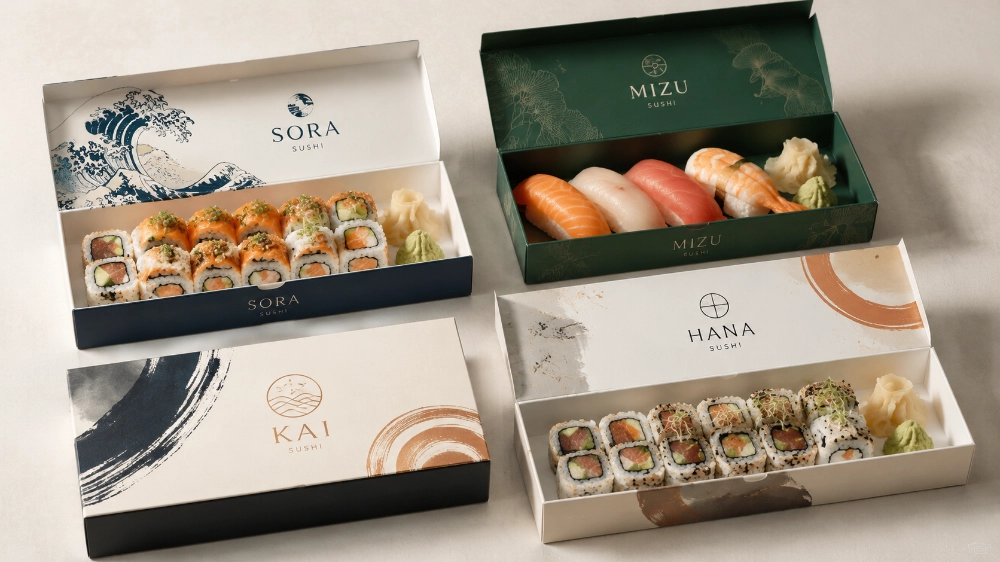
The packaging should hold the order close to its intended layout without compressing it. Properly designed custom sushi boxes can adjust the tray footprint, usable height, divider layout, window position, and closure structure around the restaurant’s actual portions.
How much empty space should a sushi box have?
There is no universal clearance measurement that works for every sushi format. The correct space depends on the size, height, weight, and stability of the pieces being packed.
Restaurants should use a practical movement test rather than guessing a fixed number. Close the loaded box, keep it level, and move it gently from side to side. The pieces should not travel far enough to collide, overlap, or lose their arrangement.
At the same time, the box should not grip the food so tightly that staff damage the rolls while packing them. There must also be enough vertical clearance to stop the lid from marking fish, sauces, roe, or garnishes when another package is placed above it.
A good fit therefore has three characteristics:
- Minimal uncontrolled side movement.
- No direct lid contact with the tallest item.
- Enough access for fast, clean packing during busy service.
How does condensation ruin sushi takeout packaging?
Condensation can soften nori, wet the box base, loosen rice, and reduce product visibility. It commonly develops when warm moisture is trapped inside a closed container and then reaches a cooler lid or surface.
Moisture does not always mean the packaging material is leaking. It may be water released by warm rice, moist fillings, sliced vegetables, chilled fish, or temperature differences inside the pack.
A scientific review of seafood packaging notes that excess moisture can cause condensation on the inner packaging surface and reduce consumer appeal. For sushi, that moisture can also create a slippery base that makes pieces easier to move during braking or cornering. Excess moisture can also affect seaweed texture and customer experience. Restaurants can learn more about why sushi seaweed gets chewy after takeout and how packaging choices influence nori quality.
Restaurants should review the complete packing sequence:
- Is the rice still releasing noticeable heat when the lid is closed?
- Are chilled ingredients being combined with warm components immediately?
- Is freshly washed garnish draining inside the box?
- Is the packaging completely sealed even when moisture needs to escape?
- Is the order moving directly to delivery, or waiting in a warm pickup area?
The answer is not to leave completed raw-fish sushi on the counter until it feels cool. The solution is to use a validated rice-preparation process, control ingredient temperatures, reduce unnecessary surface moisture, close the pack at the correct stage, and maintain the required cold chain.
Should sushi delivery packaging be airtight or vented?
Sushi delivery packaging should be securely closed, but it does not always need to trap every trace of moisture. The correct design depends on the sushi format, delivery time, ingredient temperature, and food safety procedure.
A tightly closed container helps prevent contamination and accidental opening. However, a completely non-breathable design may retain moisture when warm components continue releasing vapor.
Small vents, breathable paper structures, anti-fog lid options, or carefully designed closures may help manage visible condensation. These features must not compromise hygiene, leakage resistance, or lid security. Clear packaging design also plays an important role in maintaining customer perception. Understanding how clear sushi lids improve product presentation can help restaurants balance visibility and protection.
Packaging ventilation is a quality-management feature, not a substitute for temperature control. The Hong Kong Centre for Food Safety advises keeping finished sushi under suitable temperature control and consuming takeaway sushi as soon as possible.
Why do soy sauce, wasabi, and side items cause sushi boxes for delivery to fail?
Condiments create problems when they are treated as harmless fillers. A loose sauce cup, wasabi portion, ginger pile, or chopstick pack can move through the box and push directly against the sushi.
Soy sauce is especially disruptive after leakage. It can spread across the base, stain paper packaging, soften rice, weaken nori, and make the food slide more easily. Proper container structure and condiment placement can reduce these failures. Restaurants should also consider solutions to prevent sushi sauce leakage inside takeout boxes during delivery.
The safest arrangement depends on order volume:
- Place sealed sauce containers in a dedicated compartment.
- Use a separate small pack when the main tray has no secure condiment space.
- Keep wet ginger away from exposed nori.
- Avoid resting sauce cups directly against delicate nigiri.
- Do not place chopsticks or heavy accessories on top of sushi.
- Confirm that every sauce lid remains closed after tilting and vibration.
For larger delivery orders, the outer package also matters. A correctly sized custom paper bag with handles can help keep multiple boxes upright, but it should not be so wide that trays rotate freely inside it.
Should sauces and condiments be packed separately?
Yes, separate packing is usually the more reliable option when the main sushi box has no secure compartments. It limits leakage, reduces contact with rice and nori, and prevents accessories from becoming moving objects inside the tray.
Restaurants do not necessarily need a separate bag for every condiment. A fitted section, sealed cup, sleeve, or small secondary container can work when it remains stable throughout the route.
Before adopting a sauce container, fill it with the restaurant’s actual sauce and test it upside down, on its side, and after repeated movement. A lid that works with a thick sauce may not perform the same way with a thin soy-based liquid.
Clear custom PET cups may suit some side-item or condiment applications, but the closure must be selected and tested for the sauce viscosity, fill level, and delivery conditions.
Can loose sushi rice make even good sushi delivery packaging fail?
Yes, a strong container cannot fully protect sushi that lacks structural stability before packing. Packaging can control movement, but it cannot rebuild loosely formed rice after vibration begins.
Rice may separate when the portion is too wet, too dry, handled inconsistently, or formed with insufficient cohesion. The correct preparation standard should be defined by the restaurant and repeated across shifts rather than left entirely to individual preference.
Rice acidification is also a safety control, not merely a flavor decision. Maricopa County’s acidified sushi rice guidance identifies Bacillus cereus as a concern in cooked rice and describes specific pH and process controls, although restaurants must always follow the regulations and approved procedures in their own jurisdiction.
A Hong Kong government study similarly reported that sushi preparation involves significant manual handling and that raw materials, hygiene, and temperature control can affect microbiological quality. These findings show why restaurants should not confuse a food-handling problem with a box-design problem.
From a structural perspective, the test is simple: a prepared piece should survive normal transfer from the board to the tray without splitting. If it is already unstable before packing, delivery movement will expose that weakness quickly.
Should sushi cool before the box is closed?
Sushi rice should reach the restaurant’s validated working condition before the completed order is sealed. Finished sushi containing raw fish should not be left at room temperature simply to reduce lid fogging.
The correct process is to control rice preparation and cooling before final assembly, then keep the completed sushi within the applicable time and temperature rules. Once raw salmon or another time-and-temperature-controlled ingredient is added, the complete item must be managed accordingly.
Restaurants should document:
- The target condition of rice before shaping.
- The maximum preparation and holding time.
- The required storage and dispatch temperature.
- The point at which the package is closed.
- The action staff must take if an order waits too long.
The FDA Food Code is intended as a model for food safety practices in retail and foodservice establishments, but local requirements and approved HACCP procedures should determine the restaurant’s final operating limits.
What is the best sushi takeout packaging for different sushi formats?
There is no single best sushi box for every menu. Maki, nigiri, sashimi, hand rolls, specialty presentations, and large platters have different movement, moisture, height, and separation risks.
A low rectangular tray may work for compact maki but fail with tall rolls covered in sauce or roe. Nigiri needs enough horizontal support to prevent tipping, while sashimi arrangements often need separation from wet garnish and loose condiments.
Specialty products may need a completely different eating format. For example, a disposable sushi push pop container is intended for compact, vertically presented portions rather than a conventional mixed sushi platter.

Do maki, nigiri, and sashimi need different sushi boxes for delivery?
Yes, different formats should at least be tested separately, even when the restaurant hopes to use one packaging family. Their shapes and failure points are not the same.
| Sushi format | Main delivery risk | Recommended packaging feature | Common mistake to avoid | Best use case |
|---|---|---|---|---|
| Maki rolls | Pieces slide and separate | Close-fitting base or shallow insert | Using a tray much larger than the roll count | Standard delivery sets |
| Inside-out rolls | Rice and toppings stick to the lid | Adequate vertical clearance | Choosing a lid based only on tray width | Sauced or garnished rolls |
| Nigiri | Fish shifts and rice bases tip | Individual positioning or narrow spacing | Leaving large open areas around each piece | Premium mixed sets |
| Sashimi | Moisture and garnish migration | Separate sections and a stable base | Packing wet garnish against fish | Chilled premium orders |
| Hand rolls | Nori softens and shape collapses | Individual support or separate wrapping | Packing tightly beside wet items | Short delivery routes |
| Party platters | Center pieces shift during turns | Rigid base, secure lid, and internal layout control | Using a flexible tray under a heavy order | Catering and group orders |
| Specialty sushi portions | Unusual shapes move or deform | Product-specific structure | Forcing the item into a standard flat tray | Events and modern concepts |
A restaurant trying to reduce stock complexity can standardize materials, colors, and branding while still using two or three carefully chosen sizes. Standardization should reduce operational burden without forcing incompatible sushi formats into the same internal space.
How should restaurants test sushi boxes for delivery before ordering in bulk?
Restaurants should test packaging under real delivery conditions, not only on a preparation counter. A basic route test can expose sliding, lid contact, condensation, sauce leakage, stacking damage, and difficult handling before a bulk order is placed.
The test does not need to reproduce a laboratory certification procedure. However, restaurants can borrow the principle that transport testing should evaluate the product and package together and define acceptable damage before testing begins.
Use the actual menu, actual portion sizes, actual condiments, and the expected outer delivery bag. A sample tested empty or with substitute weights cannot show how rice, fish, sauces, and garnish interact.
A practical restaurant test should include:
- Photograph the completed order before closing the box.
- Prepare at least two or three identical samples.
- Stack the boxes in the normal delivery configuration.
- Follow a typical 20–40 minute route with turns, stops, and uneven surfaces.
- Include a reasonable waiting period before departure.
- Open each package immediately after the route.
- Photograph and score the final condition.
- Repeat the test with the worst-selling and best-selling mixed sets.
ISTA guidance also emphasizes defining damage tolerance, documenting the packaging configuration, and using photographs. These principles are useful even when the restaurant performs only an internal screening test.
What should a simple sushi delivery test include?
A simple test should measure results rather than rely on “looks okay.” Give every package a score for movement, lid contact, moisture, leakage, and final appearance.
A basic scoring method can use:
- 0: No visible failure.
- 1: Minor change that most customers would accept.
- 2: Clear quality loss or unattractive presentation.
- 3: Product damage, leakage, opening, or safety concern.
Set the acceptance rule before the test. For example, a box may fail automatically if sauce leaks, the lid opens, raw fish contacts an unintended surface, or the arrangement no longer resembles the menu presentation.
Also test staff handling. A technically strong box may still be unsuitable if it takes too long to assemble, closes inconsistently, occupies excessive storage space, or is difficult to identify during a busy delivery shift.
How can custom sushi boxes reduce delivery complaints?
Custom sushi boxes can reduce complaints when customization solves a measured operational problem. Changing dimensions, height, compartments, closure strength, coating, or stacking structure is useful only when the change addresses a real failure observed during packing or delivery.
Customization may help restaurants:
- Match box dimensions to actual portion layouts.
- Keep condiments away from sushi.
- Increase clearance above decorated rolls.
- Add inserts for nigiri or mixed sets.
- Improve resistance to sauce, oil, and surface moisture.
- Strengthen the lid and base for stacking.
- Standardize the visual presentation across locations.
- Reduce the number of loose accessories inside the pack.
Brand printing should come after structural performance. A visually attractive box that allows rolls to slide will not protect customer perception.
Before mass production, restaurants should request unprinted or digitally printed samples and run the same delivery test used for existing packaging. Once the structure passes, branding, color matching, windows, sleeves, and finishing details can be finalized.
What should restaurants ask a sushi packaging manufacturer before placing an order?
Restaurants should begin with operational questions rather than asking only for price, material, and minimum order quantity. A reliable sushi packaging manufacturer should understand the menu, delivery process, and most common packaging failures before recommending a structure.
Restaurants should ask:
- Which internal dimensions are usable after the box is assembled?
- How much vertical clearance remains under the lid?
- Can the structure include dividers or fitted inserts?
- Is the base resistant to sauce, oil, and moisture?
- How does the lid perform when several loaded boxes are stacked?
- Can the same design support multiple portion counts?
- Are food-contact declarations and test reports available?
- Can samples be tested before final production?
- What dimensional tolerances apply during manufacturing?
- Will material or structural changes require another test?
Provide the manufacturer with the product weight, tallest item, portion layout, expected delivery time, stacking method, condiment arrangement, and photographs of previous failures. Better input produces a more useful packaging recommendation.

Conclusion
Sushi rarely falls apart because of one isolated mistake. Restaurants achieve more reliable delivery by controlling food preparation, temperature, moisture, box fit, condiment placement, outer carrying packaging, and route testing as one connected system.
The right sushi packaging should be selected from evidence gathered under real service conditions, not only from a catalog photograph or an empty sample. When the container fits the menu and the packing process is consistent, restaurants can reduce product movement without crushing the food or slowing down operations.
MaiBao works as a professional foodservice packaging supplier and long-term packaging partner, helping restaurants connect material, structure, branding, and supply planning with their actual operating conditions. The focus is not simply on supplying a box, but on supporting a packaging system that remains practical during preparation, stable during delivery, and consistent as the business grows.
Frequently Asked Questions
Why does sushi get soggy during delivery?
Sushi gets soggy during delivery when excess moisture becomes trapped inside the packaging. Warm rice, wet garnish, sauces, chilled ingredients, and temperature changes can create condensation that softens nori, wets the box base, and reduces rice stability. Restaurants should control ingredient moisture before packing, avoid closing boxes while rice is releasing excess heat, keep sauces and wet garnish separate, select sushi takeout packaging with suitable moisture resistance or ventilation, and test complete orders under the same delivery time and temperature conditions customers experience.
What is the best sushi box for delivery?
A good sushi box for delivery is a close-fitting, food-safe container that limits side movement and provides enough height above the toppings. The best choice depends on whether the restaurant is packing maki, nigiri, sashimi, hand rolls, or mixed platters. Operators should compare internal dimensions rather than only external box size, load the container with actual menu portions, include the normal condiments, check stacking performance, and complete a real delivery test before purchasing sushi boxes for delivery in bulk.
Should sushi sauce be packed separately?
Yes, sushi sauce should usually be packed separately unless the main container has a fitted compartment that keeps the sealed cup stable. Separate sauce packaging reduces leakage, rice softening, nori damage, flavor transfer, and the risk of loose cups pushing against delicate sushi. Restaurants should test every closure with the actual sauce and fill level, then place it in a secure compartment, secondary container, or upright section of the outer delivery bag used for home, office, or catering orders.
How can restaurants test sushi delivery packaging?
A restaurant can test sushi delivery packaging by loading several samples with real menu items and carrying them through a typical delivery route. Photograph the starting arrangement, stack the boxes normally, and include stops, turns, waiting time, and uneven movement over 20–40 minutes. After the route, score product movement, lid contact, condensation, leakage, closure security, box deformation, and presentation. Reject any design with a critical failure, and repeat the test whenever the portion layout, material, supplier, or delivery conditions change.