Skip to content
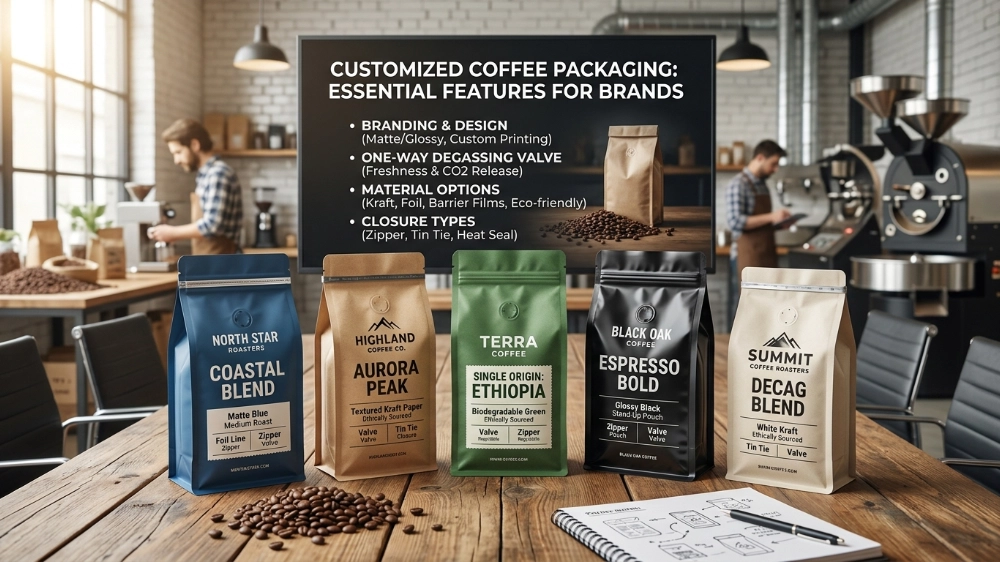
Choosing the right custom coffee bags for different coffee products requires more than selecting an attractive bag shape. Coffee brands must match the valve, material structure, closure, size, printing method, and filling process to the coffee’s roast profile, packing schedule, sales channel, and expected shelf life.
The best coffee bag features are not necessarily the most expensive ones. They are the features that protect the coffee before opening, remain practical after opening, work with the brand’s production process, and support accurate environmental claims.
Do Coffee Bags Need a One-Way Degassing Valve?
Most freshly roasted whole-bean coffee bags need a one-way degassing valve when the coffee is packed before most carbon dioxide has escaped. The final decision depends on roast profile, grind size, resting time, bag volume, and distribution period.
Roasted coffee continues releasing carbon dioxide after it leaves the roaster. A time-resolved study of whole-bean and ground coffee degassing confirms that gas release continues over time and varies according to the physical state of the coffee.
When fresh coffee is sealed in a bag without enough internal space or a controlled release route, pressure can build inside the package. A properly specified one-way valve allows carbon dioxide to escape while limiting the uncontrolled exchange of outside air through the valve opening.
However, a valve is not a complete freshness system. It cannot compensate for weak barrier material, an incomplete heat seal, poor storage conditions, or an unsuitable bag size. The Specialty Coffee Association’s review of roasted coffee staling explains that exposure to oxygen can accelerate the loss of volatile aroma compounds after roasting.
A valve may be unnecessary when coffee has been sufficiently degassed before packaging, when the product follows a different controlled-atmosphere process, or when a brand has validated a short local selling period. These cases should be confirmed through packing trials rather than assumed from general rules.
How Does Roast Level Affect the Valve a Coffee Bag Needs?
Darker roasts generally release carbon dioxide faster than lighter roasts, but roast color alone cannot determine the correct valve specification. Packing time, roast profile, grind size, bag volume, and storage conditions must also be evaluated.
Research on the effect of roasting conditions on carbon dioxide degassing found that the rate of carbon dioxide release increased with the degree of roast. The study also found that different time-temperature roasting profiles produced different degassing behavior, even when the coffees reached the same degree of roast.
This means two visually similar coffees may not create identical pressure inside a sealed bag. Brands should therefore avoid selecting a valve based only on labels such as light, medium, or dark roast.
Grind size also matters. Grinding increases the exposed surface area and changes how quickly retained gas can leave the coffee. The gravimetric degassing research involving whole beans and ground coffee shows why a bag specification developed for whole beans should not automatically be copied for ground coffee.
Before ordering, a coffee brand should tell its coffee bag manufacturer:
- Whether the product is whole bean or ground coffee
- The approximate roast level and roast profile
- How many hours or days pass between roasting and packing
- The weight and approximate volume packed in each bag
- The intended shelf life and distribution distance
- Whether nitrogen flushing or another packing process is used
These details allow the manufacturer to assess valve placement, bag headspace, material structure, and sealing requirements together.
Which Coffee Bag Material Keeps Coffee Fresh the Longest?
The best coffee bag material is the structure that provides sufficient oxygen, moisture, and light protection for the intended shelf life. Terms such as kraft, foil, or plastic do not describe the complete performance of a coffee bag.
Coffee freshness is affected by several interacting factors. The SCA literature review on roasted coffee shelf life identifies oxygen exposure as an important contributor to aroma degradation and also discusses the influence of moisture, temperature, and storage conditions.
For this reason, buyers should evaluate the complete material structure rather than judge a bag by its visible exterior. A kraft paper surface may be laminated to one or more barrier layers. A metallic-looking pouch may use foil, metallized film, or another structure with different performance and disposal implications.
Useful specifications include:
- Complete material composition
- Total thickness
- Oxygen transmission performance
- Water-vapor transmission performance
- Light-barrier requirements
- Seal strength
- Puncture and drop resistance
- Compatibility with the valve and zipper
- Suitability for the filling temperature and machinery
A local roaster selling coffee within a short period may not require the same barrier level as a brand shipping through e-commerce fulfillment centers or holding inventory for several months. The material should therefore be matched to a defined shelf-life target instead of automatically choosing the highest possible barrier.
Brands comparing paper-based presentation with flexible pouch structures can also review the practical differences between paper coffee bags and flexible coffee pouches.
For customized retail presentation, branded coffee bags can combine printed graphics with the required valve, closure, and barrier layers. The visual design should be finalized only after the functional material structure has been confirmed.
Are Kraft, Foil, Mylar, and Recyclable Coffee Bags Really Different?
Yes, these coffee bag options differ in construction, barrier performance, appearance, disposal route, and compatibility with valves and closures. A kraft exterior does not automatically make a bag paper-only, while recyclability must be evaluated across the complete package.
Kraft coffee bags are commonly selected for their natural paper appearance. However, the visible kraft layer may require an internal coating or laminated film to protect coffee from moisture, oxygen, grease, and aroma loss.
Foil-based structures can provide strong protection against oxygen, moisture, and light. Their multilayer construction may also make them difficult to process through conventional recycling systems, especially when the layers cannot be efficiently separated.
“Mylar” is also not a complete purchasing specification. Buyers should request the actual layer composition, thickness, barrier performance, and sealant material rather than relying on a broad commercial description.
Recyclable coffee bags usually require more careful structural design. The CEFLEX Designing for a Circular Economy guidelines emphasize that flexible packaging should be considered in relation to collection, sorting, and recycling processes. CEFLEX also recommends mono-PE or mono-PP structures where appropriate, while recognizing that product protection remains a core packaging function.
A recyclable base film does not necessarily make every finished bag recyclable. The following components may affect the final result:
- Degassing valves
- Zippers and other closures
- Labels
- Inks and coatings
- Adhesives
- Metallized layers
- Non-compatible laminated materials
Coffee brands should therefore evaluate whether the complete coffee bag can be recycled, not only whether one layer is technically recyclable.
Recyclable, biodegradable, and compostable are also different claims. Brands considering alternative materials should first understand the conditions that separate biodegradable and compostable coffee bags, including certification, collection infrastructure, and intended disposal routes.

Is a Zipper, Tin Tie, or Heat Seal Best for Coffee Bags?
A heat seal protects the unopened product, while a zipper or tin tie helps the customer reclose the bag after opening. The best combination depends on the coffee format, bag construction, expected consumption period, and filling equipment.
A heat seal and a reclosure feature perform different jobs. The heat seal creates the initial sealed barrier and can provide visible evidence that the bag has not been opened. A zipper or tin tie is mainly intended for use after the customer breaks the original seal.
A zipper is practical for retail bags that will be opened repeatedly at home, in an office, or behind a café counter. It can offer a more consistent reclosure than simply folding the top of the bag, but coffee particles should be kept away from the zipper track to help it close correctly.
A tin tie offers a simple roll-down closure and a familiar artisan bakery or roastery appearance. It may suit locally sold coffee that customers consume quickly, but it should not automatically be treated as equal to a high-performance airtight closure.
Research on coffee freshness after packages were opened compared an integrated screw-cap package with tape, a clip, and transfer to a separate container. The screw-cap package performed best in that study, demonstrating that the quality of the post-opening closure can affect oxygen, carbon dioxide, and aroma changes.
The study did not directly compare coffee-bag zippers with tin ties. Brands should therefore avoid using it as proof that one conventional closure is always superior. Instead, it supports a broader conclusion: secondary shelf life begins after opening, and the reclosure method should be selected according to how customers actually use the coffee.
For larger wholesale coffee bags, a strong heat seal may be more important than a consumer-style zipper. The bag may also require a separate reusable closure after it reaches a café, restaurant, office pantry, or foodservice distributor.
How Should Coffee Bag Features Change by Bag Size and Sales Channel?
Coffee bag features should change with package volume, distribution distance, retail environment, and reopening frequency. A small retail pouch sold locally should not automatically use the same structure as a large wholesale bag shipped to cafés.
Small retail bags are often opened several times by consumers, making a convenient reclosure valuable. Larger wholesale bags may experience heavier handling and require stronger seals, puncture resistance, reinforced gussets, and better control of the bag’s filled shape.
Sales channel also changes the packaging risk:
- Local café retail: Shorter distribution routes may reduce the required storage period, but the bag still needs to control oxygen and moisture.
- E-commerce: Bags must withstand fulfillment handling, parcel compression, temperature changes, and a less predictable delivery period.
- Supermarkets: Shelf stability, upright presentation, barcode placement, print consistency, and longer inventory cycles become more important.
- Wholesale supply: Larger bags need sufficient strength for repeated handling in cafés, offices, restaurants, and distribution warehouses.
- Subscription coffee: Frequent shipping and multiple roast profiles may require flexible digital printing and consistent valve placement.
Bag format should also match the channel. Stand-up pouch coffee bags provide a compact retail format, while flat-bottom coffee bags provide a broader base and additional printable panels for shelf presentation.
| Coffee Use Case | Typical Bag Format | Valve | Barrier Requirement | Closure | Main Consideration |
|---|---|---|---|---|---|
| Local café retail | 250–500 g stand-up pouch | Usually required for freshly packed coffee | Medium to high | Heat seal and zipper | Repeated opening at home or office |
| E-commerce coffee | 250–500 g flat-bottom bag | Usually required | High | Heat seal and zipper | Shipping time and parcel handling |
| Supermarket retail | Flat-bottom or quad-seal bag | Usually required | High | Heat seal and reclosure | Shelf life and presentation |
| Coffee subscription | Stand-up or flat-bottom pouch | Based on packing schedule | Medium to high | Heat seal and zipper | Frequent SKU and design changes |
| Wholesale café supply | 1–5 lb side-gusset bag | Depends on degassing time | High | Strong heat seal or suitable reclosure | Weight, handling, and storage |
| Fully degassed coffee | Channel-specific format | Case-specific | Based on shelf-life target | Channel-specific | Lower internal gas pressure |
These recommendations are starting points rather than fixed specifications. The rate of coffee degassing varies with roast conditions, so the final bag should be validated with the actual coffee, filling weight, sealing process, and storage conditions.
Which Features Matter Most on Custom Printed Coffee Bags?
The most important custom features are those that protect the coffee and support filling, sealing, transport, display, and customer use. Printing should not interfere with valve operation, seal integrity, recyclability, or required barrier performance.
The functional structure should be approved before the artwork is finalized. Otherwise, the graphic design may place important text, logos, windows, or barcodes inside areas required for sealing, valves, gussets, zippers, or tear notches.
A custom coffee bag layout should identify:
- Top and bottom seal areas
- Zipper position
- Tear-notch position
- Degassing-valve position
- Front, back, and side-gusset panels
- Barcode and regulatory information
- Date-code area
- Transparent window, when used
- Artwork bleed and safe zones
- Direction of machine filling
Valve position deserves particular attention. It should remain accessible to the coffee inside the bag without creating avoidable conflicts with the zipper, artwork, or top seal. The exact position should be confirmed against the bag size, filling level, and manufacturing tolerances.
Printing method should be selected according to order quantity and SKU requirements. Digital printing can be practical for smaller runs, seasonal products, and multiple designs, while gravure or flexographic printing may be more economical for stable, higher-volume programs.
The surface finish also affects both appearance and production. Matte, gloss, paper-touch, metallic, and spot-finish effects should be tested with the chosen inks, laminate, sealing temperature, and handling process.
From a circular-design perspective, decoration cannot be evaluated separately from the package. The CEFLEX design principles for flexible packaging explain that materials and packaging elements must work together to deliver the required functionality while remaining compatible with the intended end-of-life system.
Before mass production, brands should approve both appearance and performance. Recommended checks include:
- Printed-color comparison
- Barcode scanning
- Seal testing
- Filled-bag drop testing
- Valve-position inspection
- Zipper opening and closing
- Rub and scratch resistance
- Storage testing with the actual coffee
What Should Coffee Brands Ask a Coffee Bag Manufacturer Before Ordering?
Coffee brands should provide details about the coffee, packing process, shelf-life target, bag size, distribution channel, printing, and disposal goals. A useful quotation should define the complete material structure and every functional component, not only the dimensions.
Start by giving the coffee bag manufacturer a clear product and operating brief:
- Is the coffee whole bean or ground?
- What is the roast level and roast profile?
- How soon after roasting will it be packed?
- How much coffee will each bag contain?
- What bag format and finished dimensions are required?
- Where will the coffee be sold?
- How long must it remain unopened?
- How quickly will customers use it after opening?
- Is the bag filled manually or by machine?
- Is nitrogen flushing used?
- Is a valve, zipper, tin tie, or tear notch required?
- What food-contact market will receive the product?
- Is recyclability or compostability part of the packaging claim?
- How many printed designs or SKUs are needed?
- What is the expected annual order volume?
The quotation should state the bag format, material layers, thickness, valve type, closure, printing method, surface finish, quantity tolerance, packing method, sample process, production lead time, and applicable food-contact documents.
Brands should also request samples for filling and storage trials. Coffee is affected by the roast, grind, packaging time, and consumer behavior, so a specification that works for one product may not deliver the same result for another.

Conclusion
The right coffee bag is a coordinated system rather than a collection of optional add-ons. Coffee brands should first define the product, packing schedule, distribution channel, shelf-life target, and customer usage, and then choose the valve, material, closure, bag format, and printing method that support those conditions.
When evaluating custom printed coffee bag solutions, buyers should ask for the complete material structure and test the finished bag with the actual coffee before committing to mass production.
As a professional foodservice packaging supplier, MaiBao works with coffee, restaurant, and takeaway businesses to coordinate packaging structure, printing, sampling, and supply requirements. We see packaging development as a long-term partnership, helping buyers balance product protection, daily operations, brand presentation, and responsible material choices.
Frequently Asked Questions
Do all coffee bags need a valve?
No, not all coffee bags need a valve. Freshly roasted coffee packed soon after roasting commonly requires a one-way degassing valve because retained carbon dioxide continues leaving the beans. Fully degassed coffee or products using a validated alternative packing process may not need one. Brands should test the actual roast level, grind size, filling weight, packing time, bag dimensions, and storage period before removing the valve from custom coffee bags.
Does a zipper keep coffee fresh?
Yes, a zipper can help protect coffee after opening, but it does not replace the original heat seal or the bag’s barrier material. A zipper is most useful when customers repeatedly open printed coffee bags at home, in an office, or behind a café counter. Keep coffee particles out of the zipper track, close it completely after each use, and store the bag away from heat, moisture, oxygen exposure, and direct sunlight.
Are kraft coffee bags recyclable?
Not always, because a kraft appearance does not mean the entire coffee bag is made from recyclable paper. Many kraft coffee bags include plastic films, foil, adhesives, valves, zippers, coatings, or inks that affect collection and recycling. Buyers should request the complete material structure, confirm whether every component is compatible with the intended recycling stream, and check the actual recycling infrastructure in the market where the wholesale coffee bags will be discarded.
What information does a coffee bag manufacturer need?
A coffee bag manufacturer needs the coffee type, roast level, packing time, filling weight, target shelf life, sales channel, bag size, valve, closure, printing, and material requirements. Brands should also explain whether the product is packed manually or automatically, whether nitrogen flushing is used, which food-contact market will receive it, and whether recyclable or compostable claims are planned. A complete purchasing brief reduces unsuitable samples, design changes, and production delays.