Skip to content
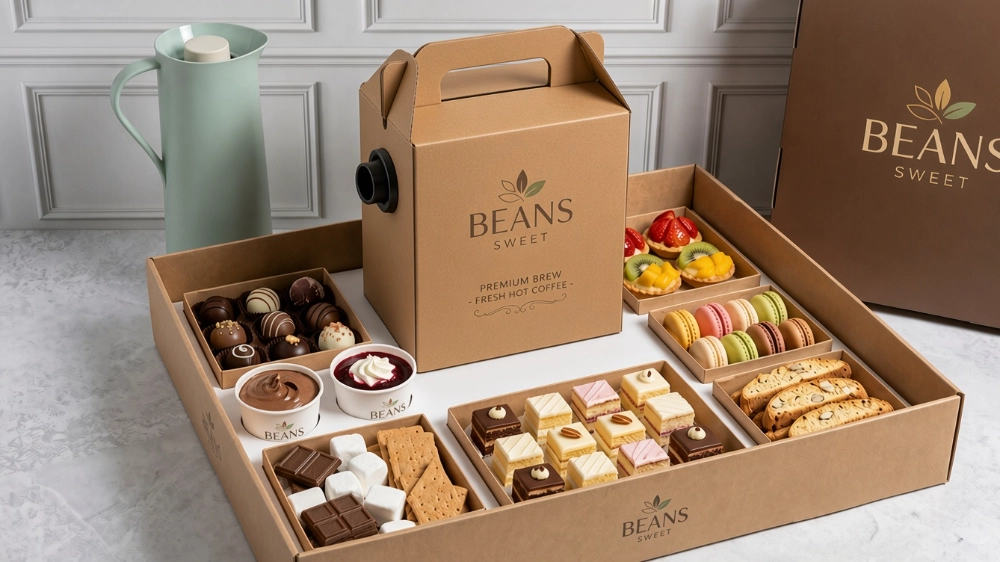
For coffee shops and bakeries moving beyond single-drink and single-pastry orders, custom bakery packaging solutions increasingly need to support group service, transport, presentation, and serving in one system. One format attracting attention is the dessert and coffee combo catering box: a transport-ready set that can combine bulk coffee, pastries or sweets, cups, and serving accessories instead of treating every item as a separate takeaway package.
A typical catering set may use a bag-in-box beverage section, where coffee is held in an inner beverage bag and dispensed through a tap, together with separate compartments or drawers for cakes, pastries, cookies, chocolates, or other desserts. Depending on the menu, the outer structure can also accommodate cups, lids, napkins, stirrers, sugar, or other service items.
This does not mean combo catering boxes are replacing standard bakery boxes. Their value appears when a café, bakery, or catering business regularly needs to move several products together for office meetings, afternoon tea, events, parties, corporate orders, or other group occasions.
Importantly, there is not yet a strong public dataset measuring adoption of dessert-and-coffee combo catering boxes as a standalone packaging category. What can be measured is the broader shift toward off-premises ordering, bundled products, specialty coffee consumption, workplace food, and packaging that protects product quality during transport—and those trends help explain why this format is becoming relevant.

What Is a Dessert and Coffee Combo Catering Box?
A dessert and coffee combo catering box is an integrated takeaway system designed to organize beverages and bakery products in one coordinated package. Depending on the structure, it may contain a coffee dispenser, dessert trays or drawers, dividers, cups, and serving accessories.
Unlike a standard pastry carton, the packaging is developed around the complete catering order rather than one food item. The beverage section may use a flexible bag held inside a rigid outer structure, while pastries remain physically separated in dedicated compartments.
For businesses unfamiliar with the format, custom catering takeaway boxes for desserts and coffee provide a useful example of how dessert compartments, beverage areas, food-grade paper structures, liners, and customized layouts can be combined into one catering set.
The exact configuration should follow the menu. A bakery serving croissants and drip coffee will need a different internal layout from a dessert brand combining cream cakes, cookies, coffee cups, napkins, and condiment packs.
Why Are Coffee Shops and Bakeries Paying More Attention to Catering Orders?
Catering allows coffee shops and bakeries to serve occasions that go beyond individual counter transactions. Offices, training sessions, meetings, celebrations, and group coffee breaks can create orders where several drinks and bakery products need to arrive together.
The broader off-premises market already supports this direction. The National Restaurant Association's 2025 Off-Premises Restaurant Trends report found that 47% of U.S. adults pick up takeout from restaurants, coffee shops, snack places, or delis at least once a week, while consumers also show interest in expanded options such as snack items and meal bundles.
Coffee itself also remains highly relevant to foodservice. The National Coffee Association reported that 46% of American adults consumed specialty coffee in the past day in 2025, and 35% of past-day specialty coffee drinkers had their coffee prepared out of home, compared with 20% of traditional coffee drinkers.
Those figures do not prove that combo catering boxes themselves are growing at a particular rate. They do show why coffee shops and bakeries have reason to consider packaging formats designed for larger, bundled, off-premises orders.
Why Do Coffee and Desserts Work Well as One Catering Set?
Coffee and desserts naturally share many group-serving occasions, from business meetings to afternoon tea and social events. Packaging them as one coordinated set can make the order easier to identify, carry, set up, and serve.
A traditional group order might require one coffee dispenser, one or more pastry boxes, cups, lids, napkins, sugar packets, stirrers, and an additional carrier or bag. When those components are routinely purchased together, organizing at least some of them into one structure can reduce fragmentation.
This matters particularly in workplace environments. The ezCater 2025 Lunch Report found that 94% of surveyed employees said taking a lunch break improves their performance, even though many employees still skip lunch during the workweek. The report is not specifically about coffee catering, but it reinforces the continuing operational role of convenient workplace food occasions.
The same logic applies to meetings and short refreshment breaks where a full meal may not be required. Coffee, pastries, cookies, cakes, and other small desserts can form a self-contained group serving format without requiring individual meal packaging.
What Occasions Are Dessert and Coffee Catering Boxes Used For?
Dessert and coffee catering boxes are best suited to occasions where several people share refreshments from one order. Common applications can include office meetings, training sessions, afternoon tea, corporate events, hotel hospitality, parties, showroom events, and group coffee breaks.
The menu should determine the packaging rather than the occasion label alone. A 10-person meeting ordering coffee and cookies needs a much simpler structure than a premium afternoon-tea set containing pastries, cakes, chocolates, cups, and serving accessories.
This distinction matters for procurement because “catering box” can describe very different products. Buyers should specify guest count, food dimensions, beverage volume, service sequence, and delivery conditions before discussing structural design.
What Problems Can Combo Catering Boxes Solve?
Combo catering boxes primarily solve organization and transport problems created when one catering order contains several different components. Their value comes from packaging architecture, not simply from putting a larger box around smaller packages.
The strongest use cases occur when the same products are repeatedly ordered together. If every catering order is completely different, separate stock packaging may provide more flexibility.
Can One Catering Box Replace Several Separate Packages?
One coordinated catering set can sometimes consolidate several packaging components, but it will not eliminate every separate container in every order. The result depends on food-contact needs, menu size, beverage volume, accessories, and the final structural design.
A conventional order might involve:
- one bulk coffee carrier;
- one pastry or dessert box;
- a separate cup or lid sleeve;
- a bag for napkins and condiments;
- an additional carrier for moving everything together.
That does not mean every integrated package automatically costs less. Packaging cost needs to be evaluated together with assembly time, inserts, printing, storage, packing complexity, transport performance, and order volume.
How Can Catering Packaging Make Group Orders Easier to Carry?
A well-designed catering box can reduce the number of loose packages that staff or customers need to handle. Carrying performance, however, depends on total weight, handle strength, dimensions, center of gravity, and internal placement.
Coffee is heavy. That means a box designed primarily around appearance can perform poorly once several liters of liquid, desserts, cups, and accessories are placed inside.
Structural design therefore needs to consider where the beverage weight sits relative to the handle and how the dessert section is supported. Reinforced paperboard, corrugated structures, partitions, or different board thicknesses may be required depending on the final load.
Packaging science supports the broader principle that transport performance depends on structure and dimensions. The Institute of Food Technologists notes that packaging is important for limiting physical abuse during distribution and that package-size optimization can improve delivery efficiency.
How Do Compartments Help Protect Pastries During Delivery?
Compartments help control where desserts sit inside a catering package and reduce unnecessary contact between products. Their purpose is product restraint and load organization, not decoration.
Delicate bakery products can be especially sensitive to movement. Frosted cakes, pastries with toppings, chocolates, dessert cups, and decorated sweets may lose presentation quality even when the outer carton itself remains undamaged.
The Institute of Food Technologists identifies prevention of physical damage during distribution as a core packaging function. In practical bakery packaging, this means inserts and partitions should be developed around actual product dimensions rather than added as generic dividers.
A compartment that is too large still allows movement. One that is too tight can damage toppings or make removal difficult, so prototype testing with real products is important.
How Do Bag-in-Box Coffee Catering Systems Work?
In a bag-in-box coffee system, the beverage is held inside a flexible food-contact bag while the outer box supplies structure, handling support, and printable surface area. A fitted dispensing tap allows customers to serve the drink without opening the entire package.
This separation of functions is useful because the outer paper structure does not necessarily need to perform the same role as the primary beverage-contact layer. Instead, the inner bag handles direct liquid containment while the outer structure supports transport and presentation.
When this beverage section is incorporated into a dessert catering set, designers must also consider heat, moisture, total beverage weight, tap access, and how close the beverage section sits to pastries.
The design should allow the coffee to be dispensed without requiring customers to remove or disturb the dessert section every time a cup is filled.
What Is the Inner Bag in a Coffee Catering Box For?
The inner bag acts as the primary beverage container, while the outer box supports carrying, dispensing, and branding. Its material specification must match the beverage, filling method, temperature, storage period, and intended conditions of use.
This is why “food-grade” should not be treated as a generic claim covering every possible application. In the United States, the FDA explains that food-contact substances used in packaging must comply with the authorization applicable to their specified intended use.
The FDA also evaluates food-contact uses based on factors including migration and consumer exposure. For buyers, the practical lesson is straightforward: ask suppliers about the actual beverage-contact component and the conditions for which it is intended rather than approving a system solely because the outer box is paper.
How Long Should a Coffee Catering Box Keep Coffee Hot?
There is no universal heat-retention time that applies to every coffee catering box. Performance depends on beverage volume, starting temperature, bag construction, insulation, ambient conditions, opening frequency, box design, and the temperature considered acceptable for serving.
Claims such as “keeps coffee hot for three hours” are only meaningful when the test conditions are known. A large filled container in a warm indoor room will not lose heat at the same rate as a partly filled container carried outdoors in winter.
Coffee shops comparing suppliers should therefore ask for test conditions alongside the headline result. Useful information includes:
- starting beverage temperature;
- beverage volume;
- ambient temperature;
- measurement intervals;
- box and liner construction;
- frequency of dispensing;
- final measured temperature.
The same rule applies when businesses conduct their own trials. Test a fully filled catering system under the delivery conditions customers are likely to experience rather than judging thermal performance from an empty sample.
Are Combo Catering Boxes Better Than Separate Coffee and Dessert Packaging?
Not always. Combo catering boxes work best when coffee, desserts, and service items are repeatedly ordered together, while separate packaging remains more flexible for small orders, changing menus, and single-item purchases.
The correct decision is therefore operational rather than stylistic. Buyers should compare how the order is packed, carried, delivered, opened, served, stored, and reordered.
When Should You Use a Combo Catering Box Instead of Separate Packaging?
| Decision Factor | Combo Catering Box | Separate Packaging |
|---|---|---|
| Coffee and desserts regularly sold together | Strong fit | Works, but requires multiple packs |
| Office or group catering | Strong fit | More units to organize |
| Individual coffee or pastry order | Usually unnecessary | Better fit |
| Menu changes frequently | Requires flexible structure | Easier to adapt |
| Carrying | Can consolidate several components | Several units may be required |
| Product separation | Built-in compartments possible | Products remain in separate packs |
| Brand presentation | Coordinated format | Branding spread across several packs |
| Structural development | Requires more planning | Simpler standard formats |
| Low-volume trial catering | May be premature | Stock packaging is often practical |
| Repeat standardized catering menu | Stronger justification | More packaging SKUs may remain necessary |
This is also where off-premises quality matters. According to the National Restaurant Association, 90% of surveyed off-premises customers said they would likely order a greater variety of items if upgraded packaging helped maintain food closer to its dine-in temperature, taste, and quality, while more than half said they would pay extra for packaging that supported food quality during transport.
That finding does not mean premium catering boxes automatically produce higher sales. It does show that packaging performance is something consumers notice when food leaves the premises.

What Should Coffee Shops and Bakeries Look for in a Catering Box?
Buyers should start with the real menu, packing process, and delivery conditions rather than selecting a catering box only by dimensions or appearance. Coffee volume, dessert dimensions, weight, moisture, cups, accessories, serving sequence, and delivery distance all influence the specification.
A good supplier conversation therefore begins with the products being packed. Structural design should follow the order rather than forcing an existing menu into a standard compartment layout.
How Should You Choose the Right Catering Box Size?
Choose catering box dimensions after laying out every item that needs to travel inside the order. The required space depends on both product dimensions and the clearance needed for protection, removal, and structural support.
Useful inputs include:
- coffee capacity;
- number and dimensions of desserts;
- cup quantity and size;
- lids and sleeves;
- napkins and cutlery;
- sugar, creamers, or stirrers;
- total packed weight;
- delivery distance;
- carrying method;
- whether products are served immediately or stored first.
This type of custom bakery packaging makes the most sense when the catering menu is sufficiently standardized to justify structural development.
What Materials Should Dessert Catering Boxes Use?
There is no single best material for every dessert catering box. Material selection should follow the food, moisture level, grease content, temperature, total load, delivery conditions, and local regulatory requirements.
Dry cookies may require relatively little barrier protection. Cream pastries, desserts with sauces, chilled foods, and greasy bakery products can place very different demands on paperboard and liners.
The outer transport box and the direct food-contact packaging also do not need to perform identical functions. A corrugated exterior can provide structural strength while inserts, trays, wraps, or liners provide the appropriate surface for food contact.
This is another reason to evaluate the package as a system. The Institute of Food Technologists cautions that packaging decisions should consider the combined impact of the product, process, and package, because reducing packaging without considering product protection can create other losses.
Are All Paper Catering Boxes Automatically Food-Safe?
A box being made from paper does not automatically make every component appropriate for every direct food-contact application.
Paperboard, coatings, liners, adhesives, inks, windows, internal bags, and other components can each have different regulatory considerations. Temperature and the type of food being packed can also change the intended conditions of use.
The FDA states that food-contact notifications are tied to specified intended uses and that manufacturers must follow the specifications and limitations of applicable authorizations.
For procurement teams, “food-grade” should therefore start a compliance discussion rather than end one.
When Does Custom Bakery Packaging Make More Sense Than Stock Packaging?
Custom bakery packaging is most justified when standard packaging no longer matches the menu, packing workflow, transport requirements, or brand system. Catering sets are a good example because their internal layout often needs to accommodate several products with different dimensions and functions.
A coffee shop testing catering for the first time may be better served by stock coffee carriers and ordinary pastry boxes. That approach keeps commitment low while the business learns which products, portions, and group sizes customers actually order.
Once a repeatable catering menu develops, customization becomes easier to justify. A fixed coffee volume, known dessert assortment, standard number of cups, and predictable accessories allow engineers to design compartments around real operating requirements.
For businesses reaching that stage, a custom dessert and coffee catering box can be developed around specific sizes, structures, dividers, material thicknesses, artwork, and barrier needs instead of adapting several unrelated stock packages.
Does Custom Catering Packaging Always Cost More?
A custom catering box can cost more per unit than a basic stock carton, but unit price alone is an incomplete measure of packaging cost. Procurement teams should compare the complete packaging system and the operational work required to use it.
A useful calculation is:
Total packaging cost = packaging components + printing + inserts + assembly + storage + logistics + damaged-product risk + packaging SKU management
For example, an integrated catering set may use a more complex outer box but potentially organize items that previously required several separate cartons and carriers. Whether that produces a lower total cost depends on the actual configuration and order volume.
Custom packaging also has tooling, sampling, artwork, and minimum-order considerations. Businesses with unstable demand should therefore validate their catering menu before committing to a highly specialized structure.
The strongest business case usually occurs when the same set is sold repeatedly enough for the operational benefits of standardization to matter.
How Should Coffee Shops Test Catering Boxes Before Ordering Wholesale?
Coffee shops and bakeries should test a fully packed catering system rather than judging an empty sample. Real product weight, heat, moisture, movement, dispensing, carrying, and delivery conditions reveal problems that cannot be seen from a dieline alone.
Testing is especially important for a structure that combines liquid and delicate desserts. A box that performs well with empty cups may behave very differently once filled with several liters of coffee and a full pastry assortment.
What Should Be Included in a Catering Packaging Test?
A useful test should reproduce the way staff and customers will actually use the package. At minimum, test the complete pack through filling, carrying, transport, setup, dispensing, and product removal.
Check:
- actual coffee volume and temperature;
- beverage bag and tap installation;
- leakage around the dispensing area;
- total packed weight;
- handle strength;
- bottom-panel deformation;
- box compression;
- dessert movement;
- divider fit;
- stacking behavior;
- cup and accessory organization;
- delivery vibration and handling;
- customer setup;
- coffee dispensing while desserts remain packed.
This is particularly useful for bakery packaging wholesale orders because identifying a structural problem after mass production is far more expensive than finding it during sampling.
Who Should Consider Dessert and Coffee Combo Catering Boxes?
These catering sets make the most sense for businesses that repeatedly sell beverages and bakery products together to groups. Coffee shops, bakeries, café chains, catering companies, hotels, corporate foodservice providers, and premium dessert brands are the clearest candidates.
They are less compelling for businesses whose sales consist almost entirely of individual drinks or single pastries. A specialized package can create unnecessary inventory if there is no stable catering menu to support it.
Strong Fit
- coffee shops offering coffee travelers or bulk coffee;
- bakeries developing office catering;
- café chains with standardized catering menus;
- afternoon tea concepts;
- corporate catering companies;
- hotel and hospitality foodservice;
- premium dessert or gifting programs;
- event and meeting suppliers.
Weaker Fit
- mostly single-item takeaway;
- very low catering volume;
- frequently changing menus;
- businesses still validating demand;
- orders where coffee and desserts are rarely purchased together.
The distinction matters because good custom packaging should respond to an established operating need rather than create complexity for its own sake.
Are Dessert and Coffee Combo Catering Boxes Just a Packaging Trend?
They are better understood as a packaging format for a particular foodservice model rather than as a universal replacement for bakery boxes or coffee carriers.
The underlying conditions are measurable. Consumers continue to use off-premises foodservice frequently, 67% expressed interest in bundled meals in the National Restaurant Association's 2025 research, and specialty coffee continues to have significant out-of-home consumption.
What is still missing is a reliable industry dataset quantifying how many coffee shops or bakeries have specifically adopted dessert-and-coffee combo catering boxes. Until such data exists, it is more accurate to describe the format as a practical response to group-order and catering requirements rather than claim it is replacing conventional packaging.
For operators, the decision is straightforward: if a business increasingly sells coffee, desserts, cups, and accessories as one repeatable order, it makes sense to ask whether the packaging should also function as one coordinated system.

Conclusion
Dessert and coffee combo catering boxes are useful not because they are newer or more visually distinctive, but because they can solve a specific operating problem: moving coffee, desserts, cups, and serving accessories as one organized catering order. Their strongest applications are repeat group orders where transport stability, product separation, carrying convenience, setup, and presentation all matter.
The right approach is to start with the menu and workflow, test the complete package under realistic conditions, and only then decide whether an integrated format is better than separate packaging. Businesses comparing options can explore MBPAK's custom bakery packaging solutions to see how pastry boxes, food boxes, bags, cups, inserts, materials, and custom structures can work together as a coordinated packaging system.
As a professional foodservice packaging supplier, MaiBao works with coffee shops, bakeries, restaurant groups, and catering businesses as a packaging partner rather than simply supplying individual boxes. Our role is to translate real menus and operating requirements into practical packaging specifications, from structural design and material selection to customization and scalable production.
FAQ
What Is a Coffee Catering Box?
A coffee catering box is a portable system designed to hold and dispense a larger quantity of coffee for group service. Many formats combine a rigid outer box with an inner beverage container and tap so the coffee can be transported and served from the same package.
Can Coffee and Desserts Be Packed Together?
Yes, coffee and desserts can be organized within one catering set when the beverage and foods use appropriate containers and separated compartments. The structure should account for liquid weight, heat, moisture, dessert movement, food-contact requirements, and serving access.
What Is the Best Packaging for Bakery Catering?
The best bakery catering packaging is the format that matches the actual menu, quantity, product dimensions, moisture level, transport conditions, and serving method. For repeat coffee-and-dessert orders, an integrated catering box may be more practical than several unrelated packages.
When Should a Bakery Use Custom Catering Boxes?
A bakery should consider custom catering boxes when recurring group orders cannot be packed efficiently in standard boxes. Stable menu combinations, predictable volumes, specific divider requirements, carrying challenges, or a need for coordinated branding make customization easier to justify.