Skip to content
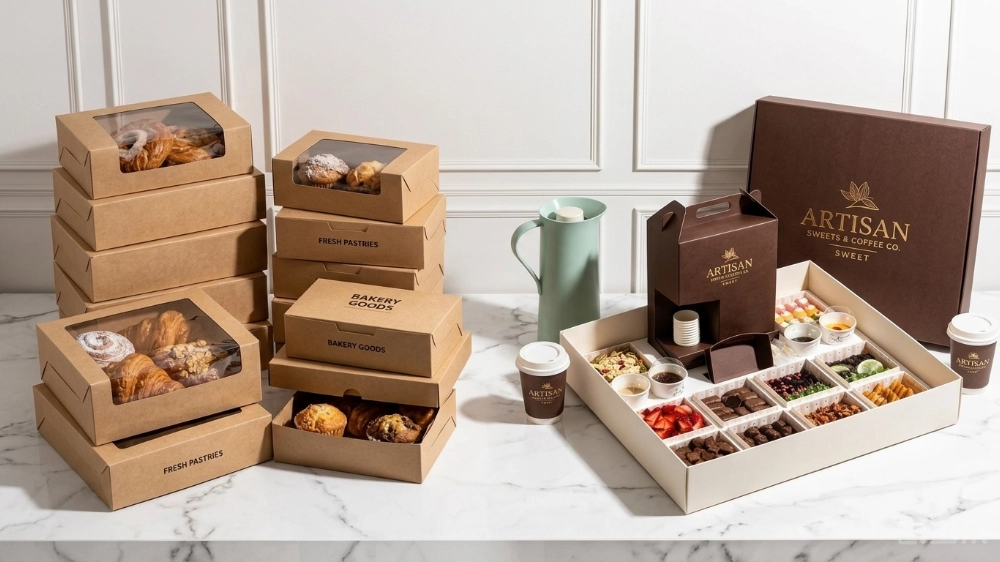
For bakeries and coffee shops, large catering orders create a different packaging challenge from normal takeaway sales. Businesses using bakery packaging solutions for cakes, pastries, and desserts may suddenly need to coordinate those boxes with coffee, cups, lids, serving accessories, and outer packaging when fulfilling larger office, event, or catering orders. At that point, the question is no longer simply which bakery box or coffee cup to buy, but how all of these components should work together as one complete order.
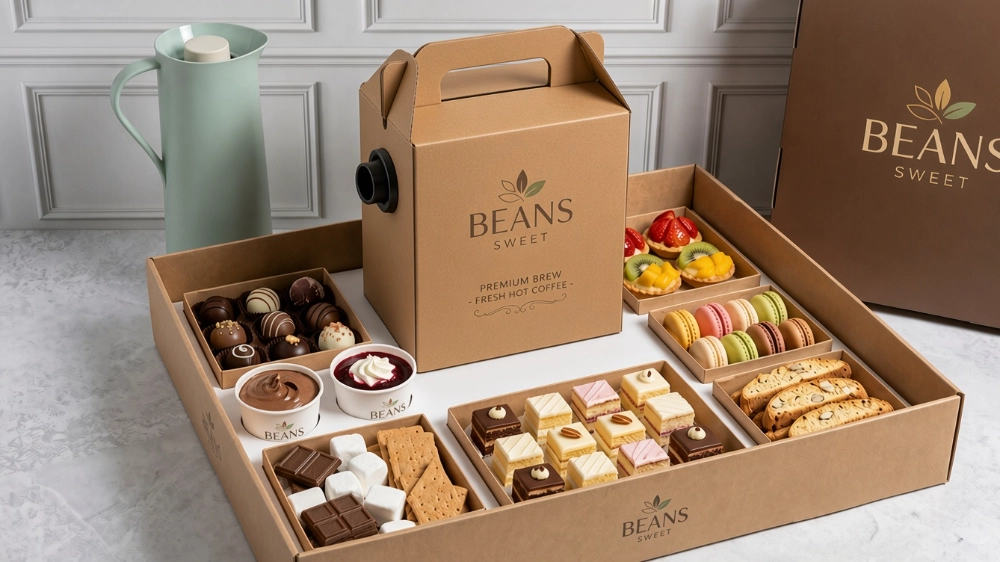
A dessert and coffee catering set box is a coordinated packaging system designed for this purpose. Depending on the structure, it can combine a rigid outer paper box, an internal food-grade beverage bag or coffee dispenser, a separate compartment for pastries or sweets, and space for takeaway coffee cups, lids, napkins, stirrers, or other accessories.
Unlike standard bakery boxes, which mainly contain and protect cakes, pastries, cookies, or other baked goods, a catering set is designed around the entire serving process. That difference becomes more important as order volume increases.

What Is the Main Difference Between Bakery Boxes and Dessert and Coffee Catering Set Boxes?
Traditional bakery boxes package bakery products as individual food units, while catering set boxes organize several parts of a coffee-and-dessert order into one coordinated system. The real difference is therefore not just box design, but how the order is packed, carried, transported, and served.
Traditional bakery packaging is highly flexible. A bakery can keep several sizes of cake boxes, pastry boxes, cookie boxes, cupcake boxes, and inserts in stock and select them according to each order.
A catering set starts from a different question: what products normally leave the store together? If the same order repeatedly contains brewed coffee, pastries, serving cups, lids, napkins, and condiments, packaging those components as a coordinated unit can simplify fulfillment.
This approach is consistent with the National Restaurant Association's recommendation to evaluate off-premises packaging according to actual menu characteristics rather than assuming that one format will suit every product. Its guidance highlights factors such as temperature, texture, appearance, and package integrity when evaluating takeaway and delivery packaging.
What are traditional bakery boxes designed to do?
Traditional bakery boxes are mainly designed to contain, protect, organize, and present baked goods during storage, takeaway, and delivery. Their effectiveness depends on matching the box structure and material to the specific food inside.
Cakes, cupcakes, cookies, croissants, filled pastries, and other bakery products do not behave identically inside a package. A review of packaging technologies for bakery products discusses the importance of moisture, oxygen, grease, mechanical protection, and other barrier requirements because different baked products have different deterioration mechanisms and packaging needs.
Paper and paperboard are widely used for food packaging because they can provide structure, printability, and practical foodservice functionality, but their performance can change when exposed to moisture or grease. A review of paper and paper-based food packaging materials explains why suitable coatings, laminates, or barrier treatments may be required for particular food applications.
This is why a good pastry box is not simply a box with attractive printing. Dimensions, paperboard strength, internal clearance, inserts, grease resistance, and delivery conditions all affect performance.
How does a dessert and coffee catering set box work?
A dessert and coffee catering set combines components that would otherwise be packed separately. Coffee can be contained in a food-grade inner beverage bag supported by a rigid outer structure, while pastries and serving accessories remain in separate compartments.
The exact construction varies by design. Some systems use a bag-in-box style coffee compartment with a dispensing tap, while others organize a separate coffee container alongside pastries, cups, lids, napkins, and condiments.
The important principle is separation within consolidation. Coffee and fragile pastries should not simply share an open cavity; liquids, heat, food products, and accessories need appropriate containment and structural separation.
The U.S. Food and Drug Administration's sanitary transportation framework is aimed at regulated food transportation rather than every local bakery delivery, but its broader principles illustrate why transport equipment and containers should be suitable for their intended food use and should prevent conditions that could make food unsafe during transportation.
Which Packaging System Uses Fewer Pieces for a Large Order?
A catering set can use fewer separate hand-carry units when coffee, pastries, cups, and accessories are repeatedly sold together. Traditional packaging remains simpler when an order contains only desserts, only a few drinks, or many individually prepared beverages.
Consider a conventional coffee-and-pastry catering order. The business may need bakery boxes, filled takeaway coffee cups or a separate coffee traveler, cup carriers, lids, sugar packets, creamers, napkins, stirrers, and outer bags.
Each component may be inexpensive on its own. The complexity appears when all of them must be counted, assembled, carried, loaded into a vehicle, checked at handoff, and arranged again at the destination.
How many separate packages can a traditional catering order require?
The number depends on the menu, but traditional catering can create multiple bakery boxes, drink carriers, accessory bags, and outer bags for a single customer order. As guest counts rise, the number of physical packages can become an operational issue even when every individual package works correctly.
This is visible in real large-order discussions. In one Reddit thread about transporting 252 cupcakes, bakers discussed container counts, stacking, trays, product movement, and non-slip liners rather than focusing only on the cost of each cupcake box.
A similar problem appears with large coffee orders. In a discussion about ordering 55 coffees, users highlighted the practical burden of carrying dozens of individual drinks and carriers, with one commenter contrasting individual cups with a bulk coffee box.
These discussions are anecdotal rather than controlled studies, but they reveal the operational questions real buyers and delivery users ask: How many packages are involved? Can they be stacked? How many trips are needed? What happens if one carrier tips?
Can catering set boxes reduce packaging complexity?
When the same combination of products is ordered repeatedly. Consolidating coffee, desserts, cups, and accessories can reduce the number of separate packages staff need to organize, but the advantage decreases when each order has a different configuration.
This is why catering sets are most useful for standardized menus rather than every takeaway transaction. A fixed “Coffee + Pastry Breakfast for 20” package, for example, is relatively predictable. A customer ordering 20 different espresso drinks, six croissants, three cakes, and several dietary-specific desserts is much less suitable for the same standardized system.
Which Option Is Faster to Pack for Large Catering Orders?
Integrated catering packaging can reduce repetitive packing steps when the menu and serving quantity are standardized. Traditional bakery boxes are often faster for dessert-only orders or when every drink has to be prepared individually.
Packing speed is determined by workflow, not simply by the number of folds in a carton. If staff have to prepare 40 takeaway coffee cups individually, each cup may require filling, a lid, labeling or identification, grouping into carriers, and careful loading. The desserts then have their own packaging process.
A shared bulk-coffee format moves part of that work to the serving location. Instead of transporting every portion as a filled cup, the business transports brewed coffee in bulk and supplies empty cups for guests to serve themselves.
Why do individual coffee cups create more packing steps?
Individual takeaway coffee cups require each drink to be portioned before delivery, while a bulk dispenser transports multiple servings in one beverage container. The trade-off is that bulk service works mainly when guests can share the same coffee rather than requiring individually customized drinks.
Starbucks, for example, describes its 96 fl oz Coffee Traveler as serving approximately twelve 8 fl oz cups, illustrating how multiple portions of brewed coffee can be transported as one catering unit. This does not eliminate disposable cups. Guests still need cups at the destination.
For businesses buying wholesale coffee cups, the choice is therefore not always “bulk dispenser or cups.” In many catering systems, the dispenser handles transportation while the takeaway coffee cups become serving vessels at the event.
When are traditional bakery boxes faster?
Traditional bakery boxes are usually faster when the order is dessert-only or when the business already has a simple, proven packing routine. An integrated catering set adds little value when there are few components to consolidate.
A bakery sending six pastry boxes to a nearby office may not need a specialized catering system at all. Likewise, a coffee shop producing personalized lattes, oat-milk cappuccinos, decaf drinks, and flavored beverages for named recipients may still benefit from individual personalized disposable coffee cups because each drink must remain identifiable.

Which Packaging System Is Easier to Carry and Transport?
Large-order transport depends on package count, stability, stacking, internal movement, leakage risk, and vehicle placement. Consolidation can make handling easier, but only when the packaging keeps beverages and fragile bakery products securely separated.
Packaging is expected to do more than contain a product before it leaves the counter. The Institute of Food Technologists explains that packaging helps protect food against physical damage, environmental exposure, contamination, and losses during distribution.
For a catering order, that means buyers should evaluate the journey from packing bench to customer table.
Why does the number of packages matter during delivery?
Every additional package becomes another item to count, load, stabilize, unload, and hand to the customer. For very large orders, reducing physical handling units can be operationally valuable even when the total amount of food remains unchanged.
The cupcake and 55-coffee examples above demonstrate the same underlying issue from two different directions: bakery products create problems around stacking and movement, while drinks create problems around upright transportation and spills.
A consolidated catering format does not automatically solve those problems, but it can reduce the number of independent objects the delivery team has to manage.
How should coffee and pastries be separated during transport?
Liquids and fragile bakery products should have independent containment so that leakage, heat, or movement from one component cannot easily damage another. A catering set is effective only when its internal structure maintains that separation throughout handling and transport.
A suitable structure may require a sealed food-grade beverage bag, a rigid supporting outer structure, a defined dispenser position, separate pastry compartments, inserts or dividers, appropriate headspace, and secure closures.
The same principle applies to traditional pastry boxes: good packaging should limit product movement rather than merely provide enough volume to fit the food.
Which Option Protects Pastries Better?
Neither format is automatically better for pastry protection. Product fit, structural stiffness, inserts, moisture behavior, internal clearance, and movement during delivery matter more than whether the package is called a bakery box or catering set. A properly sized pastry box may outperform an oversized custom catering box if the pastry can move freely inside the larger package.
Why does pastry type affect the packaging choice?
Different bakery products fail in different ways, so they should not all be packaged to the same specification. Crisp pastries may be sensitive to moisture, decorated cakes to contact damage, cupcakes to tipping, and oily products to grease penetration.
Research covering bakery products identifies moisture transfer, oxidation, microbial stability, mechanical protection, and barrier properties among the factors that influence bakery-product packaging decisions.
Research on paper-based food packaging likewise notes that paper's sensitivity to water, oil, and grease can require additional barrier treatments for specific food uses.
For procurement teams, the practical lesson is simple: specify the food first and the carton second.
Do catering set boxes still need dessert inserts or dividers?
When the dessert can slide, tip, collide, or deform during transportation. Combining several products into one outer package does not remove the need for internal restraint.
A set containing cookies may need very little restraint. A set containing decorated cupcakes, individual mousse desserts, or delicate pastries may require fitted dividers, cavities, trays, or inserts.
The Institute of Food Technologists' discussion of food protection during distribution reinforces why structural packaging has to account for mechanical handling rather than only shelf presentation.
Which Option Costs Less for Large Orders?
The cheapest individual box is not necessarily the cheapest complete packaging system. Buyers should compare the cost of every component and the operational effort required to prepare, transport, and deliver one finished catering order.
This is one of the most important differences between retail packaging procurement and catering packaging procurement.
Looking only at the price of bakery boxes wholesale can hide the cost of coffee carriers, takeaway bags, lids, accessory bags, individual cups, assembly, storage, and delivery handling.
Why is unit packaging price not enough?
Unit cost measures one SKU, while catering-order cost measures the complete packaging workflow. A lower-priced box can still produce a more expensive finished order if it requires several additional components and more staff handling.
For this reason, packaging trials should evaluate the actual off-premises experience.
The National Restaurant Association recommends testing takeout packaging under real conditions and considering attributes such as temperature, texture, visual appeal, and package integrity rather than evaluating packaging only in isolation.
How should buyers calculate packaging cost per catering order?
List every packaging item required to complete a typical order, then compare the total with an alternative system. Add operational measures such as assembly steps, packing time, hand-carry units, storage requirements, and damaged-order risk where those can be measured reliably.
A practical traditional packaging calculation may include bakery boxes, takeaway coffee cups, lids, cup carriers, condiment packs, napkins, takeaway bags, labels, and packing labor.
An integrated catering calculation may instead include the catering outer box, beverage bag or dispenser, dessert insert or compartment, serving cups, lids, accessories, and assembly labor.
The better option is the one that produces the required customer experience at an acceptable total order cost, not necessarily the one with the cheapest carton.
How Do Traditional Bakery Boxes and Catering Set Boxes Compare?
| Decision Factor | Traditional Bakery Boxes + Separate Coffee Packaging | Dessert & Coffee Catering Set Box |
|---|---|---|
| Best suited to | Flexible or dessert-only orders | Repeat coffee + dessert packages |
| Dessert flexibility | High | Medium to high |
| Beverage flexibility | High with individual drinks | Best with shared bulk coffee |
| Separate packaging pieces | Usually more for mixed orders | Can be fewer |
| Packing workflow | Multiple independent steps | Can consolidate steps |
| Carrying units | Often more | Can be fewer |
| Pastry protection | Strong when correctly sized | Strong with correct inserts or dividers |
| Beverage separation | Naturally separate | Must be engineered internally |
| Branding | Individual boxes and cups | Coordinated full-order presentation |
| SKU flexibility | High | Lower |
| Repeat-order consistency | Depends on staff assembly | High for standardized menus |
| Inventory model | Multiple familiar stock SKUs | More specialized system |
| Custom development | Relatively simple | Requires more structural planning |
| Best use case | Variable takeaway and bakery orders | Meetings, events, and repeat catering |
The table should be treated as a decision framework rather than a universal ranking. Actual performance depends on menu design, package construction, delivery conditions, and order volume.
Which Option Is Better for Branding?
Traditional packaging creates multiple individual branding surfaces, while a catering set can present an entire order as one coordinated branded experience. Neither approach is inherently stronger; they create brand visibility at different moments.
With traditional packaging, a business can customize bakery boxes, pastry boxes, cup sleeves, bags, and individual coffee cups.
This works particularly well when products are consumed separately or customers carry individual items away from the event.
A catering set emphasizes the moment the complete order arrives and is opened.
Are personalized paper cups still useful with catering boxes?
Yes. A bulk coffee dispenser replaces the need to transport every serving as a pre-filled drink, but it does not eliminate the cups people drink from. Personalized paper cups can therefore remain part of an integrated catering system.
This creates a useful hybrid approach: bulk beverage transport for operational efficiency combined with personalized serving cups for brand visibility.
For brands already purchasing wholesale coffee cups, moving to catering sets does not necessarily require abandoning an existing branded cup program.
Can the catering box itself become part of the brand experience?
Yes, especially when the full package is presented to a group rather than immediately separated into individual orders. Corporate meetings, events, office breakfasts, hotel catering, and client hospitality are situations where the complete package may become part of the presentation.
Branding can potentially extend across the outer carton, serving cups, sleeves, internal cards, napkins, or other printed components.
The goal should still be functional clarity first. A visually impressive box that is difficult to carry, dispense from, or dispose of does not become better packaging simply because more printing has been added.
Which Packaging Option Is Easier to Buy Wholesale?
Traditional bakery boxes are generally easier to source as standard wholesale items because common sizes and formats are widely available. Customized catering systems require more decisions about product dimensions, beverage capacity, compartments, cups, materials, printing, and assembly.
For new or unpredictable catering programs, this flexibility matters.
A bakery can test several standard pastry boxes without committing to a completely new packaging system.
When do standard wholesale bakery boxes make more sense?
Standard bakery boxes make more sense when order quantities and product combinations vary significantly. They are also useful when a business is still learning which sizes, dessert formats, and catering packages customers actually buy.
Real bakery operators discussing packaging procurement frequently recommend testing packaging dimensions before committing to larger purchases and evaluating how boxes fit into the rest of the takeaway system.
That is a sensible procurement principle: prove the workflow first, then standardize it.
When is custom catering packaging worth considering?
Custom catering packaging becomes easier to justify when a business already has repeatable menu combinations and predictable catering demand. Stable requirements allow dimensions, beverage volume, dessert layout, cup storage, printing, and assembly to be designed around a real recurring order.
Before customization, buyers should ideally know the typical guest count, common dessert quantities, coffee volume, cup size, delivery distance, usual accessory set, monthly order frequency, storage limitations, and expected order growth.
Without those inputs, a highly customized package may solve a problem the business does not actually have.
When Are Traditional Bakery Boxes the Better Choice?
Traditional bakery boxes are usually the better choice for small, variable, dessert-only, or highly customized orders. Their main advantage is flexibility: businesses can combine different box sizes and drink formats as the order changes.
Traditional packaging is particularly appropriate when most orders contain desserts only, catering demand is irregular, cake and pastry sizes vary substantially, customers order many different beverages, drinks must arrive ready to consume, or the business is still testing its catering menu.
The National Restaurant Association's emphasis on matching packaging to specific menu characteristics supports this case-by-case approach rather than treating one package as universally suitable.
When Is a Dessert and Coffee Catering Set Box the Better Choice?
A catering set becomes more attractive when the same group of products repeatedly leaves the store together. Standardized coffee-and-dessert packages for offices, meetings, events, conferences, and corporate catering are therefore stronger candidates than highly customized individual orders.
Typical applications include office breakfast packages, corporate meetings, conferences, training sessions, hotel and event catering, recurring coffee-and-pastry bundles, franchise catering menus, and group dessert-and-coffee packages.
The benefit does not come from the carton simply being larger or more specialized.
It comes from designing one repeatable fulfillment system around products that customers already buy together.
How Should a Bakery or Coffee Shop Choose Between the Two?
Choose packaging based on the order pattern you can measure, not the format that looks more innovative. Compare how products are packed, transported, served, and purchased before deciding whether consolidation creates a real benefit.
Before switching packaging systems, buyers should review the following factors:
- Typical number of guests
- Average dessert quantity
- Dessert types and fragility
- Average coffee volume
- Number of beverage variations
- Number of current packaging pieces
- Packing steps or packing time
- Number of hand-carry units
- Delivery distance
- Common leakage or damage issues
- Packaging cost per completed order
- Monthly catering volume
- Custom branding requirements
- Storage capacity
- Acceptable purchasing quantities
Food packaging is protective and logistical as well as visual. The Institute of Food Technologists highlights packaging's role in protecting food throughout distribution, while FDA transportation guidance illustrates the broader principle that food transport containers and equipment should be appropriate to their intended use.
Which One Works Better for Large Orders?
Neither format is better for every large order. Traditional bakery boxes offer greater flexibility, while dessert-and-coffee catering set boxes become more useful when coffee, pastries, cups, and accessories are repeatedly prepared, transported, and served as one standardized package.
For a bakery selling changing combinations of cakes, pastries, cookies, and individually prepared drinks, traditional bakery packaging and takeaway coffee cups may remain the most practical system. Standard boxes allow operators to adjust packaging according to different product sizes, quantities, and customer requirements without committing every order to a fixed catering configuration.
For a coffee shop, bakery, hotel, caterer, or foodservice operator repeatedly fulfilling office breakfasts and group coffee-and-dessert orders, an integrated catering set can make more sense because procurement is being designed around the complete order rather than individual packaging SKUs.
The most useful purchasing question is therefore not “Which box is better?” but “Which packaging system matches the way this order is actually prepared, transported, and served?”
MaiBao works with bakeries, coffee brands, foodservice operators, and distributors as a professional foodservice packaging partner, helping buyers evaluate the complete packaging system—from bakery boxes and personalized paper cups to integrated dessert-and-coffee catering sets—rather than treating one packaging format as the answer for every application. For large-order programs, that partnership is most useful when packaging decisions are built around real menu combinations, transportation conditions, branding requirements, and repeatable procurement needs.
FAQ
Are catering set boxes cheaper than traditional bakery boxes?
Not always. A catering set can lower total packaging complexity when it replaces several separate components, but buyers should compare the full cost of the finished order—including cups, carriers, bags, accessories, assembly, and handling—rather than comparing box prices alone.
Can a catering box hold both hot coffee and pastries?
Yes, if the beverage and bakery products have independent containment and suitable structural separation. The package should prevent coffee leakage, heat, or internal movement from damaging pastries during handling and transportation.
Do I still need takeaway coffee cups with a bulk coffee box?
Yes. A bulk dispenser transports several servings together, but guests still require disposable serving cups at the destination, which can include standard takeaway coffee cups or personalized paper cups.
Are traditional bakery boxes better for small orders?
Usually, yes. Standard bakery boxes and pastry boxes provide greater flexibility when quantities, dessert types, and beverage choices change from order to order, while specialized catering sets make more sense when the same large-order configuration repeats regularly.