Skip to content
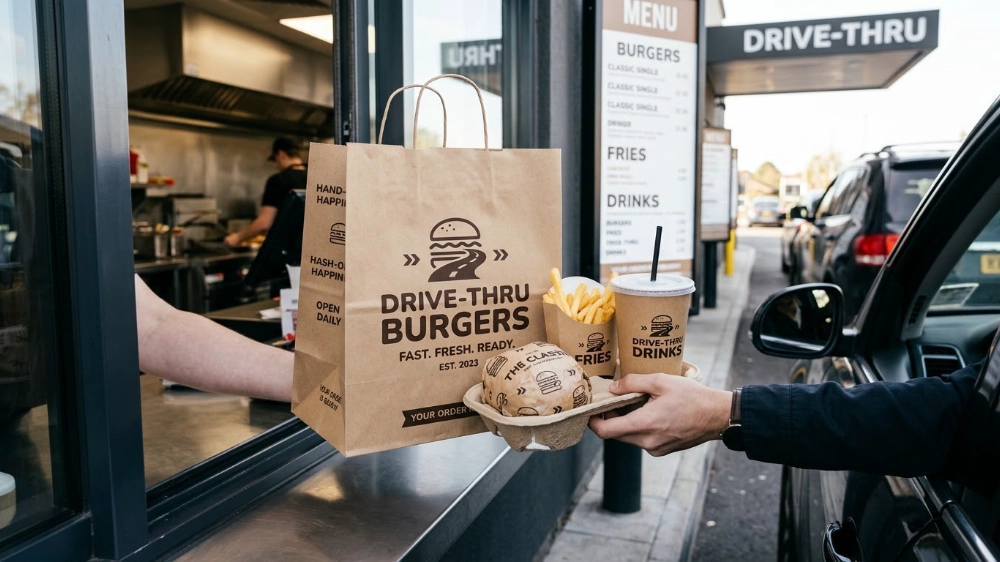
Drive-thru burgers usually fall apart because trapped steam, grease, sauces, vehicle movement, and compression weaken the bun and disturb the burger’s structure after it leaves the kitchen. The right drive-thru packaging solutions manage moisture, resist grease, limit movement, preserve headspace, and release enough steam without allowing the food to cool too quickly.
A burger can look perfect when it is assembled and still arrive ten minutes later with a wet bottom bun, displaced toppings, leaking sauce, or a compressed crown. That does not always mean the recipe failed. In many cases, the hamburger packaging did not match the temperature, moisture load, size, or transport conditions of the food.
For drive-thru restaurants, QSRs, and takeaway operators, good food packaging for burgers should therefore be judged by the condition of the burger when the customer opens it—not simply by whether the box stayed closed.

Why do drive-thru burgers fall apart before customers get home?
A drive-thru burger can lose its structure because steam, grease, sauces, motion, and pressure act on it at the same time. Effective burger packaging boxes need to manage these stresses together rather than focusing only on keeping the food hot.
Inside a freshly packed burger, several moisture sources remain active. The hot patty releases water vapor, melted cheese and meat contribute fat, while tomato, pickles, mayonnaise, and sauces add liquid directly to the sandwich. The Institute of Food Technologists explains that moisture gain or loss can alter food texture and that packaging plays a major role in controlling moisture movement.
Transport introduces a mechanical problem as well. Acceleration, braking, cornering, bag handling, and stacking can move a burger that has too much free space inside its container. At the same time, insufficient headspace can push down on a tall burger and force sauces and toppings outward.
The result is rarely caused by one failure alone. A slightly softened bun may still hold together in the restaurant, but add grease, lateral movement, and lid pressure and the whole stack becomes much less stable.
Why does a burger stay together in the kitchen but fall apart during transport?
At the pass, the burger has only just been assembled. Once the lid closes, however, it enters a changing microenvironment where heat and water vapor accumulate while the package is being moved.
That is why fast food burger packaging should be evaluated as part of the transport process. A package that performs well for two minutes across a counter may not perform the same way after a 10- or 20-minute drive.
What causes the bottom bun to become wet first?
The bottom bun often receives moisture from several directions at once: meat juices and fat from above, sauce from the filling, and moisture that accumulates in the lower part of the package.
Its position also means it carries the weight of the rest of the burger. Once the crumb becomes saturated and compressed, it becomes less able to keep sauces, patties, and toppings aligned.
Why does steam make burger buns soggy inside a closed box?
Hot burger components continue releasing water vapor after packing. If that vapor is trapped, humidity inside the container rises and moisture can return to the food or package surfaces, softening the bun.
Keeping a burger hot and keeping it dry are not the same packaging problem.
IFT notes that water vapor moves in response to humidity gradients and can interact with both the packaged food and the package material. It also explains that packaging requirements depend on the actual food, moisture conditions, temperature, and distribution environment rather than on material type alone. This moisture-control principle is directly relevant to hot takeaway food enclosed in a small package.
For a burger, the problem develops quickly. The patty may be much hotter than the lid or the air around the package. Water vapor leaving the food raises humidity in the confined headspace; if it is not managed, the bun and other absorbent components are exposed to increasingly humid conditions.
This is why simply choosing the most tightly sealed burger boxes can backfire. A design that improves heat retention but traps too much moisture may protect temperature while damaging texture.
Why does condensation form inside burger packaging?
Condensation can occur when warm, moisture-rich air inside the package meets a cooler surface and water vapor changes into liquid droplets.
The exact amount depends on food temperature, ambient conditions, material behavior, headspace, and the rate at which moisture can leave the package. For restaurant operators, that means condensation should be checked with the actual burger rather than predicted from the appearance of an empty box.
Does sealing a burger box tightly keep the burger fresher?
Not necessarily. A tighter closure can reduce heat and moisture loss, but for a hot, moisture-generating burger it may also create a humid environment that softens the bun.
The correct goal is controlled moisture management—not simply maximum sealing.
Do burger boxes need ventilation holes?
Yes, many hot burgers benefit from controlled ventilation because it allows excess moisture to escape before it accumulates inside the package. However, more ventilation is not automatically better because excessive airflow can also accelerate heat loss.
Vent design is therefore a balance between moisture release and heat retention.
A juicy double cheeseburger, a small dry hamburger, and a heavily sauced chicken burger do not produce the same internal conditions. The appropriate ventilation depends on the food’s temperature, water and grease load, assembled height, expected holding time, and surrounding secondary packaging.
Foodservice operators already use this principle with foods where steam damages texture. Restaurant Business has reported takeaway packaging designs using ventilation to protect food quality during transit, illustrating why the ability to release steam can matter just as much as enclosure.
For burgers, the practical question is not simply, “Does this box have vents?” It is, “Does this amount and placement of ventilation keep this burger in acceptable condition for the customer journey?”
How much ventilation does a burger box need?
There is no universal number of holes or vent area that works for every menu.
Restaurants should test the final package with the actual patty temperature, bun, cheese, vegetables, sauce load, and expected drive time. If the bun remains wet, moisture may still be accumulating too quickly; if the burger loses heat too rapidly, ventilation or package configuration may need adjustment.
Can too much ventilation make burgers cold?
Opening a package to the surrounding air can help moisture escape, but it can also increase heat exchange.
That trade-off is why burger packaging solutions should be tested for both texture and temperature rather than treating ventilation as an isolated feature.
How do grease and sauces weaken burger packaging?
Grease and sauces can affect both the burger and the package surrounding it. Without an appropriate barrier, oils and moisture can stain or penetrate paper-based packaging while also moving into the bun and reducing its structural integrity.
Grease resistance is not the same thing as simply using thick cardboard. Barrier performance depends on the material and surface treatment used to slow oil or water penetration.
The U.S. Food and Drug Administration describes grease-proofing agents as substances applied to paper and paperboard packaging to prevent grease or oil leakage. The FDA also states that PFAS-containing grease-proofers are no longer sold for food-contact paper and paperboard use in the U.S. market and that the related authorizations were determined to be no longer effective in January 2025. This makes the choice of food-contact grease-barrier technology an important specification rather than a generic “greaseproof” claim.
Research published in Carbohydrate Polymers also demonstrates that the water-vapor and grease resistance of paper can be materially changed through barrier coatings. In one study, a chitosan-beeswax bilayer improved both water-vapor barrier performance and grease resistance, demonstrating that barrier construction—not paper thickness alone—can determine how paper responds to moisture and oil.
For a restaurant buyer, the implication is practical: a juicy burger with melted cheese and sauce may require different grease-resistant burger packaging from a relatively dry hamburger even if both use the same bun diameter.
What does grease-resistant burger packaging actually do?
Grease-resistant packaging slows oil penetration through the food-contact surface and the paperboard structure.
That can help reduce visible staining, leakage into bags or hands, and premature weakening of the package. It does not mean the package can compensate indefinitely for unlimited sauce, fat, or holding time, so resistance should still be tested under realistic service conditions.
Is thicker cardboard automatically more grease resistant?
No. Board thickness can improve rigidity or compression resistance, but grease resistance is a separate material-performance characteristic.
A thick untreated board can still absorb oil, while a properly designed barrier layer may substantially improve grease performance on a lighter paper substrate. Restaurants should therefore specify both structural requirements and food-contact barrier requirements.

Can the wrong burger box size make a burger fall apart?
Yes. An oversized box gives the burger more room to slide during transport, while an undersized box can compress the bun and push sauces or toppings out of position.
The better sizing rule is simple:
Size the package around the assembled burger, not the bun alone.
Bun diameter is only one dimension. A packaging supplier also needs to understand the finished burger’s total width, height, topping profile, and how much clearance is required above the top bun.
Too much lateral clearance increases movement. Too little vertical clearance introduces compression. Both can turn a neatly stacked burger into a leaning or partially disassembled one by the time the customer opens the box.
This is particularly important for double-patty burgers, brioche buns, crispy chicken sandwiches, burgers with onion rings, or premium menu items with tall ingredient stacks. Operators comparing different sizes can also evaluate kraft takeaway boxes where the structure and dimensions need to be matched to the finished menu item rather than selected by nominal serving size alone.
How much space should be left around a burger inside the box?
There is no single clearance measurement that works for all burgers.
The box needs enough room to avoid squeezing the assembled product but not so much room that normal driving allows significant lateral movement. The correct clearance should be established through physical samples and transit testing.
Why does burger headspace matter?
Headspace protects the top of the burger from continuous lid pressure.
If the lid pushes on the crown, it can compress the bun, increase contact with wet ingredients, squeeze sauce outward, and shift vegetables away from the center. A package may technically “fit” by width while still being too shallow for the actual product.
What is the best packaging material for drive-thru burgers?
There is no single best material for every burger. Material selection should reflect steam output, grease load, burger weight and height, holding time, stacking requirements, barrier needs, and the level of physical protection required during transport.
Paperboard clamshells are common because they provide a useful combination of structure, printable surface area, and serving convenience. Heavier or more complex burgers may need greater rigidity, while short-distance service may work well with a close-fitting paper wrap if crushing risk is low.
Moisture exposure matters to structure as well. A 2024 study in Applied Sciences found that changes in temperature and relative humidity significantly affected the mechanical performance of corrugated board, with higher humidity associated with reduced strength under the tested conditions. The study reinforces the broader packaging principle that moisture is not only a food-texture issue; it can also influence fiber-based package performance.
For burger packaging, material and structure therefore need to be considered together.
| Packaging Format | Main Strength | Main Risk | Best Suited To |
|---|---|---|---|
| Paperboard clamshell | Good shape protection, presentation, and branding area | Can soften if moisture or grease barrier is inadequate | Standard drive-thru and takeaway burgers |
| Micro-flute or stronger fiber box | Greater crush and stacking resistance | More material and storage volume | Large, tall, or heavy burgers |
| Paper wrap | Close fit and low packaging volume | Limited crush protection | Short holding times and simple burgers |
| Barrier-coated paperboard | Better resistance to grease and moisture | Barrier choice must match food-contact and disposal requirements | Juicy, greasy, or heavily sauced burgers |
Restaurants should avoid selecting a format only because it is described as “premium,” “eco-friendly,” or “heavy duty.” Those labels do not tell an operator whether the package will control steam, fit the assembled burger, or withstand the actual food-contact conditions.
Structural designs can also change how food is served after transport. For menu concepts where the container becomes part of the eating experience, an unfolding takeout box that converts to a plate-ready format is one example of how package structure can address both transport and consumption.
Is paperboard better than wrapping a burger in paper?
Neither format is universally better.
A rigid paperboard box provides more crush protection and headspace, while a wrap can hold a burger more closely and reduce lateral movement. Some restaurant concepts use both because the wrap manages the burger directly while the outer package provides additional protection.
When does a burger need a stronger box?
A stronger structure becomes more valuable as burger height, weight, moisture load, stacking pressure, or journey difficulty increases.
Large double patties, heavy sauces, tall toppings, combo meals, and bags containing multiple orders can all increase the mechanical demands placed on fast food burger packaging.
How should restaurants test burger packaging before ordering?
Restaurants should test burger packaging with the finished menu item under realistic drive-thru conditions, not with an empty box. The test should track bun texture, condensation, grease penetration, food movement, package deformation, and temperature across the normal customer journey.
This is one of the most useful ways to avoid choosing a package from specifications alone.
The IFT moisture-control guidance emphasizes that packaging performance depends on factors such as food moisture, package properties, humidity, temperature, and distribution conditions. The practical takeaway for QSR operators is that the most meaningful test uses the food and conditions the package will actually encounter.
Burger Packaging Transit Test
At 0 minutes:
Record the burger’s starting condition, approximate food temperature, assembled height, package fit, and any initial grease or sauce contact.
At 5 minutes:
Check for visible condensation, lid moisture, burger sliding, and initial grease marks.
At 10 minutes:
Inspect the bottom bun, topping alignment, package walls and base, grease penetration, and eating temperature.
At 15–20 minutes:
Evaluate whether the burger can still be lifted and eaten normally, whether the bun remains intact, whether the package has softened or deformed, and whether the overall eating quality remains acceptable.
The time points should reflect the restaurant’s real customer journey. A location where most customers eat within eight minutes does not need the same test protocol as a restaurant where takeaway orders routinely remain packaged for 25 minutes.
How long should a burger packaging test last?
It should last at least as long as the restaurant’s typical drive-thru or takeaway journey.
Operators should use their own service pattern rather than an arbitrary industry number. If a meaningful share of customers travels 15 minutes before eating, the package should be evaluated at 15 minutes—not only immediately after packing.
What should restaurants check after a burger delivery test?
- Bun moisture: Is the bottom or top bun noticeably wet or compressed?
- Grease penetration: Has oil stained or passed through the food-contact surface?
- Burger movement: Has the sandwich shifted significantly inside the box?
- Topping displacement: Are vegetables, cheese, or sauce still positioned correctly?
- Package deformation: Has the base, wall, or lid softened or collapsed?
- Temperature: Is the burger still within the restaurant’s intended serving-quality range?
Testing competing burger packaging solutions against the same burger, journey, and handling conditions makes supplier comparisons much more meaningful than comparing board descriptions alone.
How can drive-thru restaurants choose burger packaging that protects food quality?
The right burger packaging matches the burger’s moisture, grease, dimensions, structure, and expected travel time. Restaurants should define performance requirements first, test samples with real food, and select the package that gives the most consistent customer outcome.
A useful purchasing conversation therefore starts with the menu rather than the packaging catalog.
Restaurants should be ready to tell a supplier the assembled burger dimensions, patty type, typical sauces, expected packing temperature, average journey time, whether orders are stacked, and whether the burger travels with fries or other hot items.
That last point can matter. Supply Chain Dive reported an industry example of a compartmentalized cheeseburger meal package in which fries, burger, bun, and cold vegetables were separated, with the fries vented and the bun isolated from hot, wet components. The example shows how foodservice packaging can manage different temperature and moisture needs within the same meal rather than treating the entire order as one environment.
Alternative formats may also make sense for particular menu concepts. For example, snack paper boxes can be evaluated where smaller burgers, sides, or combined serving formats require a different footprint from a conventional clamshell.
What should restaurants ask a burger packaging supplier?
- Does the box fit the assembled burger rather than only the bun diameter?
- How is steam expected to leave the package?
- What grease and moisture barrier is used on the food-contact surface?
- Is the structure suitable for the burger’s weight and expected stacking conditions?
- Can the supplier provide different depths or dimensions if the burger is unusually tall?
- Can samples be tested with the actual menu item before a bulk order?
These questions shift the conversation from “How much does this box cost?” to “Will this package protect food quality through the actual customer journey?”
Should burger packaging be tested before a bulk order?
A material data sheet cannot reproduce the interaction between a restaurant’s actual bun, patty temperature, sauces, toppings, kitchen workflow, packing method, secondary bag, and transport time.
Testing samples before committing to volume is the most direct way to see whether the proposed hamburger packaging solves the restaurant’s real problem.

Conclusion
A burger box should not be judged only by whether it can hold a burger. It should be judged by what the burger looks, feels, and tastes like when the customer opens it several minutes after leaving the restaurant.
Steam control, grease resistance, headspace, sizing, structural strength, and transit conditions all influence that outcome. Choosing drive-thru food packaging around the actual menu and customer journey gives restaurants a more reliable way to protect food quality than choosing packaging from material or price alone.
For foodservice operators, packaging development works best as part of the menu and delivery process rather than as a separate purchasing decision. MaiBao works with restaurant and QSR businesses to match packaging structures, materials, and formats to real serving and transport conditions, helping teams evaluate packaging as a practical part of food-quality control.
FAQ
What is the best packaging for takeaway burgers?
The best packaging for takeaway burgers is a box or wrap that balances ventilation, grease resistance, structural protection, heat retention, and a close fit around the assembled burger. Restaurants should test the packaging with their actual menu item because the best solution changes with burger height, grease level, sauce load, toppings, and expected travel time.
How do you keep burgers from getting soggy in a box?
The most effective approach is to let excess steam escape while reducing direct grease and moisture transfer into the bun. Use appropriately ventilated, grease-resistant burger packaging boxes, avoid excessive empty space or lid compression, and test the packed burger over the same amount of time customers normally spend traveling before eating.
Do burger boxes need ventilation holes?
Yes, many hot burgers benefit from controlled ventilation because vents help excess water vapor leave the package instead of accumulating around the bun. The amount and location should be tested carefully, however, because excessive ventilation can increase heat loss and may not be necessary for every burger style or serving time.
What makes a good burger packaging box?
A good burger packaging box fits the assembled burger, manages steam, resists grease, prevents excessive movement, protects the food from compression, and stays structurally stable during transport. The most reliable way to judge a fast food burger packaging design is to test the finished burger after the expected drive-thru journey rather than evaluating the empty box alone.