Skip to content
The most common drive-thru packaging problems are soggy fried food, leaking containers, spilled drinks, heat loss, and boxes that crush or shift during transport. Choosing the right drive-thru packaging solutions means matching each package to the food, travel conditions, and way customers actually handle the order.
Packaging matters because the restaurant experience no longer ends at the drive-thru window. According to the National Restaurant Association's 2025 off-premises research, 90% of off-premises customers said they would likely order a greater variety of takeout or delivery foods if upgraded packaging helped keep the temperature, taste, and quality closer to the dine-in experience.
For quick-service restaurants, the problem is therefore not simply finding a box or cup that holds food. Good QSR packaging solutions need to protect food through packing, handoff, stacking, movement inside a vehicle, and the time between leaving the restaurant and being eaten.
This guide looks at five common food packaging problems, why they happen, and the practical packaging features restaurants should evaluate before changing their packaging system.

What Are the Most Common Drive-Thru Packaging Problems?
The five most common drive-thru packaging problems are trapped moisture, leaks, beverage spills, temperature loss, and structural failure during transport. Each problem usually comes from a mismatch between the food, package design, portion size, or way the order is handled.
Unlike dine-in service, a drive-thru order continues moving after it leaves the kitchen. Containers may be stacked in a bag, drinks placed in a carrier, the entire order passed through a service window, and then transported on a passenger seat or vehicle floor.
That makes transportation performance part of the dining experience. QSR packaging industry analysis identifies transport resilience, spill prevention, temperature preservation, and stackability as increasingly important packaging requirements for restaurants serving mobile consumers.
The main failure points can be grouped into five questions:
- Will steam damage the texture?
- Can grease, sauce, or liquid escape?
- Will the cup and lid remain secure while the vehicle moves?
- Will hot food still be enjoyable when the customer eats it?
- Can the package survive stacking and movement without crushing the food?
These problems should be evaluated together rather than independently. For example, sealing a fried-food box more tightly may reduce heat loss but increase condensation, while using a larger container may reduce compression but allow the food to slide around.
Restaurants building a complete packaging system can also use this drive-thru food packaging guide to compare container requirements for burgers, fries, beverages, and combo meals.
Why Does Fried Food Become Soggy in Drive-Thru Packaging?
Fried food becomes soggy when moisture released by hot food cannot escape and condenses inside the package. Controlled ventilation, suitable grease resistance, correct container sizing, and separation from high-moisture foods can help slow this loss of crispness.
Why does trapped moisture matter?
Fresh fries, fried chicken, onion rings, and similar foods continue releasing heat and moisture after leaving the fryer. If they are immediately placed inside a completely sealed container, the humid air has nowhere to go.
As the vapor cools, some of it condenses on the package and food surface. That moisture works against the dry, crisp exterior customers expect from fried food.
Food science supports the importance of moisture to fried-food texture. A 2024 review published in Measurement: Food links changes in moisture content with textural and sensory properties in fried foods, reinforcing why moisture management matters when restaurants want to preserve crispness after cooking.
Should fried food packaging be vented?
For many fried foods, some ventilation is useful because it gives excess steam a route out of the container. The National Restaurant Association specifically highlights vented takeout formats designed to help fried foods remain crisp and warm during off-premises service.
That does not mean adding as many holes as possible. Too much ventilation may accelerate heat loss, while too little ventilation can trap steam. The appropriate balance depends on the food's moisture level, portion size, serving temperature, packaging volume, and expected travel time.
A restaurant serving fried chicken, for example, should test whether its custom fried chicken boxes provide enough headspace, grease resistance, and moisture release for the actual portions being served.
Should fries and burgers share one container?
Not automatically. A burger contains moisture from meat, cheese, sauces, vegetables, and hot bread, while fries depend much more heavily on surface crispness. Packing them tightly together can create moisture transfer and make it harder to control the environment around each item.
This is one reason menu-based packaging selection usually performs better than forcing every item into one universal box.
The same principle applies when burgers arrive in poor condition. Our guide on why drive-thru burgers fall apart explains how container size, food movement, moisture, and structure affect burger quality during transport.
Why Do Takeout Containers Leak Grease, Sauce, or Liquid?
Takeout containers leak when the material, barrier, seam, closure, or lid does not match the food's oil and moisture load. Restaurants should therefore evaluate packaging against the actual menu instead of assuming one container can handle dry, greasy, saucy, and liquid-rich foods equally well.
What causes grease to soak through food packaging?
Grease resistance depends on more than paper thickness. Hot oil can expose weak points in folds, seams, corners, coatings, and paperboard surfaces. A box that holds a relatively dry sandwich successfully may perform very differently when used for fried chicken, cheesy fries, sauced wings, pasta, or other foods with higher oil or moisture loads.
The National Restaurant Association recommends testing packaging with different menu items because materials and packaging formats are not equally suited to every food. Its guidance specifically identifies package integrity, leakage, moisture barriers, temperature performance, and actual transportation testing as factors restaurants should evaluate.
Does grease-resistant packaging also need food-contact consideration?
Yes. Functional performance should not be separated from food-contact suitability.
In February 2024, the U.S. FDA announced that grease-proofing substances containing PFAS were no longer being sold for food-contact use in the United States. The agency noted that these substances had previously been applied to products including fast-food wrappers and take-out paperboard containers to provide grease- and water-resistant properties.
For restaurant buyers, the practical lesson is simple: grease resistance should be evaluated together with food-contact compliance rather than treating resistance to oil as the only purchasing criterion.
How can restaurants reduce leaking sauces and liquid-rich meals?
Start with four areas:
- Barrier performance: Can the material withstand the food's oil and moisture?
- Closure: Does the lid or locking structure remain fully closed when the package is tilted?
- Seams and corners: Are there weak points where liquid can collect and escape?
- Sizing: Does excessive empty space allow the meal to move aggressively inside the container?
For wetter or more complex takeaway meals, formats such as custom PP food containers for takeaway and meal prep may be worth evaluating where the food, local regulations, heating requirements, and intended use make the material appropriate.
The goal is not to find the container advertised as “most leak-proof.” It is to find the container that remains secure with your specific food under realistic transport conditions.

Why Do Drinks Spill During Drive-Thru and Takeout Orders?
Drive-thru drinks usually spill because of poor cup-lid fit, cup deformation, unstable carriers, or excessive movement during transport. Reliable beverage packaging treats the cup, lid, carrier, and placement inside the order as one system rather than four separate purchasing decisions.
Why do cup lids come loose?
A lid can look secure at the packing counter and still fail inside a moving vehicle.
Potential failure points include:
- inconsistent lid-to-rim engagement;
- a cup wall that flexes too easily when handled;
- an overfilled drink;
- excessive movement inside a carrier;
- a lid opening that releases liquid during sudden braking or turning.
This is why simply specifying cup diameter is not enough. The completed cup-and-lid combination should be tested filled, handled, tilted, carried, and transported.
Are cup carriers part of the packaging system?
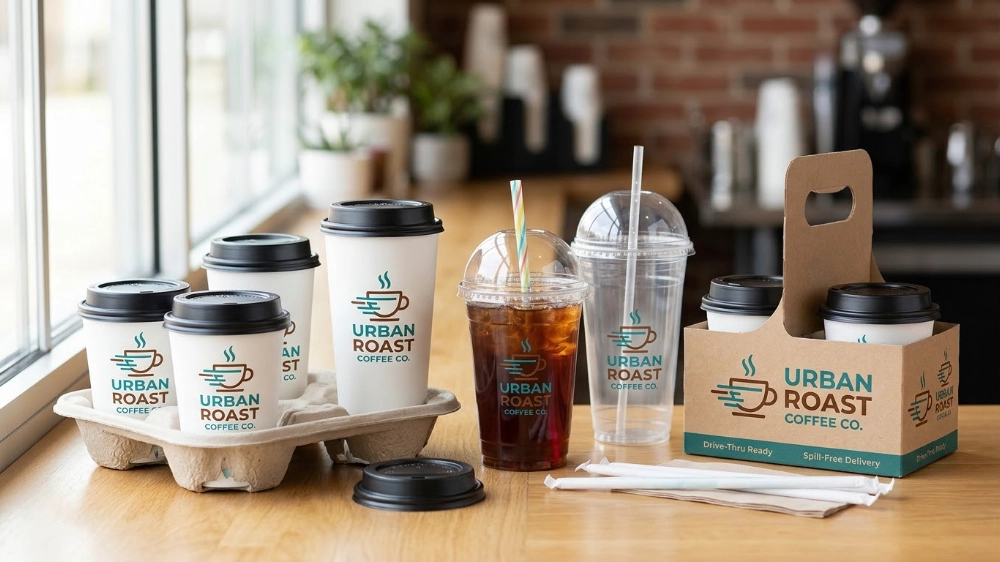
Yes. A carrier for two or four drinks needs enough grip and structural stability to prevent cups from leaning into each other or tipping when the order moves. This becomes especially important for larger drinks, multiple beverage sizes, and orders that customers may carry with one hand.
Packaging Dive notes that QSR packaging is increasingly expected to prevent spills and remain resilient during transport, reflecting how mobile dining changes the functional requirements placed on foodservice packaging.
Restaurants experiencing beverage problems should evaluate the entire system using the steps in this drive-thru beverage packaging guide.
For certain cold-drink formats, a design such as custom spill-resistant cup lids can also be evaluated alongside the matching cup and carrier rather than as an isolated component.
Should drinks go inside the food bag?
Usually not when doing so increases spill or temperature problems. A spilled cold drink can damage paper packaging, soak fries or burgers, and compromise an entire order. At the same time, placing an iced beverage directly beside hot food creates competing temperature requirements.
When practical, drinks should have their own stable transport position while hot food remains protected separately.
Why Does Drive-Thru Food Lose Heat Before Customers Eat It?
Drive-thru food loses heat because no package can stop heat transfer completely, especially as travel time increases. Effective restaurant packaging solutions therefore balance insulation, portion fit, ventilation, and hot-cold separation instead of simply sealing every food as tightly as possible.
Does tighter packaging always keep food better?
No. There is an important trade-off between heat retention and moisture control.
A tightly enclosed package may retain heat better but create excess condensation around fries or fried chicken. A highly ventilated package may release steam effectively but allow the food to cool faster.
The right balance changes by menu item. A grilled sandwich and fried fries should not automatically use identical packaging logic. Neither should soup and fried chicken.
Is temperature only a food-quality issue?
No. Restaurants also need to distinguish food quality from food safety.
The FDA Food Code 2022 provides a science-based model for safeguarding food offered at retail and foodservice establishments and establishes a framework for safe food handling. Packaging performance should therefore complement, not replace, a restaurant's required time and temperature controls.
In other words, a box that keeps a burger feeling warmer is not a substitute for proper operational food-safety procedures.
Should hot and cold products be separated?
When practical, yes.
A typical drive-thru combo can contain a hot burger, fries, sauce, and an iced beverage. Putting every component into the same environment may simplify handoff, but it does not necessarily give each item the conditions it needs.
Instead, restaurants should consider:
- which foods depend most on heat retention;
- which foods require moisture release;
- which items need cold storage or cold serving conditions;
- whether drinks can be transported separately;
- whether dividers or separate containers can prevent unwanted contact.
The goal is to protect the customer experience without making the packing process unnecessarily complicated for restaurant staff.
Why Do Food Boxes Crush, Shift, or Open During Transport?
Food boxes crush or shift when their dimensions, material strength, closure, or stacking performance do not match the order. Good QSR packaging solutions must resist vertical pressure, sideways movement, and repeated handling while keeping enough internal space to protect the food itself.
Why does package size matter?
A container can fail even when its material is strong.
If the box is too large, burgers, sandwiches, desserts, or sides may slide every time the vehicle accelerates, brakes, or turns. Sauces and toppings can move, portions can collide, and the food may no longer resemble how it left the restaurant.
If the container is too small, the opposite problem occurs. A lid may press directly onto a burger bun, toppings may be compressed, fried chicken pieces may push against the walls, or the closure may remain under constant tension.
Correct sizing therefore means providing enough clearance without unnecessary movement space.
Why is stackability important?
Drive-thru orders rarely travel as a single isolated container. Several boxes may be placed in one bag, with heavier items above lighter ones.
Packaging Dive identifies stackability as a critical QSR packaging feature because containers often sit on top of one another during takeout transport.
Restaurants should therefore ask:
- Does the base sit securely on the lid below it?
- Does the lower package deform under a realistic order load?
- Can stacked containers slide sideways?
- Does stacking block ventilation?
- Does the package remain closed after being carried?
A strong box is useful, but a stable packaging system is more important than strength measured in isolation.
How Should Restaurants Choose the Right Drive-Thru Packaging Solutions?
Restaurants should match packaging to each menu item's moisture, grease, temperature, portion, travel, and handling requirements. The best food packaging solution is not automatically the strongest or most expensive option; it is the one that performs reliably for the food and operating conditions it actually faces.
The National Restaurant Association recommends obtaining packaging samples and testing different formats with actual menu items rather than assuming one packaging style can serve an entire menu successfully.
What type of food is going inside?
Classify each item as primarily:
- dry;
- greasy;
- moist;
- saucy;
- liquid;
- crispy;
- hot;
- cold;
- or a combination of several categories.
This immediately narrows the packaging requirements.
How long will customers typically travel?
A package that performs well for five minutes may reveal different weaknesses after twenty minutes. Restaurants do not need to assume one universal travel time. Instead, test against realistic order patterns for the location.
How much movement will the package experience?
Drive-thru packaging should survive more than sitting flat on a counter. It may be handed through a window, carried one-handed, placed in a bag, stacked, transferred to a vehicle, tilted, and subjected to repeated acceleration and braking.
How easy is it for staff to pack?
Packaging that performs perfectly in a laboratory but slows down a busy service line can create a different operational problem.
Restaurant packaging solutions should therefore be evaluated for:
- assembly time;
- closure speed;
- portion visibility;
- stacking;
- storage space;
- compatibility with existing cups, lids, and bags.
Can the customer open and eat from it easily?
Drive-thru customers may eat in the vehicle, at work, or at home. Opening should be intuitive. Sauces should remain accessible. Containers should not collapse when opened, and the food should not require unnecessary repacking before it can be eaten.
Drive-Thru Packaging Problem and Solution Table
| Packaging Problem | Likely Cause | Packaging Feature to Check | Practical Restaurant Test |
|---|---|---|---|
| Soggy fries or fried chicken | Trapped steam and condensation | Ventilation, headspace, grease resistance | Compare texture after realistic holding periods |
| Sauce or grease leaks | Weak barrier, seam, or closure | Barrier performance, lid fit, seam strength | Fill, hold, tilt, and transport |
| Drinks spill | Poor lid fit or unstable carrier | Cup-lid compatibility and carrier stability | Filled-cup movement test |
| Food loses heat | Poor fit, insulation, or separation | Material, container volume, hot-cold separation | Check quality at realistic travel intervals |
| Boxes crush or shift | Wrong dimensions or weak stacking | Compression resistance and stackability | Stack a complete order and transport it |
The most useful part of this framework is the last column. A specification sheet can tell a restaurant what material a container uses. It cannot fully show what will happen when that package carries a fresh burger, sauced chicken, fries, and several drinks through a real drive-thru order.
How Can Restaurants Test Packaging Before Using It for Drive-Thru Orders?
Restaurants should test packaging with real menu items under realistic drive-thru conditions rather than evaluating empty samples. The test should examine food quality, leakage, condensation, structure, movement, opening experience, and staff handling before a format is approved for routine use.
Step 1: Pack the real food
Do not test an empty box by squeezing it with your hands and assume the evaluation is finished.
Cook the product normally. Use the normal portion. Add the normal sauces, toppings, garnishes, and sides. Then pack it exactly as restaurant staff would during service.
Step 2: Test realistic holding periods
Rather than declaring that packaging must work for a universal number of minutes, identify realistic travel windows for the restaurant.
A practical internal comparison might check the food at:
- 10 minutes;
- 20 minutes;
- 30 minutes.
These are testing checkpoints, not regulatory limits. The goal is to see when meaningful changes begin to appear.
Step 3: Reproduce movement
Carry the order. Put it in the type of bag normally used. Stack containers exactly as staff would. Place the order inside a vehicle and expose it to normal turns, stops, and handling.
The National Restaurant Association similarly recommends evaluating food through the real off-premises journey, including temperature, texture, package integrity, presentation, and movement.
Step 4: Inspect both the package and the food
When the test ends, look for:
- condensation;
- loss of crispness;
- grease penetration;
- leaks around seams;
- lid movement;
- crushed food;
- package deformation;
- sliding or mixed components;
- unstable stacked containers;
- spilled drinks;
- difficult opening.
A package can remain physically intact while still delivering poor food quality, so both sides need to be evaluated.
Step 5: Check restaurant operations
Finally, repeat the process during realistic service conditions.
Can employees close the package quickly? Can different sizes be identified easily? Do boxes stack without slowing packing? Can the restaurant reduce unnecessary packaging components without compromising performance?
The strongest food packaging solutions work for both sides of the counter: they protect food for the customer without creating unnecessary complexity for restaurant employees.
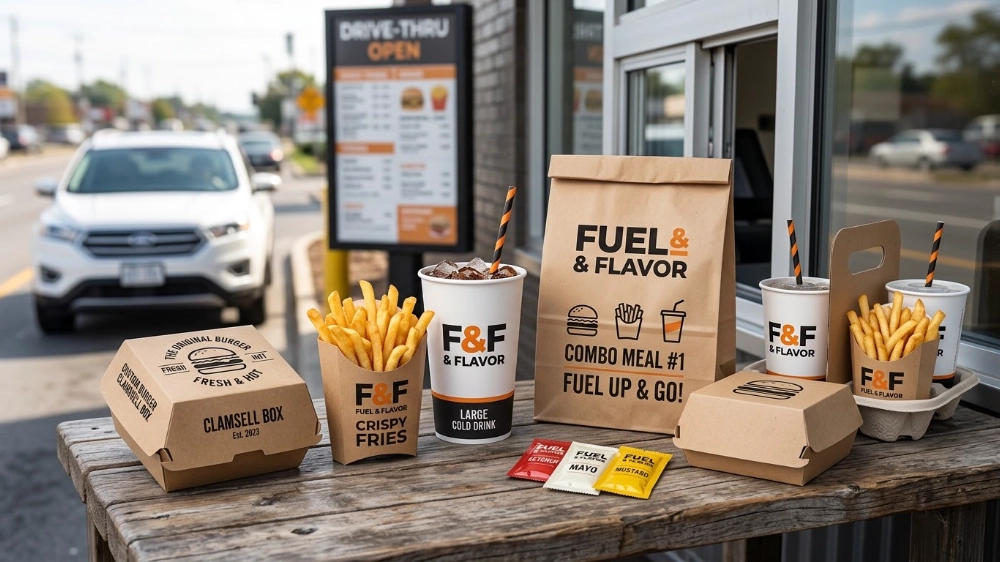
Practical takeaway: most fast food packaging problems are not caused by one universally “bad” material. They usually appear because the package, menu item, transport environment, and restaurant workflow do not match.
This menu-first approach helps restaurants choose drive-thru packaging solutions based on real performance rather than appearance or specifications alone, giving operators a more reliable basis for selecting packaging that works from the service window to the customer's first bite.
For foodservice businesses, solving that mismatch often means working with a packaging partner that evaluates the package around the food rather than simply supplying a standard container. MaiBao works with QSR and foodservice businesses to develop packaging around real serving, transport, branding, and operational requirements, helping buyers evaluate the complete system before committing to a final format.
Frequently Asked Questions
What is the best packaging for drive-thru food?
The best drive-thru packaging is the format that matches the food's temperature, moisture, grease level, portion size, structure, and expected travel conditions rather than one material or container that is assumed to work for every menu item. Restaurants should classify foods by their main risks—such as trapped steam for fries, grease leakage for fried foods, movement for burgers, or spills for beverages—and then test candidate packaging with real orders before deciding which format offers the best balance of protection, handling, and customer convenience.
How do you keep fried food crispy in takeout packaging?
Keeping fried food crispy usually requires managing steam rather than simply sealing the container as tightly as possible, because hot fries, chicken, and similar foods continue releasing moisture after cooking and trapped humidity can contribute to condensation and softer surfaces. Restaurants should evaluate controlled ventilation, adequate headspace, grease-resistant materials, and separation from wetter foods, then compare texture after realistic holding and transport periods to determine whether the packaging preserves crispness without allowing the food to cool too quickly.
How can restaurants prevent drinks from spilling in drive-thru orders?
Restaurants can reduce drive-thru drink spills by treating the cup, lid, carrier, fill level, and transport position as one packaging system instead of buying each component independently, because even a strong cup can fail when the lid fits poorly or the carrier allows excessive movement. Test filled cups with their intended lids and carriers, including lifting, tilting, one-handed carrying, vehicle movement, and multi-drink orders, and keep beverages separate from food bags whenever a spill could damage the rest of the customer's meal.
How should restaurants test new takeaway packaging?
Restaurants should test new takeaway packaging with the actual menu item, normal portions, sauces, toppings, bags, and stacking arrangement, then reproduce realistic holding and transport conditions while checking temperature where relevant, texture, condensation, leaks, deformation, movement, lid security, opening, and staff handling.