Skip to content
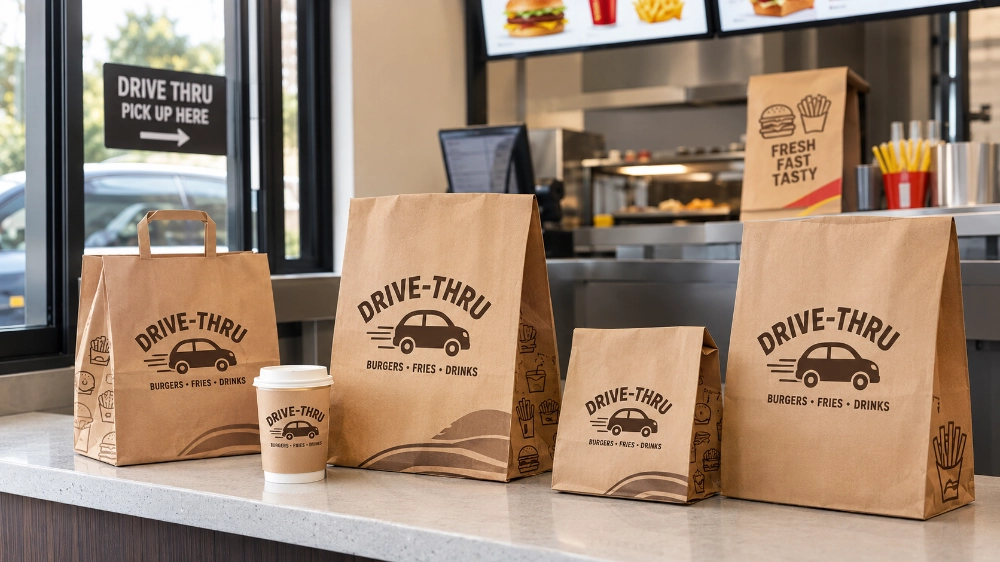
The right paper bag size for a drive-thru order should match the footprint of the largest food container, the total stack height, the weight of the complete order, and the amount of movement the packaging can safely tolerate. A bag that is too small can crush food containers, while an oversized bag can allow boxes and cups to shift, tip, or spill while using more material than necessary. For restaurants building a complete drive-thru packaging solution, paper bag sizing should therefore be treated as part of the whole meal-packaging system rather than as a separate purchasing decision.
This matters because a drive-thru bag does more than carry food from the counter to the customer. The FDA Food Code describes a carry-out container as packaging used to protect food during service or delivery to the consumer. For QSR operators, that protection depends on how the bag works with burger boxes, fry cartons, takeaway containers, cups, lids, and the actual combinations customers order.

What Size Paper Bag Should You Use for a Drive-Thru Order?
There is no single paper bag size that works for every drive-thru order. The correct size should be selected from the food-container footprint, stack height, total load, and whether drinks or liquid foods need to travel with the meal.
Generic labels such as “small,” “medium,” and “large” can be useful for inventory management, but they do not tell a restaurant whether a particular drive-thru paper bag will stabilize its menu. One supplier's medium bag may also have different dimensions, bottom width, or gusset depth from another supplier's medium bag.
Start with representative orders instead: a single burger, burger and fries, a complete combo meal, two entrées, and a larger multi-person order. For each order, identify what must sit flat, what can safely be stacked, and what should remain separate.
A practical sizing framework is: container footprint + stack height + total weight + liquid risk = bag requirement. This order-based method also fits the broader principle of packaging right-sizing. The U.S. EPA identifies reducing packaging and redesigning products as forms of source reduction, so using a larger bag than the order requires should not automatically be treated as the safest solution.
Restaurants reviewing their wider packaging system can also use this guide to choose drive-thru food packaging for burgers, fries, drinks, and combo meals.
How Do You Measure the Right Paper Bag Size for Food Containers?
Measure the width and depth of the largest container that needs to remain flat, then calculate the height of the intended stack. Add enough working clearance for staff to pack and customers to remove the food easily, but avoid so much empty space that containers can move freely.
Bag dimensions should be considered as usable internal space rather than numbers on a specification sheet alone. A burger box that technically fits through the bag opening may still be unsuitable if it has to be tilted during packing or if the bag gusset cannot open sufficiently for the box to sit flat.
The same principle applies vertically. Staff need enough height to place fries, side items, napkins, or other lightweight packaging without pushing them into the main food container. If closing, folding, sealing, or carrying the bag compresses the top package, the bag is effectively too short for that order.
How Much Extra Space Should Be Left Around Takeout Containers?
There is no universal clearance that every restaurant should add around a food box. The practical amount depends on container geometry, bag construction, packing speed, and how much movement occurs after the order leaves the service window.
The goal is controlled clearance: enough room to load the meal without damaging it, but not enough room for the main container to slide significantly from side to side.
This is why prototype testing is more useful than selecting a bag from dimensions alone. Both ASTM D5276-19 for drop testing loaded containers and ISO 7965-1:2024 for vertical-impact testing of filled paper sacks reinforce a useful packaging principle: performance should be evaluated with a realistic load rather than from an empty package alone. These standards do not specify drive-thru paper bag dimensions.
Should Paper Bag Size Be Based on the Largest Container or the Whole Order?
Use the largest container footprint to establish the minimum usable bag base, then use the complete order to determine height and load requirements. Sizing from total volume alone can leave wide containers tilted, unstable, or poorly supported.
A drive-thru paper bag should generally be designed from the bottom upward. If the main meal box does not sit securely on the bag base, adding more height or total bag volume does not solve the problem.
For example, a wide kraft takeaway box may require more gusset depth than a taller but narrower container with similar internal food capacity. The bag therefore has to match the geometry of the packaging, not merely the amount of food inside it.
Why Does the Bag Bottom Matter More Than Total Bag Volume?
The bottom of the bag establishes the support area for the heaviest part of the order. When that area closely matches the main container arrangement, boxes are more likely to remain flat and the load is less dependent on the sidewalls of the bag for stability.
A poorly matched base creates problems even when the bag looks large enough. Wide boxes may tilt, narrow containers may slide, and stacked products can develop a higher and less stable center of gravity.
The correct question is therefore not only, “Will the order fit?” It is, “Will the order remain stable after it is packed, lifted, carried, placed in a vehicle, and handed to the customer?”
What Paper Bag Size Works Best for Burger, Fries, and Combo Meals?
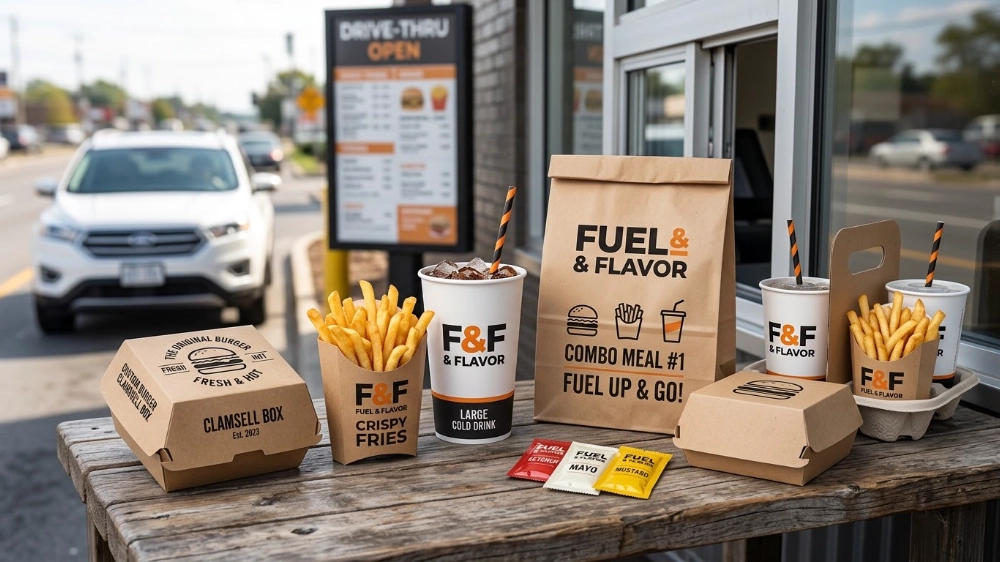
A combo-meal bag should keep the main food box flat while providing enough vertical space for fries and lighter side items without crushing them. Restaurants should size fast food paper bags around their actual meal combinations instead of relying on generic medium or large bag labels.
For a typical burger-and-fries order, the burger box or main meal container usually establishes the stable base. Fries and lighter components can then occupy controlled space above or beside it, depending on their packaging structure.
The same principle applies to fried chicken and larger QSR meals. If a custom fried chicken box becomes the widest or heaviest component, the drive-thru bag needs to accommodate that footprint without forcing the box to sit diagonally.
Packaging shape also affects food quality. Burgers can shift, compress, or lose their intended structure when their primary container is poorly supported, which is why the relationship between the outer bag and drive-thru burger packaging matters as much as the individual burger box specification.
How Should Burger and Fries Packaging Be Arranged Inside the Bag?
Place the heavier, structurally stronger main container at the bottom whenever the packaging design allows it. Lighter fries, sides, napkins, and similar components should not be positioned where they place concentrated pressure on a burger lid or another crush-sensitive package.
Restaurants should test their most common combinations rather than assuming one arrangement works for every order. A single burger order, double entrée order, and burger-fries-dessert combination may all require different internal layouts even when the same paper bag can technically contain them.
Should Drinks Go in the Same Paper Bag as Drive-Thru Food?
Drinks should share a drive-thru paper bag with food only when the cups are securely restrained and cannot tip into the meal. If cups are loose, a separate carrier or drink-handling system is often safer than simply choosing a larger paper bag.
A tall drink introduces a different geometry from a burger box or fry carton. It has a relatively small footprint compared with its height, contains moving liquid, and may create condensation when cold beverages are packed for takeaway.
Making the paper bag wider does not automatically make that drink more stable. Additional unused space may actually give an unsecured cup more room to move when the vehicle accelerates, brakes, or turns.
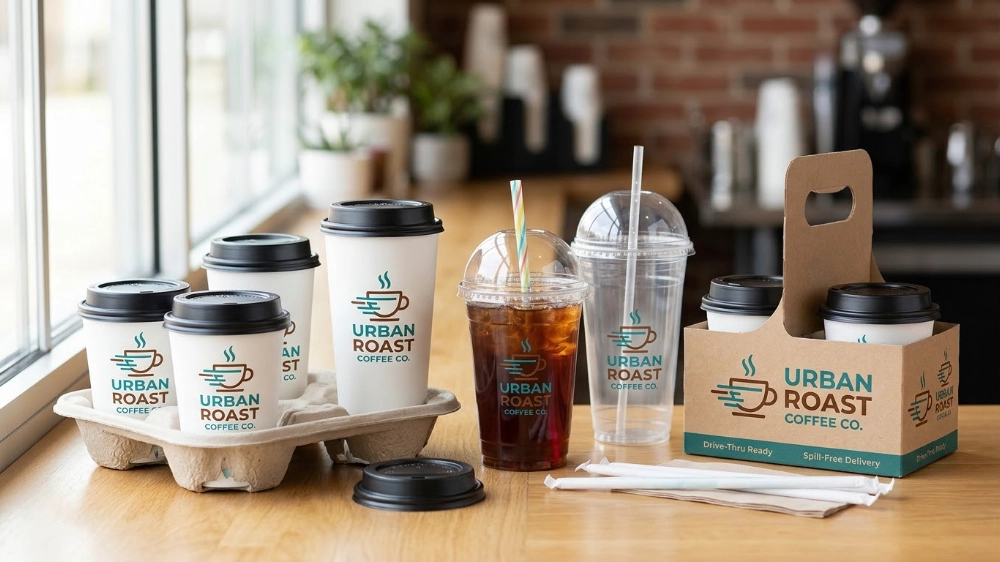
Cup stability therefore depends on the complete drink system, including the cup, lid, carrier, and bag layout. Restaurants dealing with beverage-heavy orders should evaluate cups, lids, carriers, and spill control as one drive-thru beverage packaging system rather than expecting the outer bag to correct an unstable cup.
A secure lid can provide another layer of protection. For example, spill-resistant cold-drink lids can be considered alongside cup restraints when designing beverage takeaway packaging.
When Should Drinks Be Packed Separately?
Separate drinks when the cup cannot be reliably restrained, when several drinks would make the food bag unstable, or when condensation and leakage could compromise surrounding paper packaging.
Restaurants should also consider separate handling when the cup carrier footprint does not fit the food bag base correctly. Forcing a carrier into an unsuitable bag can distort the carrier, crowd the food, or create an unstable combined load.
Can an Oversized Paper Bag Cause Spills, Crushing, or Packaging Waste?
Yes. Oversized takeout paper bags can give containers unnecessary room to slide or tip while consuming more packaging material, whereas undersized bags can compress boxes, damage food presentation, and slow staff during packing.
Bigger is not automatically safer for drive-thru paper bags.
An oversized bag can appear convenient because almost every menu item fits inside it. Operationally, however, a large empty area around the food may allow the order to change position between the restaurant counter and the customer's destination.
An undersized bag creates the opposite problem. Staff may need to push boxes through the opening, tilt containers, squeeze fries beside larger packages, or force the bag closed. Even if the bag itself does not fail, the packaging system may already have damaged the food before the customer receives it.
Right-sizing also matters from a material-efficiency perspective. EPA's source-reduction hierarchy specifically includes reducing packaging as a waste-prevention strategy. EPA's national data also show that containers and packaging accounted for 82.2 million tons, or 28.1% of U.S. municipal solid waste generation in 2018, reinforcing why unnecessary packaging volume deserves attention.
Drive-Thru Paper Bag Size Selection by Order Type
| Drive-Thru Order | Bag Base Requirement | Height Requirement | Main Risk | Recommended Packing Approach |
|---|---|---|---|---|
| Single burger | Closely match burger-box footprint | Low | Box sliding | Keep the box flat |
| Burger + fries | Match the main box footprint | Medium | Crushing fries | Stronger package below, lighter item above |
| Burger + fries + drink | Fit food plus a secured drink system if combined | Medium to high | Cup tipping or leakage | Restrain the cup or handle drinks separately |
| Two meal boxes | Match the widest stable arrangement | Medium to high | Unstable stacking | Keep stack height controlled |
| Soup or liquid meal | Close-fit, stable base | Depends on container | Leakage and wet bag failure | Minimize free movement |
| Large family order | Divide into stable load units | Varies | Overloading and high center of gravity | Consider two or more bags |
This table is intentionally based on order configuration rather than universal inch or millimeter dimensions. A restaurant should convert these requirements into actual paper bag dimensions only after measuring the food packaging used on its own menu.
When Should You Use Two Paper Bags Instead of One Large Bag?
Use two paper bags when one large bag would create excessive weight, unstable stacking, liquid risk, or an awkward mixture of packaging shapes. Splitting the order into two predictable load units can be safer than continually increasing bag size.
The decision should be based on the completed order, not merely the number of items. Two flat, lightweight boxes may work well in one bag, while one heavy entrée plus soup, sides, and drinks may benefit from separation.
Stack height also matters. A tall stack can become harder for staff to load and customers to carry, while a heavy top item can compress the packaging underneath it.
This is one reason restaurants should treat paper bags as part of a wider system of common drive-thru packaging problems and solutions. Reducing the number of bags is not an improvement if the resulting package becomes harder to carry or increases the likelihood of food damage.
How Should Restaurants Test Paper Bag Sizes Before Ordering in Bulk?
Test prospective paper bags with complete, filled drive-thru orders rather than judging an empty sample alone. The trial should reproduce real food weight, container placement, lifting, carrying, vehicle-style movement, and expected exposure to moisture or condensation.
Formal laboratory testing and an in-store operational trial serve different purposes, but both share an important principle: test the package as it will actually be used.
ASTM D5276-19 covers free-fall testing of loaded boxes, bags, and sacks and is intended to evaluate the package's ability to withstand sudden shock and protect its contents. Similarly, ISO 7965-1:2024 specifies vertical-impact drop testing for filled paper sacks. These standards are not specifications for QSR paper bag sizes, but they support the broader principle that meaningful packaging evaluation uses a filled package under realistic stress.
What Should a Drive-Thru Paper Bag Test Include?
- Pack actual menu combinations rather than empty containers.
- Record the weight and container arrangement of each order.
- Lift and carry the bag as staff and customers normally would.
- Place the order in a vehicle-sized space and introduce controlled side-to-side and stop-start movement.
- Test beverage-heavy or condensation-prone orders separately.
- Check for box movement, lid deformation, crushed fries, wet spots, handle strain, bottom deformation, and difficult unpacking.
Run the test with more than one order profile. At minimum, compare a light order, an average combo meal, a heavier multi-meal order, and an order containing drinks or liquid foods.
The best drive-thru bag is not necessarily the one that survives the largest possible order. It is the bag—or small standardized set of bag sizes—that handles the restaurant's normal order mix consistently without unnecessary material or complicated packing procedures

Conclusion
The right paper bag size for drive-thru orders is the smallest practical size that keeps the complete order stable, easy to pack, and protected without crushing containers or allowing excessive movement. Choosing effective drive-thru packaging solutions therefore starts with real menu configurations—container footprint, stack height, total weight, beverages, and liquid risk—rather than with a generic small, medium, or large bag label.
For restaurant operators, the bag, food container, cup system, and meal configuration work best when they are evaluated as one packaging system. MaiBao supports foodservice brands with this type of packaging coordination, helping match bag formats and food containers to real takeaway menus and operating conditions rather than treating each packaging component in isolation.
FAQ About Drive-Thru Paper Bag Sizes
What Is the Most Common Paper Bag Size for Takeout Food?
There is no single paper bag dimension that can be considered the correct standard for all takeout food because restaurant paper bags must accommodate very different container footprints, stack heights, and order weights. Instead of choosing a bag because it is labeled “medium” or “large,” restaurants should measure representative menu combinations and select the smallest size that keeps the main containers flat, easy to load, and stable during carrying.
How Much Bigger Should a Paper Bag Be Than a Food Container?
A paper bag should provide enough clearance to insert and remove the food container easily without forcing, tilting, or crushing it, but there is no universal extra inch or millimeter allowance that works for every container. Test the actual container inside the proposed bag and reduce unnecessary side-to-side space until the order remains easy for staff to pack while staying stable during realistic transport movement.
Are Kraft Paper Bags Strong Enough for Drive-Thru Orders?
Yes, kraft paper bags can be suitable for drive-thru orders when the paper grade, bag construction, bottom structure, carrying method, and expected load are matched correctly. Size alone cannot guarantee performance, so restaurants should test loaded fast food paper bags with their heaviest normal meal combinations and pay particular attention to moisture, handles, seams, and bottom deformation.
Should Restaurants Use Different Paper Bag Sizes for Different Orders?
Yes, restaurants with varied menus usually benefit from a small standardized range of bag formats rather than trying to force every order into one oversized bag. The objective is not to stock as many drive-thru bags as possible, but to identify a manageable set that covers single meals, normal combo meals, and larger orders while minimizing empty space, crushing, unstable stacking, and excessive packaging material.